One-clock spare keeper
If your clock accepts rechargeable AAs, look for a charger that explicitly handles one NiMH cell and makes its completed status clear. IKEA says its STENKOL has individual channels and indicators.


Check the wall clock’s instructions before buying: a rechargeable AA charger is useful for this job only if the clock accepts 1.2 V NiMH cells. If it does, a charger that can prepare one AA at a time, show its status and stop automatically suits a single spare; faster charging matters more when the desk also uses batteries in other devices, while more independent slots help manage a larger shared pool.
The number of cells you need to prepare changes the choice more than the number of slots printed on the charger.
If your clock accepts rechargeable AAs, look for a charger that explicitly handles one NiMH cell and makes its completed status clear. IKEA says its STENKOL has individual channels and indicators.
If several people use rechargeable AA or AAA cells at the desk, independent slots help you handle odd numbers of cells and check them separately. Youshiko describes this arrangement for its eight-slot YC800.
If other desk devices need charged cells sooner, compare charge times under the stated battery conditions. Duracell’s quoted 45-minute result for its Advanced Charger CEF27 is for approximately 85% charge of two 1300 mAh AA NiMH cells, not a full charge of any AA.
Start with the exact clock’s battery requirement. If it permits rechargeable AA cells, choose between preparing one spare, managing a shared pool and shortening waits for other devices.
Choose when: The main task is keeping one compatible clock spare ready, with occasional room for other cells.
Trade-off: Four slots do not necessarily mean one-cell charging; confirm independent operation for the particular model.
Choose when: Other desk equipment regularly needs rechargeable cells at short notice.
Trade-off: A headline charging time may describe a partial charge with specific cells rather than a ready time for every battery.
Choose when: Several users need to charge and track different AA or AAA cells separately.
Trade-off: Extra slot capacity offers little for a desk that only keeps one clock spare.
| Concern | What to check | Who this matters to |
|---|---|---|
| One-cell readiness | Confirm one-cell AA NiMH charging, a visible completion indicator and automatic shut-off. | I want one replacement cell ready for a compatible clock without having to charge a pair; around 50% of consumers put that single-spare need first. |
| Shared-cell organisation | Check how many slots operate independently and whether each occupied slot shows its own status. | When several people return AA or AAA cells at different times, I need to keep track of them separately. Around 38% of consumers prioritise managing the shared pool. |
| Charging turnaround | For any quoted time, check the cell count, capacity and whether it means a partial or full charge. | Other desk devices sometimes need cells sooner than a clock does, so waiting matters more to me; roughly 12% of consumers place faster turnaround first. |
AA describes a size, not whether a cell can be recharged. Energizer’s instructions for a NiMH-only charger expressly exclude alkaline, lithium, carbon-zinc and NiCd cells.
Check the charger instructions and the cell label together before placing a battery in the charger.
AcuRite cautions that rechargeable-cell voltage can cause irregular operation in some of its products. That does not establish what a different wall clock accepts.
Read the exact clock’s manual or battery-compartment label. If it requires alkaline cells, buying a rechargeable AA charger will not meet that clock’s stated requirement.
A four-slot layout alone does not establish that a single AA can be charged. A charger requiring pairs is less convenient for preparing one clock spare.
Look for explicit one-cell charging instructions. IKEA states that STENKOL can charge one to four supported cells through individual channels; check other models separately.
Spent batteries need an appropriate collection route rather than being treated as ordinary desk waste.
GOV.UK advises taking most waste batteries to a battery collection point at a supermarket or another qualifying large battery retailer.
These charger lines illustrate different capacities and charging arrangements; check the exact model rather than assuming every charger from a brand has the same features.
STENKOL is relevant when the desk mainly needs to prepare one rechargeable clock spare.
Its AA and AAA charger range is worth comparing when other desk devices make charging time important.
The YC800 addresses a larger shared pool rather than the narrow task of maintaining one clock spare.
These AA charger bundles suit different ways of keeping rechargeable cells at a shared desk. Confirm that the clock accepts 1.2 V NiMH AAs before choosing one; if you need to charge a single spare by itself, pay particular attention to the charger’s one-cell instructions.
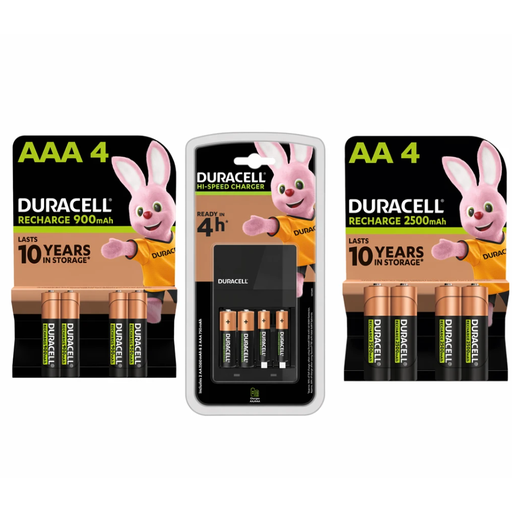 Image unavailable
Consider this bundle if you want AA cells for a compatible clock as well as AAA cells for other uses at the desk.
The bundle name specifies four rechargeable AA 2500 mAh cells and four rechargeable AAA 900 mAh cells. If charging one AA alone is essential, confirm that the instructions for this charger allow it; check the stated conditions behind the four-hour description too.
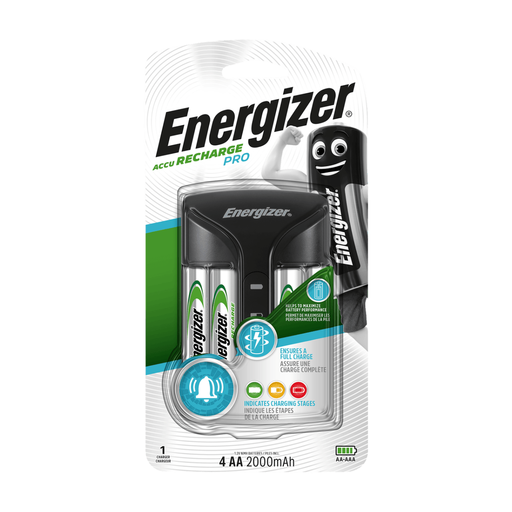 Image unavailable
This bundle makes more sense if you can prepare cells in pairs for a compatible clock or other desk devices, rather than needing to charge one spare alone.
It includes four rechargeable AA 2000 mAh batteries. The charger is described as charging two or four cells, so check its instructions if single-cell charging is a requirement.
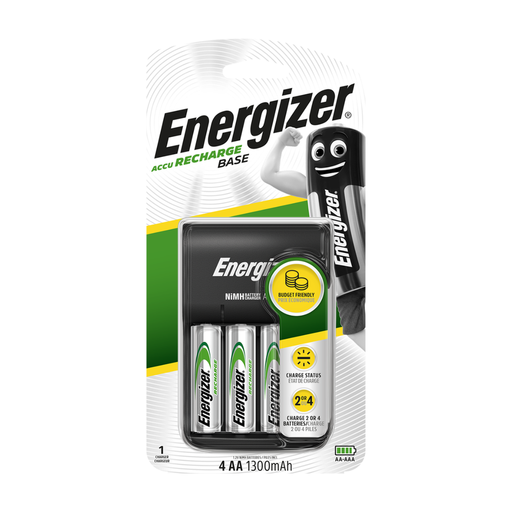 Image unavailable
Consider USB charging if a suitable USB power source is available at the desk and preparing cells in pairs works for your routine.
The bundle includes four rechargeable AA 1300 mAh batteries. The charger is described as charging two or four cells, not a single spare; confirm the required USB power source before choosing it.
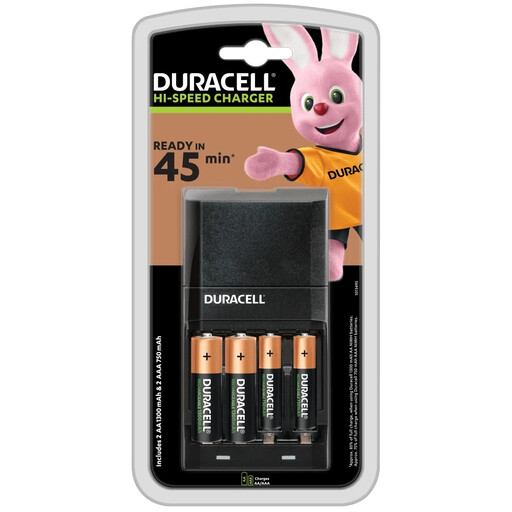 Image unavailable
This bundle is relevant when other desk devices make a shorter wait useful and charging one clock spare on its own is not essential.
It includes two AA and two AAA batteries. According to Duracell, the 45-minute figure refers to approximately 85% charge for two 1300 mAh AA NiMH cells, not a full charge in every use. The charger is described as taking two or four cells.
Not necessarily: check the exact clock’s manual or battery-compartment label before buying a charger. Rechargeable NiMH AAs are commonly rated at 1.2 V, and AcuRite cautions that rechargeable-cell voltage can affect operation in some of its products; that warning cannot determine another clock’s requirements.
Yes, if the particular charger explicitly supports one-cell charging. IKEA says STENKOL has four individual channels and accepts one to four AA or AAA NiMH cells; a four-slot charger without that specification may work differently.
No: do not put ordinary alkaline cells in a charger specified only for NiMH rechargeables. Energizer’s NiMH charger instructions also exclude NiCd, carbon-zinc and lithium batteries; always follow the chemistry restrictions for the exact charger.
Take spent cells to a suitable battery collection point rather than ordinary household rubbish. GOV.UK advises that most waste batteries can be taken to a local supermarket or another large shop that meets its battery-sales threshold.