Turnaround-focused microphone operator
You prepare AA cells shortly before meetings, rehearsals or recordings and want to see the status of each cell rather than guess whether a pair is ready.


For a shared desk, choose a NiMH AA charger with individually controlled slots and clear status indicators once the microphone manual confirms that NiMH cells are suitable. Four slots can prepare one or two AA pairs at a time; consider eight when several transmitters and ready spares need charging together. If turnaround matters, compare charge-time claims for the number and capacity of cells you actually use.
You prepare AA cells shortly before meetings, rehearsals or recordings and want to see the status of each cell rather than guess whether a pair is ready.
You manage cells for several microphones or a communal reserve and need enough separately managed slots to prepare pairs and spares without losing track of their status.
You need to check whether the microphone accepts rechargeable NiMH AA cells, keep disposable batteries out of the charger and choose clear fault and charge-status indications.
Check the microphone’s battery guidance before comparing charging time, the number of slots and how clearly the charger reports each cell’s status.
| Concern | What to check | Who this matters to |
|---|---|---|
| Turnaround before a session | Compare the stated charging time for your usual number of AA cells and their capacity; look for individual status indicators. | If I prepare a microphone pair shortly before use, I need to know whether both cells will be ready in time. Around 42% of consumers put turnaround first. |
| Shared battery-pool capacity | Count the cells needed for active transmitters and ready spares, then compare independently managed slot counts. | When several people draw from the same desk supply, I need room to prepare spare pairs without waiting for another batch. Roughly 33% of consumers prioritise shared-pool capacity. |
| Compatibility and charging safety | Check the microphone manual, the charger’s supported battery chemistry and its per-cell fault and status indications. | Before switching from disposable AAs, I need to know that the microphone accepts NiMH cells and that the charger suits those cells. About 25% of consumers make compatibility and charging safety their primary concern. |
AA specifies a size, not a rechargeable chemistry. IKEA warns against putting non-rechargeable cells in its STENKOL NiMH charger.
Match the charger to your rechargeable cells and never put disposable alkaline batteries into it.
Four slots may cover a small microphone setup but leave no room to prepare more cells at the same time. Eight slots take more desk space than a single-microphone routine may need.
Count the cells for active transmitters and the charged spares you intend to keep ready before choosing a slot count.
Panasonic Energy’s approximately 90-minute figure for the BQ-CC55 applies to two AA eneloop cells under its stated conditions. IKEA gives a 6–8 hour figure for four AA cells in the STENKOL; those figures describe different chargers and cell counts.
Check the manufacturer’s timing for your cell count and capacity, and schedule charging before the session.
In June 2022, the UK Office for Product Safety and Standards reported serious electric-shock and fire risks from one specific four-slot charger with an unsafe plug. That finding does not apply to all AA chargers.
Check the exact model’s UK plug information and instructions, and stop using a charger if its plug, cable or casing is damaged.
The STENKOL is a four-slot NiMH AA/AAA charger; the TJUGO is a charging-and-storage option for up to eight AA or AAA rechargeables.
The BQ-CC55 individually charges one to four compatible AA/AAA eneloop or eneloop pro cells.
The Powerline 8 is an eight-slot option for compatible AA/AAA NiCd or NiMH cells.
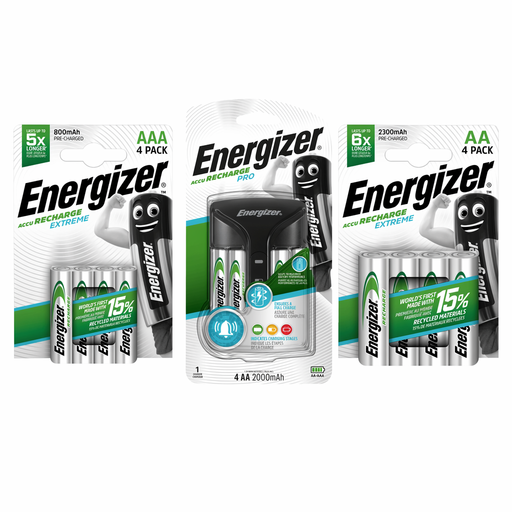
The Pro Recharge Kit pairs an AA/AAA NiMH charger with batteries for a small rechargeable-cell setup.
These AA-charger choices are relevant to preparing a small rechargeable-cell supply at a shared microphone desk. Check your microphone’s NiMH guidance first, then compare each kit’s contents, charging capacity and status information with your routine.
 No image available
For a desk preparing a small pool of rechargeable cells, Joybuy’s listing describes individual charging channels and AA/AAA NiMH charging in approximately 1–3 hours, depending on battery capacity. Confirm the exact batteries included in the kit before planning your spare supply.
 No image available
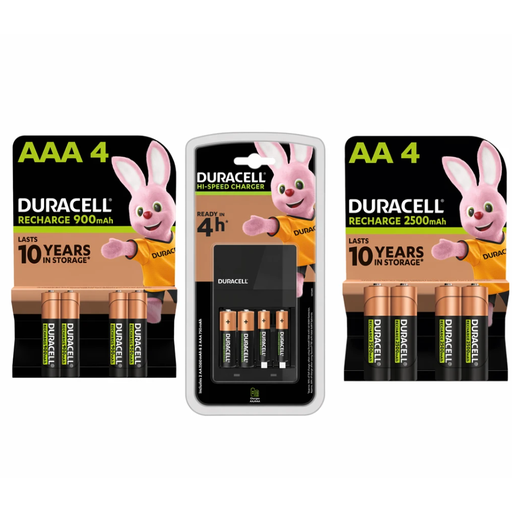
The named bundle may suit a desk keeping rechargeable AA spares alongside AAA cells: it includes four AA cells rated at 2500mAh and four AAA cells rated at 900mAh. Check how many cells the charger accepts at once before planning a shared charging batch.
 No image available
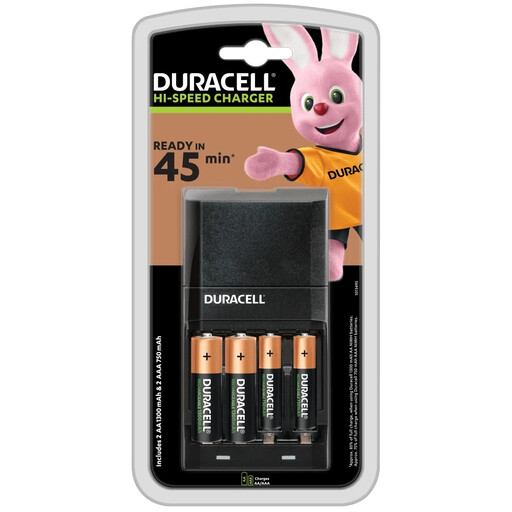
If you usually prepare one AA pair, compare the charging information for that pair with your available preparation time; the model’s name alone does not promise a full charge in 45 minutes. Check the UK plug configuration and whether it shows charge status for each cell.
You can use them if the instructions for your exact transmitter permit the rechargeable chemistry you intend to use. Shure notes that battery chemistries differ in nominal voltage, so also check how your microphone indicates remaining charge and what runtime to expect.
Choose four individually controlled slots if you normally prepare no more than two AA pairs together; consider eight if several transmitters and ready spares need a charging place at the same time. IKEA specifies one-to-four-cell charging for the STENKOL and charging and storage for up to eight AA or AAA cells in the TJUGO.
The cited IKEA STENKOL and Panasonic eneloop BQ-CC55 can charge fewer than four compatible cells, with individual control. Follow the instructions for your exact charger, and do not insert damaged or non-rechargeable batteries.
Take them to an appropriate battery collection point rather than putting them in household rubbish, as GOV.UK advises for portable batteries.