Routine CD-player listeners
If you usually prepare a set of rechargeable AA cells before listening, a straightforward charging routine may matter more than test programmes. Check how the charger’s stated timing relates to the cells you will use.


Choose a charger specified for AA NiMH rechargeable batteries, then decide whether you need straightforward preparation of a set, independent charging of individual cells, or programmes for assessing older batteries. Before relying on rechargeables for listening, check the portable CD player’s instructions to confirm that it accepts them.
If you usually prepare a set of rechargeable AA cells before listening, a straightforward charging routine may matter more than test programmes. Check how the charger’s stated timing relates to the cells you will use.
If you sometimes have just one cell to charge, look for explicit individual-slot support. Panasonic specifies independent charging of one to four compatible AA or AAA cells for its BQ-CC55.
If you want information about cells you already own, test and refresh programmes may be useful. ANSMANN specifies these functions for the Powerline 4.2 Pro, though they involve more settings than basic charging.
Check the CD player’s battery instructions first. If it accepts rechargeable AA NiMH cells, choose the charger around how you normally prepare them: to a schedule, in incomplete sets, or alongside checks on older cells.
| Concern | What to check | Who this matters to |
|---|---|---|
| Preparation time | Compare the number and capacity of cells used for a timing claim, and whether it describes a partial or full charge. | If I plan a listening session, I want enough time to prepare the cells rather than assume any quoted charging time applies to my set. Around 38% of consumers put preparation time first. |
| Charging incomplete sets | Check the minimum number of AA cells accepted and whether each slot is controlled independently. | When I have an odd number of cells ready to charge, I do not want to wait until I have a pair. For around 37% of consumers, individual-cell flexibility is the primary concern. |
| Assessing older cells | Look for a capacity-test programme and decide whether you would use refresh or discharge settings. | If I already own several older rechargeables, I want more information about their condition before choosing which to keep using. Battery assessment comes first for around 25% of consumers. |
Duracell warns that charging alkaline, zinc-carbon, lithium or other unspecified batteries in its CEF14 can cause them to burst, with a risk of injury or damage.
Use cells of the rechargeable chemistry specified for your charger, and check both labels before inserting them. Keep disposable batteries separate.
Duracell’s four-hour figure for the CEF14 refers to approximately 90% charge with four 1300mAh AA NiMH cells. It is not a full-charge time for every AA set.
Compare claims made for the same cell capacity, cell count and charge level; allow for your first charge before a planned listening session.
Panasonic specifies independent charging for one to four compatible cells in the BQ-CC55, while Duracell’s CEF14 instructions describe two- or four-cell arrangements.
If you need to charge one cell or an odd number, confirm that capability in the exact charger’s instructions.
GOV.UK guidance covers collection of portable batteries, including rechargeable AA cells.
Keep spent cells for an appropriate battery collection point rather than putting them in ordinary household rubbish.
Relevant if you want independent charging of compatible AA or AAA cells rather than always preparing a pair.
Relevant if you want charging alongside programmes for assessing and maintaining existing NiMH cells.
Relevant if you normally prepare a set and want a stated charging interval to plan around.
These chargers and battery bundles are options for preparing rechargeable AA cells before a listening session. Check the CD player’s battery requirements first; if charging a single cell or meeting a particular deadline matters, check the exact charger instructions and timing conditions too.
 No image available
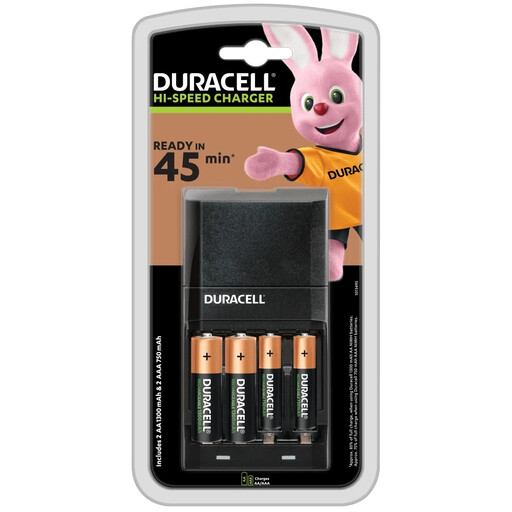
Consider this bundle if you want rechargeable AA cells alongside a charger for preparing a set. Check the conditions behind its 45-minute claim rather than treating the name as a full-charge time or a CD-player runtime.
If you need to charge one cell, confirm the permitted charging arrangement in the CEF27 instructions.
 No image available
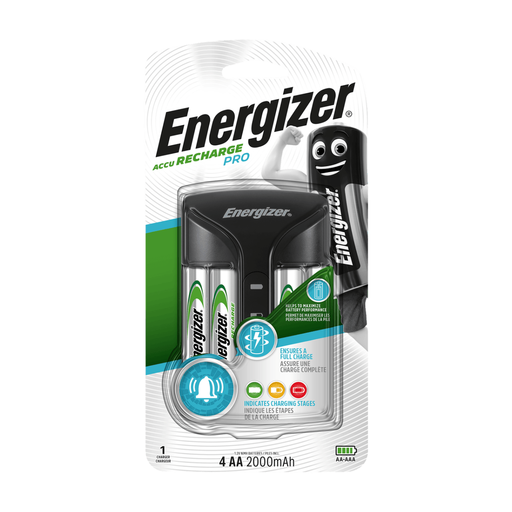
This bundle suits someone who wants four rechargeable AA cells to prepare together. For a planned session, check the charging time applicable to the included 2000mAh cells rather than applying it to other capacities.
Check the charger instructions if you expect to charge an incomplete set.
 No image available
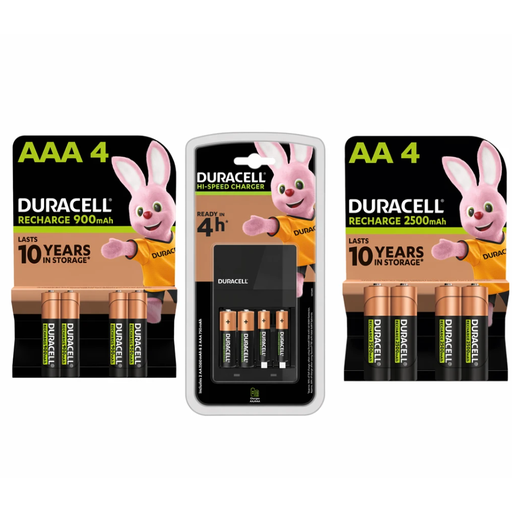
This bundle provides rechargeable AA cells for preparing a set, plus AAA cells for other compatible uses. Duracell’s cited four-hour CEF14 result uses 1300mAh AA cells and reaches approximately 90% charge; do not apply that time to the included 2500mAh AA cells.
The CEF14 instructions describe two- or four-cell arrangements, so check them before choosing this bundle for single-cell charging.
 No image available
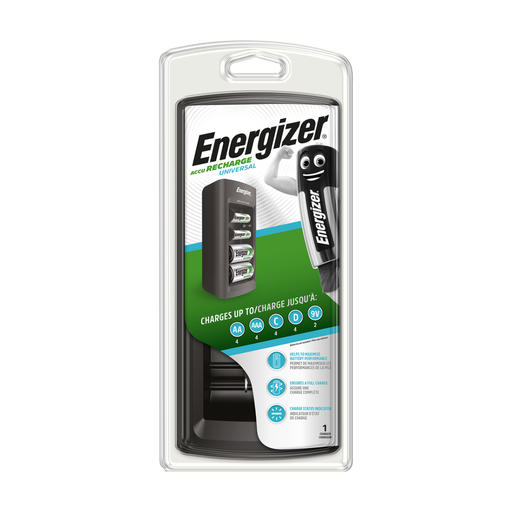
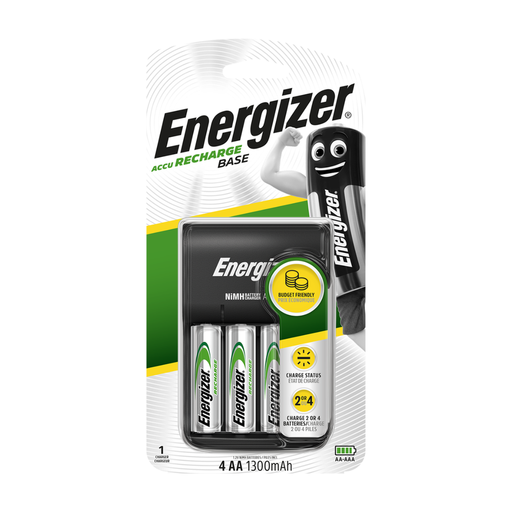
Consider this charger if you already have rechargeable AA cells and usually prepare them as a set. Check the instructions for timing with your cells’ capacity and for the number of cells it can charge at once.
If preparing one cell matters, confirm independent-slot operation before buying.
 No image available
This USB charger bundle may suit a home-office setup with a suitable USB power source and a need to prepare four rechargeable AA cells. Check whether a power adapter is included and what charging time applies to the included cells.
Consult its instructions if you need to charge a single cell rather than a set.
No: use a charger only with the rechargeable battery chemistry its manufacturer specifies. Duracell’s CEF14 instructions warn against charging alkaline, zinc-carbon, lithium and other unspecified cells because they may burst.
Individual-cell charging matters if you often prepare incomplete sets; it is not something to assume from the number of slots. Panasonic specifies independent charging of one to four compatible cells for the BQ-CC55, whereas Duracell’s CEF14 instructions describe two- or four-cell arrangements. Check the instructions for the model you intend to buy.
Take them to an appropriate battery collection point rather than putting them in household rubbish. GOV.UK identifies collection at supermarkets and other large battery retailers for portable batteries, including rechargeable AA cells.