People with few spare sockets
If your chime accepts rechargeable NiMH AA cells, a USB-input charger lets you prepare them using a suitable powered USB port or power bank rather than dedicating another wall socket to a charger.


Check the instructions for your exact doorbell chime before buying: an AA battery requirement does not establish that rechargeable NiMH cells will work in it. If they are permitted, a USB-input charger suits scarce sockets when you can use a suitable powered USB port or power bank; a mains charger is an alternative when faster charging or room for more spare cells matters more than keeping a socket free.
If your chime accepts rechargeable NiMH AA cells, a USB-input charger lets you prepare them using a suitable powered USB port or power bank rather than dedicating another wall socket to a charger.
If you prepare replacement cells for the chime or other AA/AAA devices, check how many cells the charger handles and whether it can charge an odd number independently.
If you can spare a mains socket temporarily, a small-set fast charger may be more relevant than USB input. Compare charging-time claims using the stated battery capacity and charge level.
Confirm the chime’s permitted battery type first. Then weigh the need to keep sockets free against the size of your spare-cell set and how quickly you need it ready.
| Concern | What to check | Who this matters to |
|---|---|---|
| Chime compatibility | Check the exact chime’s instructions for permitted battery chemistry and cell count; match the charger to the permitted rechargeable cells. | If my chime specifies AA batteries, I need to confirm that its exact model also permits rechargeable NiMH cells before changing over. Roughly 34% of consumers put this compatibility question first. |
| Keeping sockets free | Look for USB input, not just USB output, and check the charger’s requirements against your available USB supply. | With wall sockets already in use, I would rather charge from a suitable powered USB port or power bank. For around 33% of consumers, preserving a socket is the primary concern. |
| Spare-cell capacity | Count the cells in a replacement set and check slot capacity and whether odd numbers can be charged independently. | When I keep cells ready for the chime and other AA/AAA devices, I want enough charging slots for the reserve I maintain. That capacity is the first priority for roughly 20% of consumers. |
| Charging speed | Check the stated cell count, battery capacity and charge level behind any time claim, as well as whether the charger needs a mains socket. | If a small replacement set is needed soon and I can spare an outlet, turnaround matters more to me than socket-free charging. Around 13% of consumers put speed first. |
An AA-powered chime is not necessarily specified for rechargeable AA chemistry. Buying a charger alone cannot establish compatibility.
Read the instructions and battery-compartment markings for your exact chime, or ask its manufacturer before replacing the specified battery type.
A USB output for another device does not mean the battery charger itself can run from USB, so it may still need a wall socket.
Confirm that the charger has USB input and that your power source meets its requirements.
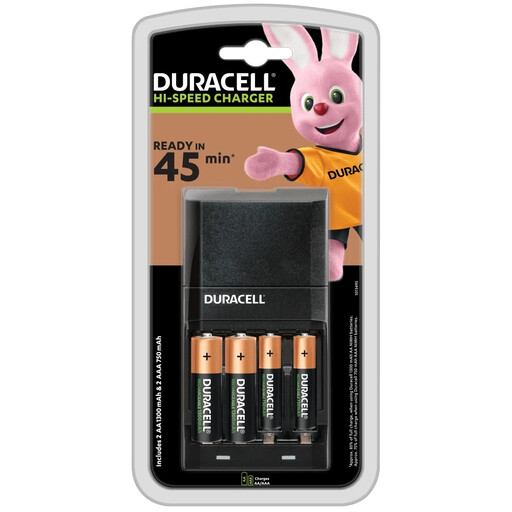
Duracell’s stated 45-minute result for the CEF27 concerns two 1300 mAh AA NiMH cells reaching approximately 85% charge, not every AA battery reaching full charge.
Check the cell count, capacity and charge level attached to a charging-time claim before relying on it for a spare set.
Moving charging away from a dedicated mains charger does not remove the need for a suitable, safely used USB supply.
Electrical Safety First advises buying USB charging equipment from a reputable retailer. Follow the charger’s instructions and do not use damaged equipment.
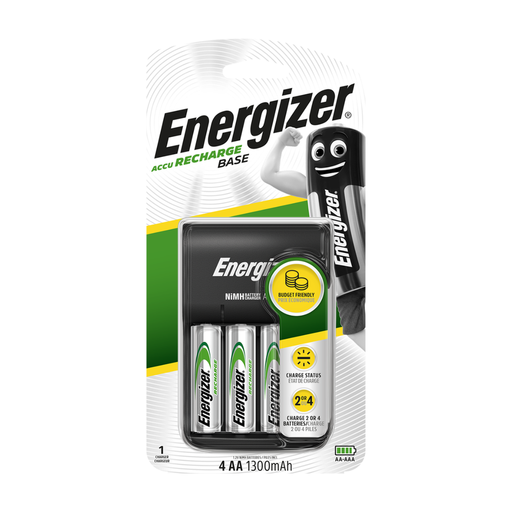
The Comfort Smart is a USB-input option for preparing a small set of rechargeable AA cells without a dedicated mains charger.
The UK-version YC800 is relevant when you maintain a larger pool of AA/AAA spare cells.
The CEF27 Hi-Speed Advanced Charger is a mains-powered option for charging a small AA/AAA set when an outlet is available.
The BQ-CC55 is relevant if individual charging and per-cell status information matter for a small spare set.
These options cover a USB-input charger for keeping sockets free and a mains-powered charger for a small set when an outlet can be spared. Either choice depends on your chime permitting the intended rechargeable AA cells.
 No image available
A USB-input option for preparing a spare AA set when you have a suitable USB power source and your chime permits NiMH cells.
 No image available
A mains-powered alternative for a small spare set if you can temporarily spare a socket and your chime permits rechargeable NiMH AA cells.
A USB-input AA/AAA NiMH charger can avoid dedicating a wall socket to charging if you have a suitable powered USB port or power bank. First confirm that your chime accepts rechargeable NiMH AA cells, and check the charger’s USB supply requirements.
No: charge only the rechargeable sizes and chemistries specified for the charger. Panasonic says its BQ-CC55 detects a dry battery inserted by mistake and stops power; that safeguard is not a reason to put disposable batteries in it.
Use an appropriate battery collection point rather than putting worn-out rechargeable cells in household waste. UK government battery guidance addresses collection and recycling; check your local authority or a retailer for a suitable drop-off point.