Label-maker users short of sockets
If another mains charger would take up a scarce socket, look for USB input and check that your available USB power source meets the charger’s stated requirement.


If your label maker accepts rechargeable AA cells, a USB-input charger can avoid occupying a dedicated mains socket when you have a suitable USB power source. Check the label maker’s permitted cell type and required cell count, then compare the charger’s input requirement and charging channels. An eight-slot model is more relevant if you also prepare batteries for other devices.
If another mains charger would take up a scarce socket, look for USB input and check that your available USB power source meets the charger’s stated requirement.
If the label maker needs several cells at once, check its battery instructions and consider how the charger indicates charge status or handles individual cells. Use a matched set rather than mixing rechargeable and single-use batteries.
If you also maintain other AA or AAA sets, extra slots may be useful. Check each device’s permitted battery type before choosing a charger that handles more than one rechargeable chemistry.
Check the label maker’s battery instructions before choosing a charger. USB input addresses the socket constraint only when an available power source meets the charger’s requirement; a mains-powered charger remains an option if you can spare an outlet.
| Concern | What to check | Who this matters to |
|---|---|---|
| Socket use | Confirm USB input and match its stated power requirement to an available USB source. | With few sockets free, I want to charge AA cells without plugging in a dedicated mains charger. Around 42% of consumers put avoiding another mains socket first. |
| A matched, usable set | Check the label maker’s permitted cell type and count, the charger’s AA support, and whether its channels handle cells individually. | When the label maker uses several cells, I want to prepare a compatible set without mixing cell types or overlooking a problem cell. Around 33% of consumers make matched-set preparation their primary concern. |
| Turnaround and capacity | Compare stated charge times under their specified battery and input conditions, then decide how many slots you will use. | If I prepare batteries for several devices, I may need more bays or less time between charging sessions. Around 25% of consumers put turnaround or batch capacity first. |
GP Batteries lists four slots but two channels for the B421, compared with four slots and four channels for the P461. Slot count alone does not tell you how separately cells are handled.
Check both figures if you expect to charge individual cells or cells at different charge levels.
AA size does not establish that a particular label maker accepts rechargeable cells. Panasonic Energy also advises against mixing its eneloop cells with single-use batteries unless the device manufacturer expressly permits it.
Read the label maker’s manual and battery-compartment markings for cell size, count and permitted type. Prepare a matched set of the same rechargeable type, brand, capacity and age.
Charging claims depend on the specified input and batteries. GP Batteries specifies 5.0V 2A for the P461 and 5V 1A for the B421; XTAR specifies 5V 3A for the L8 Pro.
Check that your USB source meets the chosen charger’s requirement, and compare charge times only with their stated cell and input conditions.
UK government guidance identifies supermarket and larger-shop battery collection points as routes for recycling most waste batteries.
Keep removed cells safe until you can take them to a suitable battery collection point.
GP Batteries lists USB-input AA/AAA NiMH charger bundles that are relevant when a dedicated mains socket is inconvenient.
Panasonic Energy’s BQ-CC55 is a mains-powered option for charging compatible eneloop AA/AAA cells individually when an outlet is available.
XTAR’s L8 Pro is a USB-C, eight-slot option for people maintaining several AA/AAA sets.
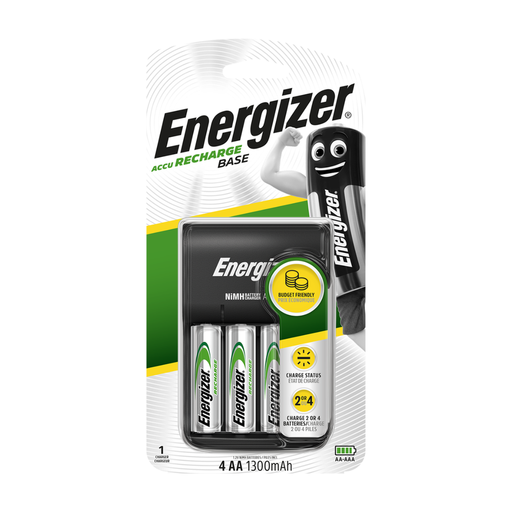
This USB charger bundle is relevant if your label maker permits rechargeable AA cells and you have a suitable USB power source. Check the machine’s instructions before using the included cells.
 No image available
For a label maker that permits rechargeable AA cells, this USB charger bundle includes four AA 1300mAh rechargeable batteries. Check the charger’s required USB input against your power source, and confirm its channel arrangement if individual-cell charging matters to you.
No: AA size alone does not confirm rechargeable-cell compatibility. Check your label maker’s instructions for the permitted battery type and required cell count. Panasonic Energy advises against mixing its eneloop cells with single-use batteries unless the device manufacturer expressly permits it.
A USB-input charger can use a suitable existing USB power source instead of a dedicated mains charger, but the source must meet its input requirement. GP Batteries specifies 5.0V 2A for the P461 and 5V 1A for the B421; XTAR specifies 5V 3A for the L8 Pro.
You can if the particular charger supports it. Panasonic Energy says the BQ-CC55 charges one to four compatible AA/AAA cells individually. GP Batteries lists four channels for the P461 but two channels for the four-slot B421, so check the model’s instructions before relying on single-cell charging.
Take removed cells to a suitable battery collection point rather than putting them in household rubbish. UK government guidance identifies supermarkets and other larger shops as collection routes for most waste batteries; if a battery cannot be removed from an electrical item, check an appropriate electrical-recycling route.