Households topping up a few AA cells
If you may need to charge one, two, three or four cells rather than a full set, look for stated individual charge control. IKEA and Panasonic specify models that can charge individual compatible cells.


Choose an AA NiMH charger around how many cells the musical toy needs and whether you want to charge one cell at a time. Individual charging channels offer flexibility, while a fast mains charger suits shorter turnarounds; USB input helps with limited sockets only if a suitable powered USB source is already available. Before buying cells, check the toy’s battery count and its manufacturer’s guidance on rechargeable 1.2V AA NiMH batteries.
If you may need to charge one, two, three or four cells rather than a full set, look for stated individual charge control. IKEA and Panasonic specify models that can charge individual compatible cells.
If the toy will be needed soon, compare charge-time claims against the number and capacity of AA cells you plan to use. A status indicator can also help you see when charging has finished.
If you keep charged spares together, a charger with storage may suit your routine. USB input is worth considering only if you already have a suitable powered USB source that does not take another needed wall socket.
Check the toy’s AA-cell requirements first, then decide whether your main constraint is charging an odd number of cells, waiting time, an available power source or keeping spares ready. Use only a charger specified for rechargeable AA NiMH cells; do not put disposable AA batteries in it.
| Concern | What to check | Who this matters to |
|---|---|---|
| Charging flexibility | Look for explicit one-cell charging or individual channels, as well as AA NiMH compatibility. Four slots alone do not establish separate control. | If I only need to replenish some of the toy’s cells, I do not want to wait for a pair to run down. Around 31% of consumers would put this flexibility first. |
| Turnaround before play | Read which cell quantity and capacity a stated charge time covers; check how the charger shows charging status. | When the toy is needed soon, I care most about how long my particular AA cells will take to charge. For around 25% of consumers, turnaround is the primary concern. |
| Limited plug sockets | Check whether the charger uses a mains plug or USB input. For USB, match its input requirements to an available powered source. | If the wall sockets are already in use, I need a power connection that does not displace another device. Socket access comes first for around 25% of consumers. |
| Organising charged spares | Check AA-cell capacity and whether the charger is intended to store cells after charging. | For repeated toy use, I would rather keep a charged set together than start charging just before it is needed. Around 19% of consumers would make spare-cell organisation their priority. |
Physical slots do not establish whether a charger controls each battery separately. That distinction matters when the toy leaves you with an odd number of cells to recharge.
Check for stated individual channels, individual charge control or support for charging one AA cell.
A USB-input charger still needs electricity. A separate USB mains adaptor would occupy a wall socket.
Identify the powered USB port you would use and check it against the charger’s input requirements.
If you do not already have a suitable powered USB source, you may need a separate power supply or powered hub.
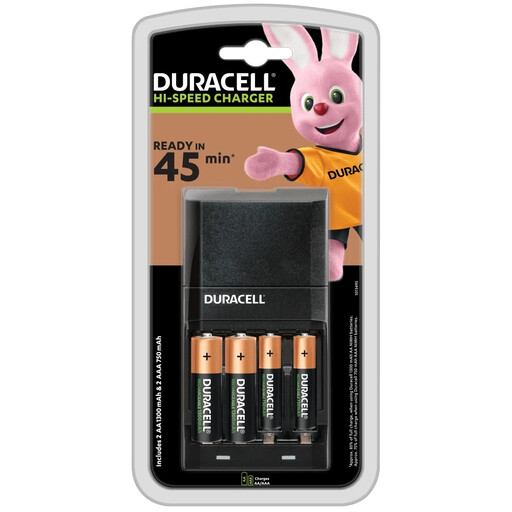
Duracell’s 45-minute claim for the CEF27 concerns two AA cells under its stated conditions, not every battery or loading arrangement.
Check the current manual and the capacity and number of cells you intend to charge. If a delay would disrupt play, consider keeping a compatible charged set ready.
Electrical Safety First has reported a recall of a four-slot AA/AAA charger posing electric-shock and fire risks. A familiar slot layout alone is not a safety check.
Before use, check the supplier, current recall information, plug suitability and the battery chemistry stated for the charger.
AA/AAA charging options for either smaller top-ups or a larger collection of spares.
A mains-charger route to examine when short-notice charging matters.
An option to examine if charging individual compatible cells is the priority.
A UK-plug option to examine for AA/AAA NiMH charging with cell-status information.
These chargers and battery bundles cover mains-powered AA preparation and a USB-input option. Check the toy’s battery instructions before choosing cells, and match the charger’s power connection to the socket or powered USB source you can actually use.
 No image available
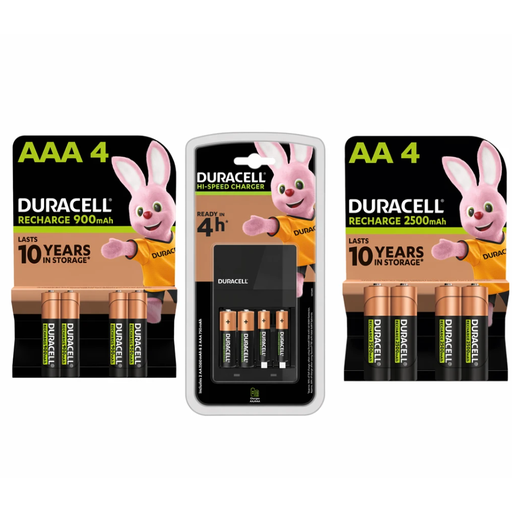
Consider this bundle if you want AA cells alongside a charger and also have a use for the included AAA cells. If topping up an odd number matters, check the charger’s individual-cell instructions before buying.
The charger uses a UK mains socket while charging. Check the toy’s required cell count and guidance on rechargeable 1.2V AA NiMH batteries.
 No image available
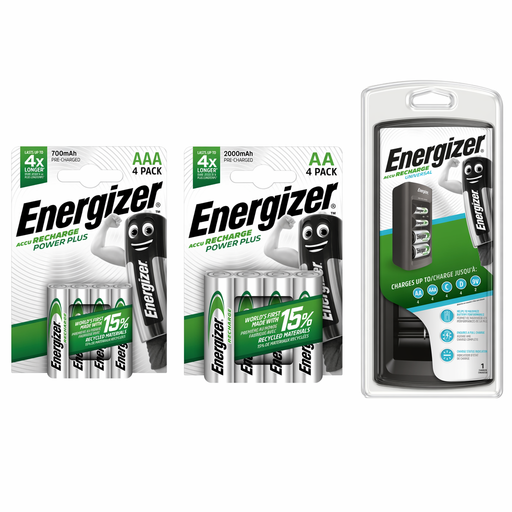
This kit is worth examining if you want a charger and rechargeable AA cells together. Check its instructions for the number of cells it charges at once if single-cell top-ups matter to you.
It uses a UK mains socket while charging. Confirm the toy’s AA-cell requirements and guidance on rechargeable 1.2V NiMH cells.
 No image available
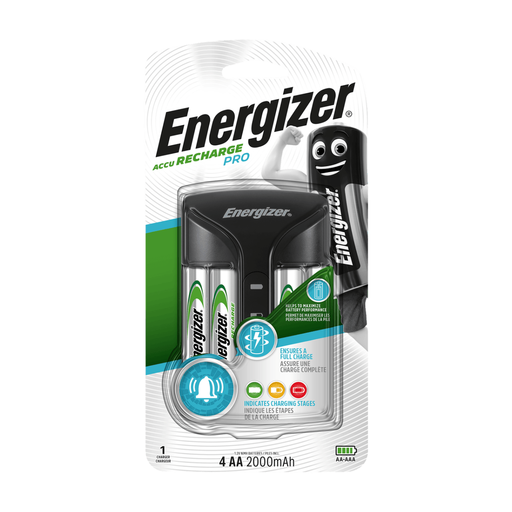
Consider this bundle if four AA rechargeable cells suit the toy or your spare-cell plan. The charging arrangement is described for two or four cells, so choose a model with stated single-cell support if odd-number top-ups are important.
The UK mains plug occupies a socket during charging. Check the toy’s battery count and rechargeable-cell guidance.
 No image available
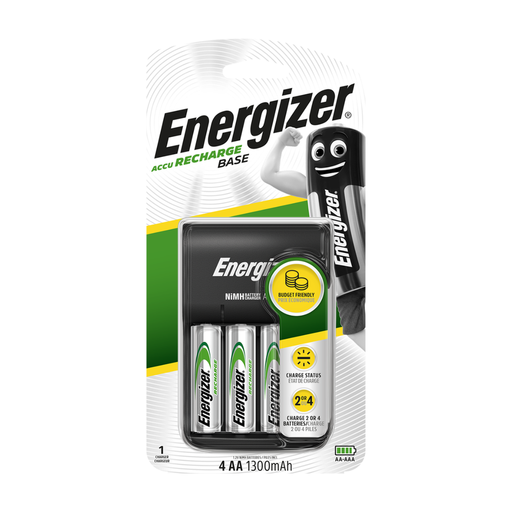
The USB input may suit a home with few free sockets if you already have an appropriate powered USB source. Check the charger’s input requirements against that source; USB input alone does not provide power.
Charging is described for two or four cells rather than a single cell. Check the toy’s AA-cell count and guidance on rechargeable 1.2V NiMH batteries.
 No image available
Consider the CEF27 if short-notice AA charging is your priority and you can spare a mains socket. Duracell’s 45-minute claim applies to two AA cells under stated conditions; check the current manual and the included cells before planning around that time.
For the fastest stated arrangement, the listing advises charging in pairs rather than establishing single-cell charging. Check the toy’s battery count and rechargeable-cell guidance.
Yes, if the charger explicitly supports single-cell charging. IKEA specifies STENKOL for one to four rechargeable AA/AAA cells, and Panasonic specifies individual charging for one to four compatible cells in the BQ-CC55. Do not assume four physical slots provide that flexibility.
No. Do not attempt to recharge non-rechargeable AA batteries. For an AA NiMH charger, use compatible rechargeable AA NiMH cells and follow the charger’s instructions.
Only if a suitable powered USB source is already available without taking a socket you need for something else. A USB mains adaptor still occupies a wall socket, so check the charger’s input requirements and the power source you would use.
No. Duracell’s 45-minute claim concerns two AA cells under its stated conditions. Check the current CEF27 manual and the number and capacity of the cells you intend to charge before relying on a particular turnaround time.