If your flash uses rechargeable AA NiMH cells, choose independently controlled charging bays when you need to prepare cells with different remaining charge. A USB-powered charger is worth considering when you have a suitable USB power source but cannot spare another mains socket; check its input requirements and whether an adapter is included. Confirm the flash’s battery requirements before choosing a charger, and never put disposable AA cells in a NiMH charger.
Who needs which features?
Flash users preparing a full set
If you charge several AA cells before a shoot, independent bays let you manage cells with different remaining charge. Panasonic specifies individual charging and status indication for one to four AA/AAA cells in its BQ-CC55.
Photographers short of sockets
If a compatible USB power source is already available, a USB-input charger may be easier to accommodate than another mains-powered device. Check the required input and supplied adapter: Nitecore UK describes USB-powered options, while BatteryStation lists the XTAR VC4SL without a wall adapter.
Users checking uneven battery sets
If older rechargeables behave inconsistently, individual cell information or a capacity-test programme may help you assess them. ANSMANN specifies those testing options for the Powerline 4.2 Pro.
What matters when choosing?
Dedicated AA/AAA NiMH charger
Choose it when: You use rechargeable AA NiMH cells and mainly want straightforward charging; Panasonic’s BQ-CC55 provides individual control for one to four AA/AAA cells.
Trade-off: A mains-powered version needs a socket, and its plug configuration must suit the UK retail version.
USB-powered multi-chemistry charger
Choose it when: A suitable USB power source is easier to spare, or you also charge other cell types supported by the exact model. Nitecore UK specifies AA NiMH support and independent bays for the UM4 and UMS4.
Trade-off: The connected USB supply can limit charging output, and you must check the charger’s supported chemistries and settings.
Charger with cell-testing programmes
Choose it when: Older rechargeable cells behave unevenly and you want to assess them individually; ANSMANN specifies capacity-test and refresh programmes for the Powerline 4.2 Pro.
Trade-off: Testing takes longer and requires more decisions than routine charging.
| Concern | What to check | Who this matters to |
|---|
| Preparing a full set |
Check how many AA NiMH cells can charge at once and whether each bay is controlled and indicated separately. |
I want the cells for my flash ready together, even if they start at different charge levels. Around 42% of consumers put independent set preparation first. |
| Saving socket space |
Compare the charger’s USB input requirements with your available supply, and check what power equipment is included. |
With few free sockets at my kit-preparation area, I need to use a compatible USB source I can spare. Preserving socket access comes first for roughly 33% of consumers. |
| Checking uneven cells |
Look for individual cell information and a capacity-test programme if you need to investigate older rechargeables. |
When a rechargeable set behaves inconsistently, I want to identify which cell needs attention. Diagnosing cells is the primary need for about 25% of consumers. |
Mistakes to avoid
-
Assuming every AA battery can be recharged
AA describes size, not chemistry. Energizer’s NiMH-charger instructions warn that charging unsupported or non-rechargeable batteries can cause leaking, rupture or explosion.
Check the battery label, the flash’s requirements and the charger manual before charging.
-
Overlooking the USB power source
A USB connection alone does not ensure a charger’s higher-output mode. Nitecore UK makes maximum output conditional on a suitable QC-capable input for its cited models; BatteryStation lists the XTAR VC4SL without a wall adapter.
Match the charger’s input specification to the USB source you plan to use, and check the bundle contents.
Using a higher-output mode may require a separate compatible adapter.
-
Reading a single-bay maximum as a four-bay rate
A charger’s maximum stated current may apply to fewer occupied bays than the number you use for a flash set.
Check the specified output with the number of AA cells you normally charge together.
-
Putting worn rechargeable cells in household waste
UK consumer guidance from GOV.UK directs consumers towards battery collection routes for waste batteries.
Keep unusable cells aside for a suitable battery collection point or recycling centre rather than putting them in general household waste.
Brands to consider for these charger types
Panasonic eneloop
A dedicated AA/AAA NiMH option for straightforward flash-cell preparation.
- Panasonic specifies individual charging and status LEDs for one to four AA/AAA eneloop or eneloop pro cells in its BQ-CC55.
- Its stated 90-minute time applies to two AA eneloop cells and varies with temperature and battery condition. Confirm the plug supplied with the UK version.
ANSMANN
An AA/AAA NiMH option for users who want to assess individual rechargeable cells.
- ANSMANN specifies selectable current and charge, discharge, refresh and capacity-test programmes for one to four cells in the Powerline 4.2 Pro.
- Those programmes require more user input and can take longer than routine charging.
Nitecore
USB-powered, multi-chemistry options for users with a suitable USB supply.
- Nitecore UK specifies AA NiMH support and four independently managed bays for the UM4 and UMS4.
- Higher charging outputs depend on suitable QC-capable input hardware.
XTAR
USB-powered options for users who also need support for other compatible rechargeable cylindrical cells.
- XTAR specifies NiMH and lithium-ion compatibility and 5 V USB power for the VC4.
- For the distinct VC4SL model, BatteryStation lists four independent positions but no wall adapter; check that model’s bundle and USB-C input needs.
Joybuy products for this scenario
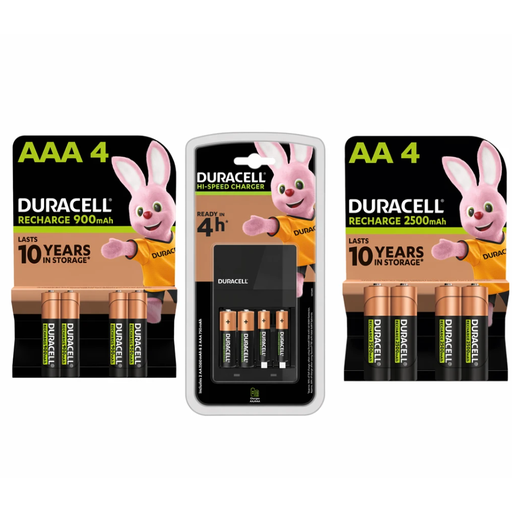
This mains-powered AA/AAA NiMH charger kit may suit readers who can spare a UK socket and want rechargeable AA cells included. Check your flash’s battery requirements and the charger’s simultaneous AA charging capacity before choosing it.
 No image available
Duracell 4-Hour Charger with 4 AA 2500mAh and 4 AAA 900mAh batteries
A mains-powered NiMH kit to consider if your flash accepts rechargeable AA NiMH batteries and you can spare a UK socket.
The kit includes four rechargeable AA 2500mAh batteries and four rechargeable AAA 900mAh batteries. Check how many AA cells the charger accepts simultaneously and whether it indicates completion separately for each slot.
View on Joybuy
Frequently asked questions
Can I charge ordinary alkaline AA batteries in a NiMH charger?
No. Use a NiMH charger only with the rechargeable battery chemistries and sizes its manufacturer specifies. Energizer warns in its NiMH-charger instructions that charging other battery types can cause leaking, rupture or explosion.
Will a USB charger free up a plug socket?
It can if you already have a compatible USB power source available. Check the charger’s input requirements and bundle: Nitecore UK makes higher-output modes conditional on suitable input hardware, while BatteryStation lists the XTAR VC4SL without a wall adapter.
When do independent charging bays matter for flash batteries?
They matter when you want to charge cells with different remaining charge or top up one cell without waiting for a pair. Panasonic specifies individual control for one to four AA/AAA cells in its BQ-CC55, and Nitecore UK specifies independent control for the UM4’s bays.
Is a capacity-test function worth choosing?
It is worth considering if older rechargeable cells behave inconsistently and you want to assess them individually. ANSMANN specifies capacity testing and refresh programmes for the Powerline 4.2 Pro, but these add time and operating steps compared with routine charging.


