Check your exact label maker’s battery instructions before buying a charger: Brother says the PT-H500 accepts rechargeable AA batteries, while its guidance for other P-touch models recommends alkaline batteries for memory backup. If your model permits rechargeable AA NiMH cells, choose faster charging for a short changeover, a 2- or 4-cell charger for preparation in advance, or individual-slot control for unevenly used cells. A four-slot charger will need more than one cycle if the device requires six cells.
Who needs which charging setup?
Cottage hosts preparing a complete set
If the label maker must be ready before guests arrive, check its exact cell count and whether it accepts rechargeable AA batteries. Brother specifies six AA cells for the PT-H500, so a four-slot charger would require two cycles for that model.
People preparing labels at short notice
For a same-day changeover, compare how many cells the charger handles at once and whether its stated charging time means a full or partial charge. Duracell’s 45-minute CEF27 claim, for example, refers to approximately 85% charge under its specified battery condition.
People maintaining several rechargeable sets
If cells return from use with different remaining charges, individual-slot control lets you select a charger intended to handle one cell or an odd number. Check the supported battery chemistry and the power connection for the particular model.
What matters when choosing an AA charger?
Start with the label maker’s battery instructions. Once rechargeable AA NiMH cells are confirmed as suitable, decide whether preparing a complete set quickly or charging individual cells matters more.
| Concern |
What to check |
Who this matters to |
| Compatibility and a complete set |
Check the exact label-maker manual for permitted battery chemistry and cell count; match the charger to the rechargeable cells. |
If my label maker needs a full set, I want to know that it accepts rechargeable AA cells and that I can prepare enough of them. Around 45% of consumers put compatibility and a complete set first. |
| Charging time |
Check the cell count and battery capacity behind the stated time, and whether it describes a full or partial charge. |
With a guest changeover close, I need cells ready without mistaking a partial-charge claim for a full charge. Charging time is the primary concern for around 33% of consumers. |
| Individual-cell flexibility |
Look for explicit individual charging or slot monitoring and a status indication for each cell. |
When cells have been used unevenly, I want to charge only those that need it rather than wait for pairs. Individual-cell flexibility comes first for around 22% of consumers. |
Mistakes to avoid
-
Assuming every AA-powered label maker accepts rechargeable cells
AA size alone does not settle the question. Brother lists rechargeable AA use for the PT-H500, but recommends alkaline cells for memory backup in guidance for other P-touch models.
Find your exact model’s battery instructions before choosing cells or a charger; check the permitted chemistry, quantity and any backup-battery guidance.
-
Reading a fast-charge claim as a universal full-charge time
Duracell describes approximately 85% charge in 45 minutes for its specified 1300 mAh AA NiMH cells with the CEF27. Energizer says the timing of its 1-Hour Charger can vary by NiMH battery.
Check the conditions behind the stated time and allow another cycle if the label maker needs more cells than the charger holds.
-
Putting disposable or mismatched cells in a charger
Duracell’s CEF27 instructions warn against charging alkaline, zinc-carbon, lithium and other unspecified batteries, and say not to mix different capacities.
Charge only rechargeable cells expressly supported by the charger, and follow its instructions when preparing a matched device set.
-
Putting worn rechargeable cells in household rubbish
UK government guidance directs consumers to battery collection points for used portable batteries.
Keep worn AA cells for an appropriate battery collection point rather than putting them in household rubbish.
Charger brands worth comparing
Energizer
Its UK AA/AAA NiMH range includes chargers for preparation in advance and for shorter turnaround.
- Energizer specifies 2 or 4 cells and an eight-hour full charge for the Base Charger; its 1-Hour Charger is specified for 1–4 cells.
- The stated one-hour time can vary by NiMH battery. Check which charger’s cell-count arrangement fits the set you need to prepare.
Duracell
The UK CEF27 is a rapid-charge option for supported AA and AAA NiMH cells.
- Duracell specifies approximately 85% charge in 45 minutes with its 1300 mAh AA NiMH batteries.
- That is a conditional partial-charge figure, not a general full-charge time. Its instructions restrict which rechargeable cells may be charged and say not to mix capacities.
Panasonic eneloop
The BQ-CC55 is an individual-control option for supported AA and AAA eneloop cells.
- Panasonic specifies independent charging for one to four supported cells, with separate status LEDs.
- Panasonic says plug configurations vary by sales region; confirm the connection on the exact variant before purchase.
ANSMANN
The USB-powered Comfort Smart offers individual-slot monitoring for supported AA and AAA NiMH cells.
- ANSMANN specifies charging for 1–4 cells, per-slot LEDs and battery-defect detection.
- Check the power supply you intend to use with the USB-powered charger before buying.
Joybuy chargers for rechargeable AA preparation
These chargers are relevant to preparing rechargeable AA cells for a label maker, provided its exact model permits them. The Duracell option has a conditional rapid partial-charge claim; the Energizer option is a choice to consider when you can prepare cells in advance.
 No image available
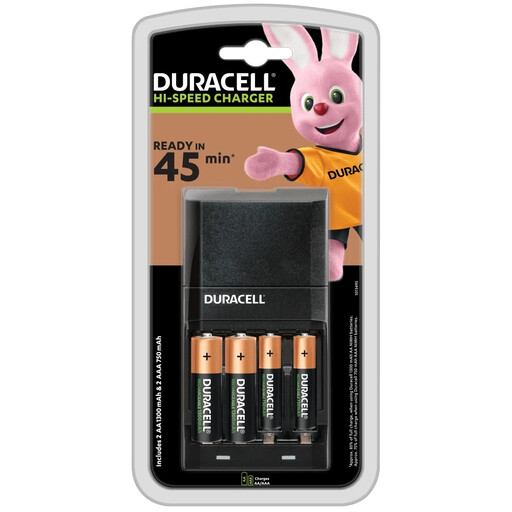
Duracell CEF27 45 Minute Charger with 2 AA and 2 AAA batteries
Consider this model when rechargeable AA NiMH cells are permitted and a short preparation window makes a partial charge useful.
Duracell specifies approximately 85% charge in 45 minutes with its 1300 mAh AA NiMH batteries, not a full charge under every condition. Check the exact variant’s instructions for how many cells it charges together before planning a complete set.
View on Joybuy
 No image available
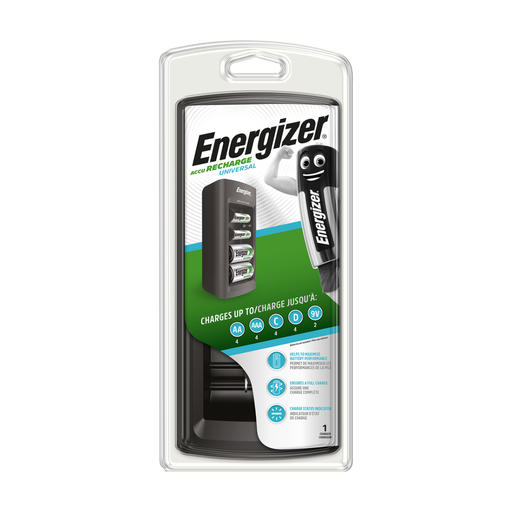
Energizer Universal Battery Charger
Consider this charger if you can prepare a rechargeable set ahead of cottage use. Before buying, confirm the exact variant’s supported cells, UK power connection and whether it can charge individual cells if that matters to you.
View on Joybuy
Questions about AA chargers and label makers
Will any AA-powered label maker take rechargeable AA batteries?
No: check the instructions for your exact model. Brother lists rechargeable AA batteries for the PT-H500, while its guidance for other P-touch models recommends alkaline batteries for memory backup.
Can I charge ordinary alkaline AA batteries?
No. Charge only the rechargeable battery types specified for your charger. Duracell’s CEF27 instructions warn that charging alkaline, zinc-carbon, lithium or other unspecified batteries may cause bursting, injury or damage.
How do I prepare batteries for a six-AA label maker with a four-slot charger?
Plan for more than one charging cycle. Brother specifies six AA cells for the PT-H500, while a charger limited to four cells cannot prepare all six simultaneously; follow the charger’s instructions for keeping the device set matched.
Can I charge batteries in a damp cottage kitchen?
Use the charger only in the environment allowed by its instructions. Duracell specifies indoor use in a dry environment for the CEF27, so a damp area is not suitable for that model.
Where should worn rechargeable AA batteries go in the UK?
Take them to an appropriate battery collection point rather than putting them in household rubbish. GOV.UK includes rechargeable AA batteries in its guidance on collecting used portable batteries.


