
24/7 Customer Support

Free returns

Same-day & Next-day Delivery

Quality Guaranteed

Unlock Your Welcome Offers: FREE Delivery | Up to 80% OFF | Free 30-day JoyPlus trial
Download the APP
As a parent or grandparent, watching a little one take their first wobbly steps is a milestone filled with joy. An adjustable baby walker can be a wonderful tool to support this journey, providing entertainment and encouraging mobility. However, the market is crowded with options, and it's easy to fall into common traps that lead to a purchase you'll regret. As your Joybuy Product Recommendation Officer, my role is to help you navigate the choices and find a product that is safe, practical and offers genuine value for your family.
Before you buy, let's look at the three most common pitfalls that catch out UK families.
foldable baby walker can quickly become a cumbersome obstacle when not in use, cluttering up your living space.To avoid these issues, focus on a few key parameters that define a well-designed and practical baby walker. Analysing these will ensure you get a product that lasts and serves your baby's developmental needs.
A truly adjustable baby walker adapts to your child's rapid growth. Look for models with at least three distinct height settings. This ensures your baby's feet can always touch the floor correctly as they grow, which is crucial for proper posture and development. Some advanced models also feature adjustable wheel speed. This allows you to set a slower, more resistant pace for early walkers and a faster speed as they gain confidence, making the walker suitable for a wider age range, typically from 6 to 18 months.
Safety should always be the top priority. A walker's stability comes from its base design. A wide, sturdy frame is less likely to tip as your baby navigates corners. Always check for anti-slip pads or grips on the base, which are designed to stop the walker at the edge of a step. Furthermore, ensure the materials are durable and non-toxic, often indicated by compliance with EN-71 safety standards.
To get the most value, consider a multi-functional model. A 4 in 1 baby walker can transform from a traditional sit-in activity walker into a baby push walker that your child can use as they learn to walk independently. Some even convert into ride-on toys. This versatility means the product remains useful for much longer. A foldable baby walker design is another key feature for practicality, allowing for easy storage under a bed or in a cupboard.
Instead of a one-size-fits-all approach, we've matched some well-suited products to different family needs and priorities.
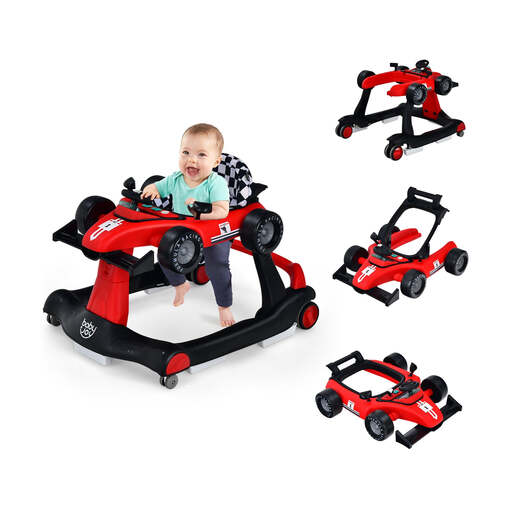
Why This Fits Their Persona: This is for the parent who wants one purchase to cover multiple developmental stages. Its ability to convert from a sit-in walker to a push-along toy provides excellent long-term value and the foldable design is ideal for tidy UK homes.
It directly counters the "one-size-fits-all" myth with 3 height positions and adjustable rear wheel speed. It also solves the storage problem with its quick-folding design.
Its 4-in-1 functionality (walker, push-behind, push car, rolling toy) and safety features like anti-slip stair pads make it a versatile and secure choice.
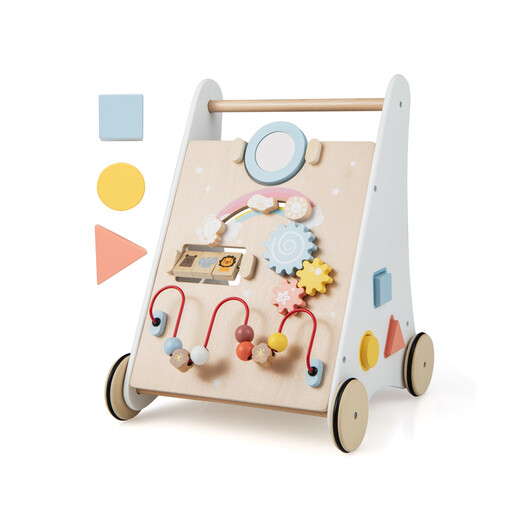
Why This Fits Their Persona: For families who prefer classic wooden toys and a focus on sensory development. This is a `baby push walker` that encourages pulling up and walking, while the built-in activities promote cognitive and fine motor skills without over-stimulation.
This model avoids the containment of sit-in walkers, promoting a more natural walking posture. Its stable triangular structure and non-slip rubber rings on the wheels address key safety concerns from the outset.
The 7-in-1 activity centre (shape sorter, maze, gears) provides lasting entertainment. It also includes a rear storage shelf, encouraging toddlers to tidy their toys.
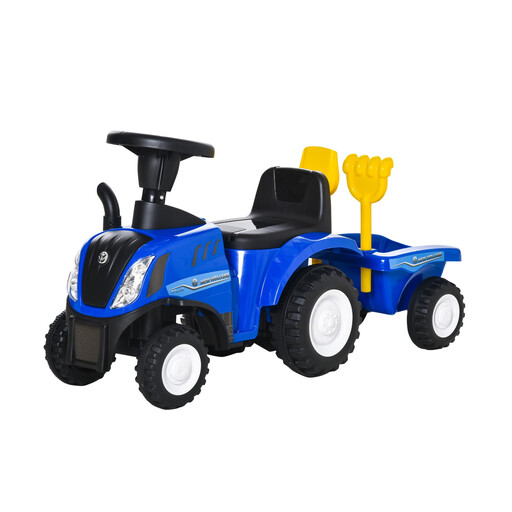
Why This Fits Their Persona: Perfect for families who want a developmental toy that doubles as a fun ride-on. This foot-to-floor walker helps improve balance and transitions seamlessly into a toy for imaginative play, suitable for toddlers from 12 to 36 months.
By combining a walker and a ride-on, it extends the product's lifespan well into toddlerhood, avoiding the trap of being outgrown quickly. The six-wheel design provides a stable base for confident movement.
The engaging features, including a horn, interactive lights and a rear cargo box for toys, make it more than just a walker—it's an adventure on wheels.
We have compiled a complete, real-time list of products that fully satisfy these strict selection criteria and UK safety regulations.
Most sit-in walkers are designed for babies who can sit up unaided, which is typically around 6 months of age. They can then be used until the baby is walking confidently or reaches the maximum weight or height limit, often around 12 to 18 months. Push-along walkers are generally introduced when a baby starts to pull themselves up to a standing position, around 9 to 12 months.
Modern baby walkers are generally designed to work on a variety of indoor surfaces, including low-pile carpets. The key is to look for models with large, high-quality wheels that can move smoothly. However, performance can vary on very thick or plush carpets. It's always a good idea to supervise your child and ensure the walker moves freely without getting stuck.
Most foldable walkers have a simple mechanism for compact storage. This usually involves pressing one or two buttons or release levers, often located under the main tray or on the frame. Once released, the walker collapses down into a flatter profile, making it easy to slide under a sofa or store in a cupboard. Always consult the product's instruction manual for the specific steps.