
24/7 Customer Support

Free returns

Same-day & Next-day Delivery

Quality Guaranteed

Unlock Your Welcome Offers: FREE Delivery | Up to 80% OFF | Free 30-day JoyPlus trial
Download the APP
An adjustable elevated dog bowl with slow feeder can make mealtimes more organised, particularly for large dogs, fast eaters and households with limited storage. However, attractive product photos and broad claims do not always reveal whether a feeding station will suit your pet, your floor space or your cleaning routine.
Before buying, look beyond the phrase “raised dog bowl stand”. The useful details are usually found in the height range, bowl materials, stability features and storage design.
A feeder described as suitable for large dogs may still be too low or too high for an individual pet. Dogs of the same breed can have different shoulder heights and eating habits. A stand with only one fixed height may become unsuitable as a puppy grows or if it is shared between pets.
Check the actual measurements in centimetres rather than relying on labels such as “large” or “X-large”. A height-adjustable dog feeder should offer settings that allow your pet to eat without an exaggerated neck bend or an uncomfortable head lift. Introduce any raised feeder gradually and monitor how your pet uses it.
A slow feeder dog bowl or anti-gulp dog bowl usually includes ridges, channels or raised sections that encourage a pet to take smaller mouthfuls. The shape and spacing matter. Very deep or tightly packed obstacles may frustrate some dogs, while a shallow design may not slow a determined eater significantly.
Slow feeding is not a substitute for supervision or advice from a veterinary professional if your pet regularly coughs, vomits or shows difficulty eating. Look for a bowl that can be removed easily for thorough cleaning.
A lightweight stand can slide across laminate or tiled floors when a large dog eats enthusiastically. Water spills can also damage untreated wood or leave a damp area beneath the feeder. Check for non-slip feet, a broad base and a frame that does not wobble after assembly.
Also confirm which components are dishwasher-safe. Stainless steel bowls are generally straightforward to wash, but the stand itself may need wiping and drying by hand. A product that takes too long to clean can become inconvenient for daily use.
Measure your dog’s shoulder height while standing and compare it with the feeder’s settings. For multi-pet homes, consider whether one station can accommodate different sizes. A cat and dog feeding station may need lower settings for a cat and higher settings for a larger dog.
Also measure the available floor area. Product dimensions of approximately 42 × 27 cm suit a different space from a broad wooden tray measuring around 17.5 × 11.2 inches. Leave enough room for your pet to stand comfortably without blocking a doorway or radiator.
For daily food and water, look for clearly stated materials. 304 stainless steel is used in several of the options below and is easy to remove, rinse and clean. Avoid placing stainless steel bowls in a microwave, and follow the product instructions for dishwasher use.
Capacity should match your pet’s routine. Two 1,600 ml bowls can provide useful room for food and water for a large dog, while a smaller bowl may be easier for a cat or compact feeding area. Do not overfill bowls, as this can increase spills and make a slow feeder harder to clean.
A stainless steel dog bowl stand may offer easy bowl cleaning, but the frame and feet still determine how stable the station feels. Inspect adjustment points, screws and non-slip pads regularly.
A foldable pet feeding stand is useful for smaller homes, travel or storing the feeder between uses. The trade-off is that a folding mechanism creates additional joints to check. Ensure the legs are fully opened and locked before adding food or water.
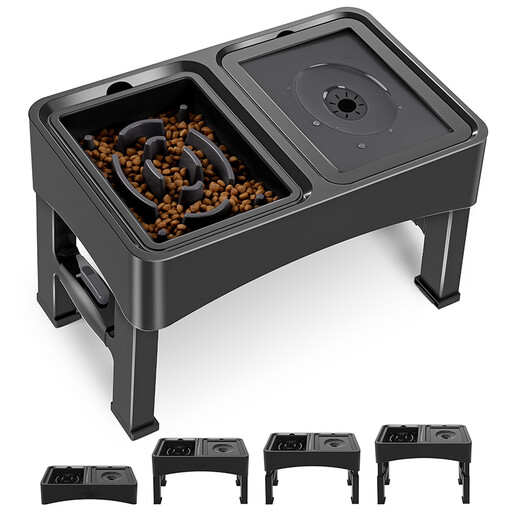
Why This Fits Their Persona: A practical starting point for UK households wanting one station for eating and drinking, with four height levels from 10 cm to 31 cm.
The listing specifies adjustable heights rather than a single fixed position, while the slow feeder and floating water bowl address fast eating and water splashing.
Two-in-one feeding and drinking setup; foldable legs support convenient storage.

Why This Fits Their Persona: Suitable for owners who prefer a separate slow feeder and stainless steel bowl that can be arranged for food or water.
Its four stated height settings and interchangeable bowl combination make the setup less restrictive than a fixed single-purpose stand.
Includes one slow feeder and one stainless steel bowl; foldable design supports storage or mobile use.
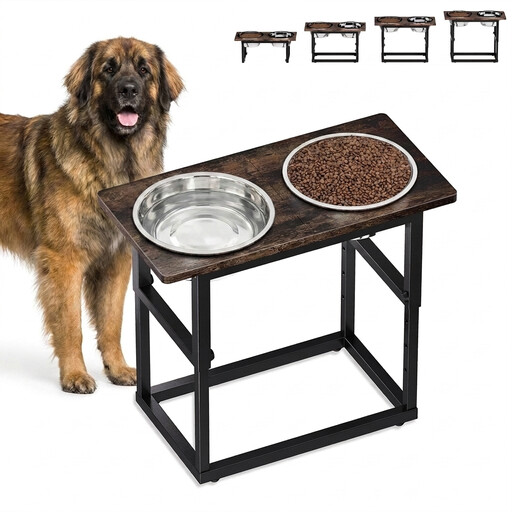
Why This Fits Their Persona: Designed for owners of larger dogs who want a wider range of feeding positions and two high-capacity bowls.
Five listed height settings, from approximately 20.8 cm to 44 cm, make it easier to match a taller dog than a low multi-purpose stand.
Two 1,600 ml 304 stainless steel bowls; non-slip feet and a metal frame with wooden base.
We have compiled a complete, real-time list of products that fully satisfy these strict selection criteria and UK safety regulations.
It can be suitable if the highest setting, bowl capacity and stand dimensions match the dog’s size. Measure the dog while standing and compare this with the product’s stated height range. A broad, stable base and non-slip feet are also important for enthusiastic eaters.
Clean the removable bowl after each meal where possible, particularly when feeding wet food. Rinse away food from ridges and channels, then dry the bowl before replacing it. Wipe the stand regularly and deal with water spills promptly to protect flooring and wooden components.
No bowl can guarantee a completely dry floor. A floating water bowl for dogs is designed to limit the amount of water available at the rim and may reduce splashing, but placement, pet behaviour and bowl cleaning still affect the result. Keep the station on a level surface and check the water level before use.