
24/7 Customer Support

Free returns

Same-day & Next-day Delivery

Quality Guaranteed

Unlock Your Welcome Offers: FREE Delivery | Up to 80% OFF | Free 30-day JoyPlus trial
Download the APP
As a Joybuy Product Recommendation Officer, my role is to help you navigate the crowded market of home fitness equipment. An adjustable weight bench with a leg developer can be the centrepiece of a powerful home gym, but choosing the wrong one can lead to frustration, wasted money and even risk of injury.
Many shoppers fall into common traps set by clever marketing. Before you commit, let's look at the three most frequent pitfalls we see and how you can avoid them.
multi-purpose workout bench that also serves as a squat rack is appealing. However, many affordable models compromise on everything. The rack might be too narrow for a standard barbell, the bench adjustment might be clunky and the overall stability can be poor, making it a master of none.To ensure you get a durable and functional piece of equipment, focus on these three core parameters. They are the true indicators of quality for any home gym weight bench.
The foundation of any good bench is its frame. Look for models constructed from heavy-duty alloy steel. Pay close attention to the specified dynamic load capacity, as this tells you the maximum weight the bench can safely handle during an exercise. For an intermediate lifter, a dynamic capacity of around 180 kg (approx. 400 lbs) or more provides a solid and safe platform for progression. A stable, wide base is also essential to prevent tipping during unilateral movements or when re-racking weights.
A truly versatile bench should offer FID (Flat, Incline, Decline) positions. This is essential for targeting different muscle groups in your chest, shoulders and back. Check for the number of backrest adjustment levels—more levels offer finer control over your exercise angles.
When it comes to the attachments, a quality FID bench with leg extension will have a developer that moves smoothly and accommodates Olympic or standard weight plates. Similarly, a good preacher curl attachment bench should have a firm, comfortable pad that can be adjusted to your arm length, allowing for a full bicep contraction.
For those looking to maximise space and functionality, a bench press and squat rack combo is an excellent choice. The key here is to verify the rack's features. Does it have adjustable J-hooks to suit your height for both bench pressing and squatting? Crucially, does it include safety hooks or spotter arms? These are non-negotiable for anyone planning to train alone, as they can catch the barbell if you fail a lift.
We've analysed products based on the practical criteria above. Instead of a simple list, we match equipment to the type of person it suits, helping you find the right fit for your specific home gym goals.
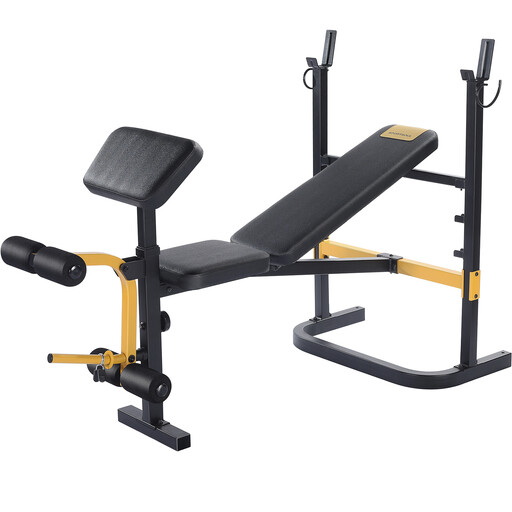
Why This Fits Their Persona: This user wants a single, robust piece of equipment to perform the 'big three' (squat, bench and deadlift variations) plus accessory work like leg curls and preacher curls. Living in the UK, where dedicated gym space can be limited, this integrated unit saves a significant amount of floor space compared to buying a separate bench, squat rack and leg machine.
It directly counters the "wobble trap" with its high-grade alloy steel construction and a clearly stated 410 lbs (186 kg) dynamic load capacity. It also avoids the "awkward attachment" flaw with a 4-level adjustable backrest and a 3-level adjustable preacher curl pad, allowing for better ergonomic alignment.
The integrated weight bench with squat rack includes safety hooks, a critical feature for training safely at home without a spotter. The combination of a FID bench, leg developer and rack in one unit offers exceptional value and space efficiency.
We have compiled a complete, real-time list of products that fully satisfy these strict selection criteria and UK safety regulations.
A typical bench press and squat rack combo requires a footprint of approximately 1.5 metres in width by 2 metres in length to allow safe movement and space for loading a 7-foot barbell. You will also need sufficient ceiling height to perform overhead movements, ideally at least 2.2 metres. Always measure your available space before purchasing.
While a folding weight bench is excellent for saving space, it often involves a trade-off in stability. The folding mechanisms can introduce points of weakness in the frame. For light to moderate weightlifting, they can be a practical solution. However, for intermediate to advanced lifters planning to handle heavy loads, a non-folding, heavy-duty weight bench with a fixed, welded frame is generally the more stable and safer choice.
strength training bench for home, a well-designed leg developer is a highly space-efficient and effective way to train your quadriceps and hamstrings without needing a separate, bulky machine.