
24/7 Customer Support

Free returns

Same-day & Next-day Delivery

Quality Guaranteed

Unlock Your Welcome Offers: FREE Delivery | Up to 80% OFF | Free 30-day JoyPlus trial
Download the APP
An adult cycling helmet with goggles and light can simplify your riding kit, but the extra features do not automatically make one helmet suitable for every cyclist. A commuter may prioritise rear visibility and easy charging, while a mountain biker may need eye coverage, a secure fit and effective ventilation.
Before buying, watch for three common traps:
Measure around the widest part of your head, approximately 2–3 cm above your eyebrows, and compare the result with the listed size. For example, the OutdoorMaster RhinoUrban is available in sizes including M for 54–58 cm and L for 58–61 cm.
An adjustable bicycle helmet should have:
Fit the helmet level rather than tilted backwards. The front edge should sit above your eyebrows, while the straps should not hang loosely.
In-mould construction commonly combines a polycarbonate (PC) outer shell with an expanded polystyrene (EPS) liner. The shell helps form the exterior structure, while the EPS liner is designed to absorb energy during an impact.
The RhinoUrban product listings specify CPSC and ASTM certification, along with PC and EPS construction. These are useful details for comparison, but UK buyers should still confirm the product’s supplied labelling and any local compliance information before riding.
Do not buy a helmet solely because it says “mountain”, “road” or “e-bike”. A mountain bike helmet for adults, road cycling helmet, commuter bike helmet or e-bike helmet should be selected according to its certification, fit and intended use—not just its marketing category. Replace any helmet after a significant impact, even if cracks are not visible.
A rechargeable bike helmet with rear light can reduce the number of separate accessories you need to mount. Check the charging connection, lighting modes and whether the light is intended to help others notice you rather than illuminate the road ahead.
For wet and windy UK conditions, detachable goggles may help shield your eyes from rain, wind and airborne grit. A removable visor can be useful in bright weather, but it should not obstruct your view or become loose during riding.
Ventilation is equally important. The RhinoUrban has 17 vents, while the DKONI HS-158 lists 20 ventilation holes. More vents may improve airflow, but the overall design, internal channels and fit also affect comfort. For additional eye coverage, a separate pair of cycling glasses may be preferable when you do not want to wear a visor.
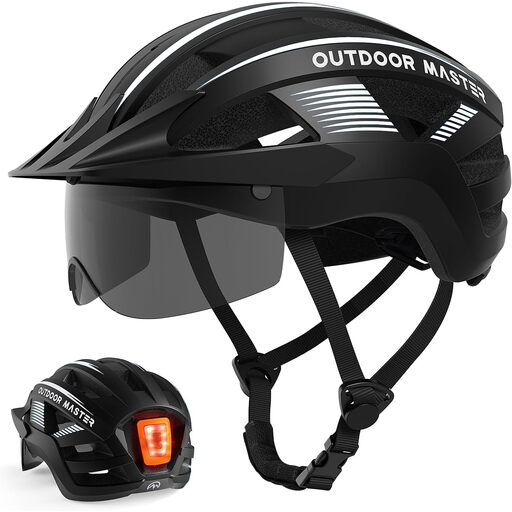
Why This Fits Their Persona: A practical option for adults starting regular commuting, leisure rides or mixed road cycling who want a helmet, eye protection and rear light in one package.
The 54–58 cm size range and adjustable dial make fit easier to fine-tune than a fixed shell. The rear light is Type-C rechargeable and the goggles and visor are detachable.
CPSC and ASTM certification are listed; PC/EPS in-mould construction, 17 vents, magnetic goggles and a removable sun visor are specified.
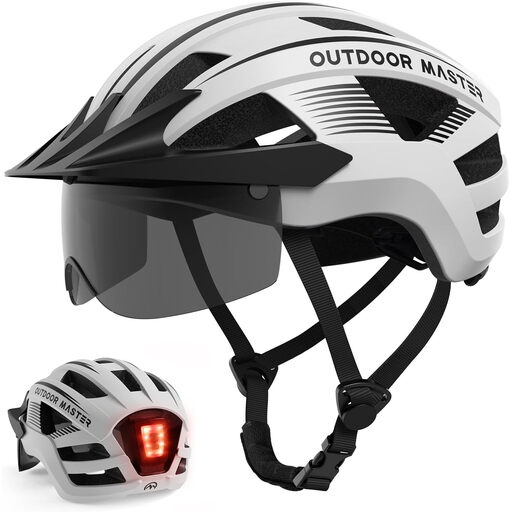
Why This Fits Their Persona: Suits riders who switch between city commuting, road routes and light mountain-bike use and prefer a clean, adaptable white finish.
The listed medium size, adjustment dial and chin strap address the common loose-fit problem. The light, goggles and visor are identified as included components.
Type-C rear LED light with multiple modes, detachable magnetic goggles, removable visor and 17 vents are listed.
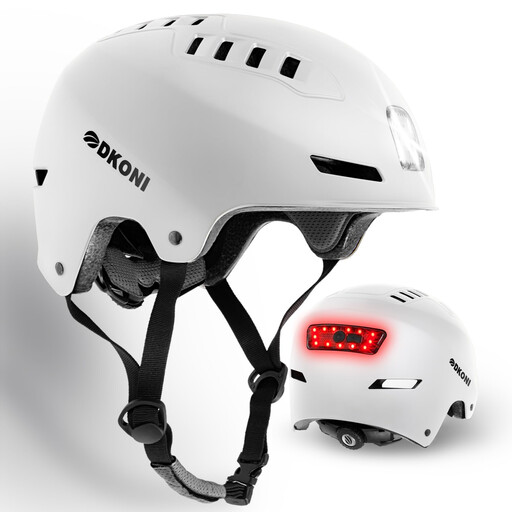
Why This Fits Their Persona: Designed for frequent urban riders who want front and rear lighting, washable lining and a compact fit for everyday commuting.
It specifies separate front and rear LEDs rather than relying on a rear-only signal, with four rear-light modes. Its one-hand dial and adjustable side straps support repeat daily fitting.
The product information lists CPSC, CE and ASTM certification, 20 ventilation holes and removable, washable inner mesh lining.
A helmet should not be your only consideration. Depending on your route, useful additions may include:
We have compiled a complete, real-time list of products that fully satisfy these strict selection criteria and UK safety regulations.
No. A built-in rear light is intended to improve visibility to people behind you, but it does not replace legally required bicycle lighting or reflective equipment where these apply. Check that the light is charged before each ride and use suitable front and rear lights for dark conditions.
Place it level on your head, adjust the rear dial until it feels secure and tighten the chin strap so it is comfortable but not loose. The helmet should not rock when you gently move your head. Check that the magnetic goggles and visor are fully attached and do not interfere with your peripheral vision.
Running time varies according to the light mode, battery condition and product design, so check the individual listing rather than relying on a general estimate. Recharge it through the specified USB or Type-C port and inspect the cable and light regularly. Replace the helmet immediately after a major impact and consider replacement if the shell, liner, straps or retention system shows damage.