
24/7 Customer Support

Free returns

Same-day & Next-day Delivery

Quality Guaranteed

Unlock Your Welcome Offers: FREE Delivery | Up to 80% OFF | Free 30-day JoyPlus trial
Download the APP
The world of chess has been transformed by technology, and the rise of the AI chess robot offers a compelling way to learn, practise and enjoy the game. For serious players, it’s a tireless training partner. For families, it’s a brilliant, engaging educational tool. However, the market is filled with devices that promise much but deliver little, leading to buyer's remorse.
As a Joybuy Product Recommendation Officer, my role is to help you see past the marketing hype. Before you invest in what can be a significant purchase, it’s crucial to understand the common pitfalls and the features that truly matter. This guide will walk you through the essential checks to ensure you choose a board that will serve you well for years to come.
Many promising-looking automatic chess boards hide flaws that only become apparent after purchase. Here are the three most common traps to watch out for:
To ensure you get a capable and future-proof device, focus on these three non-negotiable specifications.
The heart of any advanced chess computer is its AI engine. Look for a board that offers a wide and clearly defined range of difficulty levels, typically measured in ELO rating. A versatile robot should cater to absolute beginners (around ELO 200-400) and stretch all the way to grandmaster levels (ELO 2500+). This ensures the robot can grow with a player's skill, making it a long-term chess training robot rather than a short-term novelty. A limited AI range is a clear red flag.
If you are investing in a physical robot, the arm's performance is paramount. Don't just look at pictures; check the specifications for move cadence (the time it takes to complete a move) and positional accuracy. A well-engineered arm should move smoothly and quietly, with a cadence of around 8-10 seconds, mimicking the pace of a human player. This is the key to a truly immersive, screen-free chess game.
A modern AI chess robot must be more than just a board. Check for two key features:
Based on these critical parameters, here are our recommendations matched to different user needs.
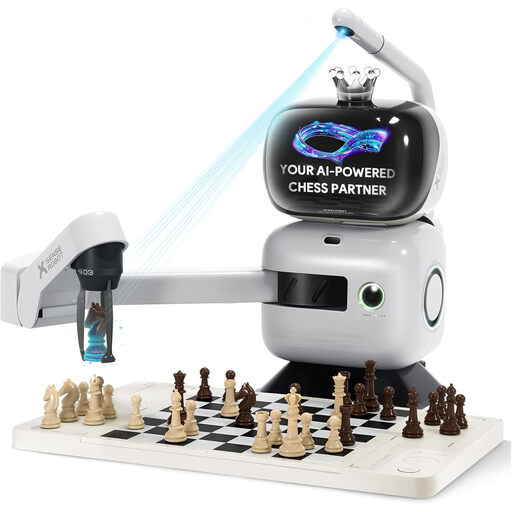
Why This Fits Their Persona: This robot is an ideal training partner for intermediate players aiming to improve. The wide AI range (up to ELO 3200+) provides a consistently challenging opponent, while the companion app's analysis tools help identify and correct weaknesses in their game.
It completely avoids the "Subscription Trap" by including lifetime access to 1,200+ exercises and endgame trainers. It also sidesteps the "Isolated Board" pitfall with full Lichess.org integration for online play.
Its key strengths are the vast, subscription-free training library and the ability to export games (PGN format) for deep analysis in other chess software.
Why This Fits Their Persona: For parents wanting to reduce screen time, this robot is an excellent choice. After a one-time setup, it operates without a phone or tablet, providing a focused, screen-free chess game. Voice coaching and hints make it accessible for children learning the rules.
It masterfully avoids the "Clunky Opponent" problem. The smooth, quiet and precise robotic arm is fascinating for young players to watch, keeping them engaged in the physical game rather than getting frustrated by a clumsy machine.
The combination of true screen-free operation and a structured, voice-guided curriculum (co-designed with the European Chess Union) makes it a powerful and self-contained educational tool.
Why This Fits Their Persona: For those who appreciate high-end technology and design, the SenseRobot delivers. The precision-engineered automatic chess board and arm provide a seamless, futuristic playing experience that feels like a premium piece of equipment.
It is protected from obsolescence through lifetime Over-the-Air (OTA) software updates. This ensures the AI, features and online integrations will continue to evolve, protecting the long-term value of the investment.
The combination of a high-precision, human-like robotic arm and guaranteed future-proofing via OTA updates makes it a standout choice for tech-savvy users seeking a top-tier device.
We have compiled a complete, real-time list of products that fully satisfy these strict selection criteria and UK safety regulations.
Most modern robots, including the SenseRobot, are designed for easy installation. They typically require a one-time setup using a companion smartphone app to connect to your home Wi-Fi. Once this is complete, many can operate entirely independently of the app for a true screen-free experience.
Yes, significantly. A quality chess training robot provides a consistent and tireless opponent, which is essential for practice. More importantly, features like structured lessons, endgame training and post-game analysis help you identify weaknesses and learn new strategies in a structured way. The ability to repeatedly practise specific scenarios is a powerful tool for improvement.
This depends on your priority. A chess robot with arm offers a far more immersive and tangible experience, closely replicating a game against a person. This is particularly engaging for children and for anyone who enjoys the physical nature of board games. Boards that use lights to indicate moves are often more compact and portable but lack the unique, interactive quality of a robotic opponent.