People seated for long periods
If a chair arm or nearby furniture obstructs a low fan, a floor-standing model with adjustable height may make it easier to direct air where you sit. Meaco lists height adjustment for its 1056P pedestal model.


Choose an adjustable pedestal air circulator if it must stand on the floor and direct air past a chair arm or nearby furniture. A compact tabletop model makes sense when there is a secure side table close to the chair; for reading or conversation, check its low-speed noise as well as its airflow direction. A fan moves air but does not provide air conditioning or resolve persistent condensation or poor ventilation.
If a chair arm or nearby furniture obstructs a low fan, a floor-standing model with adjustable height may make it easier to direct air where you sit. Meaco lists height adjustment for its 1056P pedestal model.
For reading, calls or television beside the fan, usable low speeds and noise at those settings matter more than maximum output alone. Compare noise claims for the exact setting and model you would use.
If the fan moves between a side table, the floor and other rooms, consider where each position will be stable. Duux describes its Whisper Flex² Smart as convertible between tabletop and standing configurations.
Choose it when: The fan must stand on the floor and send air above chair arms or across a wider part of the conservatory.
Allow for: A floor base and cable that need a stable position clear of walking routes.
Choose it when: A sturdy side table puts the fan close to the chair without using floor space beside it.
Allow for: The need for a level surface with enough room to keep the fan away from the edge.
| Concern | What to check | Who this matters to |
|---|---|---|
| Airflow direction | Check the height or vertical tilt and whether horizontal oscillation covers the seat and surrounding space. | If a chair arm blocks a low fan, I want air to pass the furniture rather than blow into it; around 44% of consumers put coverage and direction first. |
| Noise while seated | Compare the quoted minimum noise level with the speed or mode to which it applies. | When I am reading or talking beside the fan, I need an unobtrusive setting I can keep using; roughly 33% of consumers prioritise quiet operation. |
| Flexible placement | Check the base, available table space and cable route; consider a convertible format if you will move the fan. | If the seating layout changes, I need a fan I can place securely in each position; about 23% of consumers make placement flexibility their main concern. |
A strong fixed stream may be intrusive beside a chair, while a maximum-output figure says little about the setting used for reading or conversation.
Compare the exact model’s tilt, oscillation and low-speed settings. Treat quoted noise levels as model-specific claims and check which operating conditions they describe.
A small fan still needs a secure, level place to stand; a narrow table edge can leave it vulnerable to being knocked over.
If there is no suitable side table, consider a pedestal format instead. Position the base and cable away from walking routes.
A timer controls how long the fan runs; it does not address a damaged cable or an unstable position.
Electrical Safety First advises against leaving an electric fan running overnight or while you are out. Switch it off when it is not in use, and stop using it if you notice cable damage or a burning smell.
These model-specific features can help narrow the format to check; a brand’s inclusion does not establish availability for a particular product.
Meaco lists both a tabletop MeacoFan 1056 and an adjustable-height 1056P pedestal circulator.
Duux describes the Whisper Flex² Smart as a fan that converts between tabletop and standing use.
Levoit lists a pedestal air circulator with adjustable airflow settings and oscillation.
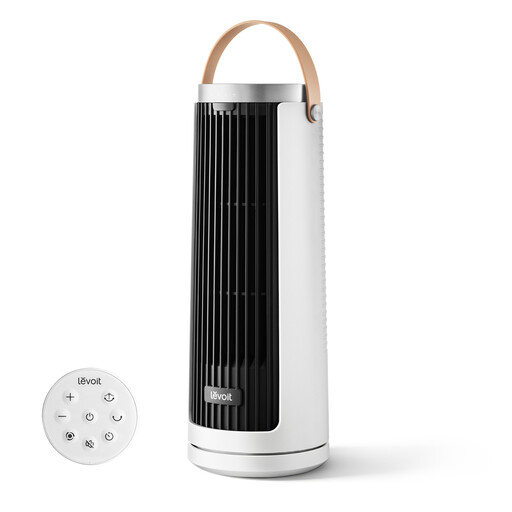
This compact tower fan is an option for personal airflow from a secure side table near the chair. Check its reach and direction before relying on it to move air past furniture or across the conservatory.
 No image available
Consider it for personal airflow near a chair when you have a stable surface for a compact fan.
The product title specifies USB Type-C recharging and multiple airflow modes. If airflow must clear chair arms, check the direction and reach; if quiet use or cordless placement matters, check noise at your preferred setting and battery runtime.
Choose a pedestal fan if it must stand on the floor or direct air above chair arms and nearby furniture. Choose a tabletop fan if a secure side table places it where you need the airflow without obstructing the seat.
No. An air circulator moves air rather than air-conditioning it. If persistent condensation, mould or inadequate fresh-air exchange is the underlying problem, assess ventilation separately instead of relying on a fan to resolve it.
Check the supplied plug and the condition of the fan and cable. Electrical Safety First advises choosing an electric fan with a fused UK three-pin plug and avoiding second-hand fans.
No. A timer does not remove the risks of unattended use. Electrical Safety First advises against leaving an electric fan running overnight or while you are out.
Position the fan and its cable so they do not obstruct a walking route. If you use an extension lead, check its current rating and the combined load of connected appliances: Electrical Safety First advises against exceeding the extension device’s maximum current rating.