People who spend time in one chair
If you read, watch television or work from the same seat, controllable direction and sound at your usual fan setting matter as much as maximum airflow.


Choose a height-adjustable pedestal circulator if you need to direct airflow past the chair and across the room; choose a tabletop circulator if you have a secure nearby surface and want to keep the floor clear. A high-output floor fan is another option when stronger airflow matters more than its lower position and potential noise. Whichever type you choose, check its direction, placement and noise at the settings you expect to use: a fan moves air but does not lower the room’s temperature.
If you read, watch television or work from the same seat, controllable direction and sound at your usual fan setting matter as much as maximum airflow.
If air feels stagnant beyond the seating area, consider whether the fan can direct air through open space rather than producing only a breeze close to the chair.
A chair-side fan needs a stable position, a clear route for its cable and enough space to avoid being knocked by people or pets.
Consider it when: You want to aim airflow at seated height or past the chair into the room.
Allow for: A base beside the furniture and noise that may vary with speed.
Consider it when: A secure side table or cabinet can hold the fan at a useful angle without occupying floor space.
Allow for: The surface must be clear and stable, and the fan’s position may be limited by nearby furniture.
Consider it when: Moving air across open room space is your priority and there is a safe floor position.
Allow for: Floor-level airflow and potentially more noise; Devola specifies 58–68 dB for its cited 16-inch floor model.
| Concern | What to check | Who this matters to |
|---|---|---|
| Reach across the room | Check the exact model’s stated air throw or airflow, and whether its head can direct air through an unobstructed space. | If I want to move air beyond my chair, a close-range breeze alone will not meet that need. Around 31% of consumers put room-wide airflow first. |
| Quiet seated use | Check which speed a stated noise figure applies to, along with speed and direction controls. | During reading or conversation, I want to adjust the breeze without a distracting fan sound; roughly 31% of consumers prioritise quiet, controllable airflow. |
| Height and safe placement | Measure the available floor or table space, assess base stability and keep the cable out of walkways. | With furniture close to the chair, I need a useful airflow angle without creating a knock-over or trip hazard. About 23% of consumers make placement their primary concern. |
| Everyday controls | Check which adjustments are available from the chair and compare power figures at stated operating settings. | If I change the airflow often, accessible controls and avoiding unnecessary running matter most to me; around 15% of consumers put day-to-day convenience first. |
Energy Saving Trust explains that fans move air and can help you feel cooler, but do not lower the room’s temperature.
Choose a circulator for airflow. If the room itself overheats, also consider shading and whether cooler outdoor air can be used safely; assess active cooling separately if you need to lower the room temperature.
A floor fan’s output does not tell you whether its low position will direct air comfortably beside a chair. Noise at the intended setting matters too.
Compare height, head adjustment and available floor space alongside each model’s stated airflow and noise conditions.
A crowded chair-side position can leave the fan unstable or put its cable across a walkway.
Use a stable, level position, route the cable away from people and pets, and inspect the fan and cable before use. Electrical Safety First advises unplugging a fan when it is not in use.
An image cannot establish whether the supplied fan has appropriate marking, instructions and identifiable manufacturer details.
Before ordering for UK use, check the seller and the product information for those details, as advised by the Office for Product Safety and Standards.
Meaco’s air-circulator range includes compact and pedestal models with directional airflow.
Devola offers compact circulators and larger floor fans, giving chair-side buyers different placement options.
The Duux Whisper Flex² Smart can be configured as a table fan or a standing fan, according to Duux.
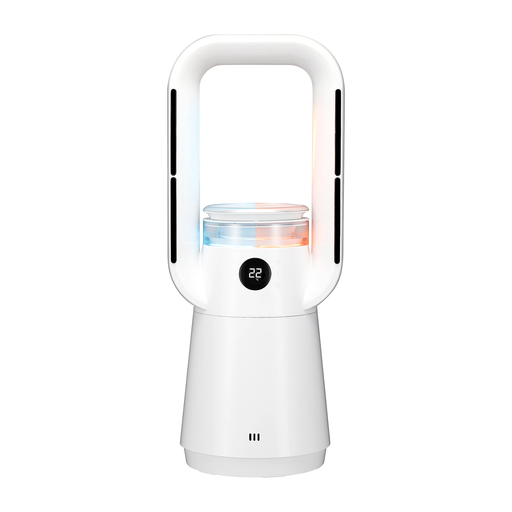
This air-circulator choice offers oscillating airflow for a living-room seating area, alongside other functions. Check its reach and physical fit before relying on it to circulate air across a large room.
 No image available
Consider this model if you want adjustable airflow beside a living-room chair and would also use its heater, humidifier and air-purifier functions.
The product name specifies a cooling-fan function, 65° oscillation and an included HEPA filter. Check its airflow reach, dimensions, placement clearance and noise at the settings you would use before deciding whether it fits a large room.
No. Energy Saving Trust explains that a fan moves air and can help you feel cooler, but it does not lower the room’s air temperature. If overheating is the problem, consider shading and safe use of cooler outdoor air as well as the fan.
A pedestal circulator is worth considering when you need to aim air at seated height or past the chair; a floor fan may suit a clear floor position when stronger airflow is the priority. Check the exact models’ noise conditions and the space each needs before deciding.
Check that the seller and manufacturer are identifiable and that the product information covers appropriate marking, instructions and warnings. The Office for Product Safety and Standards advises checking these details rather than relying on the listing image alone.
Electrical Safety First advises against leaving an electric fan running overnight or while the home is empty. Keep it stable with its cable clear of walkways, and stop using it if the unit or cable is damaged.
No. An air circulator redistributes air already in the room, whereas ventilation replaces stale indoor air with fresh outdoor air, as Energy Saving Trust explains. If stale air or persistent damp is the concern, assess ventilation rather than relying on a room fan.