People sharing a quiet lounge
If conversation or television viewing happens close to the fan, adjustable speed, direction and a timer may matter more than maximum airflow.


For a shared lounge, prioritise an air circulator you can aim over or around the sofa and adjust when people are seated nearby. A tabletop model needs a stable surface and a clear air path; a pedestal model offers a higher floor position but takes up walking space. If the room layout changes, a convertible model may suit both positions, provided its low-speed sound, dimensions and controls work for your lounge.
If conversation or television viewing happens close to the fan, adjustable speed, direction and a timer may matter more than maximum airflow.
When sofa arms or cushions obstruct a low fan, vertical aiming, oscillation or adjustable height can help establish a useful air path without fixing the breeze on one person.
If available table and floor space changes, a model that can move between tabletop and pedestal positions may be worth considering.
Start with a position that gives air a clear path around the sofa, then check whether the controls and power-cable route suit a room used by several people.
| Concern | What to check | Who this matters to |
|---|---|---|
| Quiet, adjustable airflow | Check the exact model’s stated low-speed noise, speed controls and timer. Noise figures from different brands may not be directly comparable. | When people are talking or watching television, I want to turn down or redirect the airflow without disturbing them; around 36% of consumers put quiet, controllable airflow first. |
| Air path around the sofa | Check vertical aiming and horizontal oscillation; consider adjustable height if the sofa obstructs a floor-level air path. | Air aimed at one cushion does little for the seats beside it, so I need a position that reaches across the seating area. Around 29% of consumers prioritise that air path. |
| Placement and footprint | Measure the intended stable surface or floor position, and check the model’s dimensions before choosing tabletop, pedestal or convertible placement. | If the lounge layout changes, I need to move the fan without giving up a useful table or blocking a walkway; roughly 21% of consumers place flexible positioning first. |
| Power and cable route | Check that the lead can reach a suitable socket without crossing a walking route. If using an extension, keep within its marked rating. | With other equipment plugged in near the sofa, I need a safe socket and a cable route people will not trip over; around 14% of consumers make electrical setup their primary concern. |
A strong direct breeze may be less comfortable when several people spend time close to the fan. The named Meaco, Dreo and Pro Breeze models list different controls and noise figures, but those manufacturer figures are not a like-for-like test.
Compare the exact model’s lower speed settings, direction controls and timer as well as its maximum setting.
A tabletop position saves floor space but may leave the air path behind an armrest; a pedestal can stand higher but needs room for its base.
Measure the sofa and intended position, then check whether the fan can aim across or above the seating area without obstructing a walkway.
A convenient spot beside the sofa may leave the cable across a walking route or add load to an extension already serving lounge equipment. Electrical Safety First warns against overloading extension equipment.
Plan the socket and cable route before ordering. If an extension is necessary, use one suitable for the connected load, stay within its marked rating and stop using equipment that is damaged or overheating.
The MeacoFan 1056 tabletop model and 1056P pedestal model offer two placement approaches for a sofa area.
The TurboPoly 512 is a pedestal option for directing air around more than one lounge seat.
The AirFlo 43 is designed to switch between tabletop and pedestal placement.
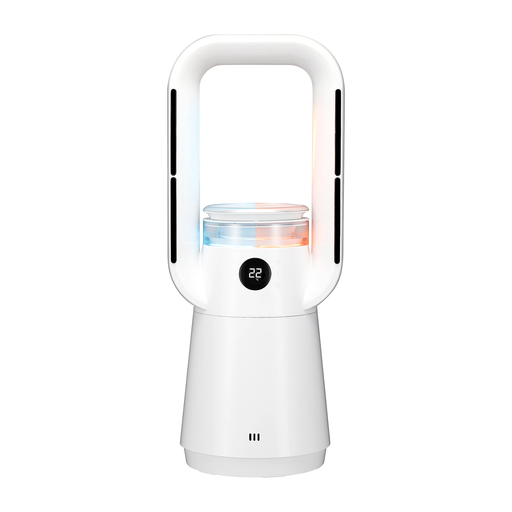
This air circulator has a cooling-fan function and oscillation. Check its aiming range and placement before choosing it for airflow around a sofa.
 No image available
The listed cooling-fan function makes this a possible choice for moving air near lounge seating, provided its position gives the airflow a clear path. Its name specifies 65° oscillation, a heater, humidifier and air-purifier functions, and an included HEPA filter. Check the oscillation direction, vertical aiming, low-speed sound, dimensions and cord reach against your sofa layout.
Place it where air can travel across or around the seating rather than remain fixed on one person. A position beside, behind or diagonally opposite the sofa may work if the head can aim above obstructing cushions; keep the base and cable out of walking routes.
Choose a tabletop model if you have a stable surface with a clear air path and want to preserve floor space. A pedestal model is worth considering when the fan needs more height to clear the sofa, provided its base fits safely; a convertible model makes sense if you will use both positions.
You can use a suitable extension lead only while keeping the total connected load within its marked rating. Electrical Safety First advises against overloading or daisy-chaining extension equipment; stop using a lead or socket that shows damage or signs of overheating.
Check the plug and cable for damage before use, and stop using equipment that shows signs of overheating. Follow the instructions for your exact model when cleaning it or removing a grille rather than assuming every fan comes apart the same way.