People working on calls or audio
If calls, recordings or concentrated work fill much of your day, look at the fan’s low-speed controls and published noise conditions. A timer or remote control may also help when the fan sits away from your desk.


Choose a compact desk fan if you mainly want airflow at one workstation; choose an adjustable air circulator if air needs to move through a room occupied in more than one spot. For calls and focused work, check noise at the speed you expect to use, as well as airflow direction and placement. A purifier-fan hybrid makes more sense when filtration or heating is also a genuine need.
If calls, recordings or concentrated work fill much of your day, look at the fan’s low-speed controls and published noise conditions. A timer or remote control may also help when the fan sits away from your desk.
If the office is shared or you move between your desk and another seat, adjustable height and airflow direction may matter more than a breeze aimed at one chair.
If your workstation is compact or temporary, compare a fan’s base footprint, height and ease of moving it before choosing a floor-standing format.
Choose it when: You mainly need air directed towards one workstation and have little floor space.
Trade-off: A narrowly aimed fan may not move air around a shared room.
Choose it when: You need to direct airflow towards more than one occupied part of the office.
Trade-off: A pedestal model needs floor space, and its quietest quoted setting may not provide the airflow you want.
Choose it when: Airflow is not your only requirement and you also want particle filtration or heating.
Trade-off: Check filter upkeep and whether you will use the additional functions; this is not a like-for-like substitute for a simple fan.
| Concern | What to check | Who this matters to |
|---|---|---|
| Distraction during work | Check which speed a quoted noise level describes and whether you can adjust the airflow in small steps. | If I spend hours on calls or focused tasks, I want moving air without distracting background noise; roughly 42% of consumers would put low-distraction airflow first. |
| Airflow beyond one seat | Check horizontal and vertical aiming against the room layout, and allow space for the fan’s base. | When my office is shared or I work in different parts of it, air aimed at one chair is not enough; about 33% of consumers would prioritise room-wide air movement. |
| Flexible placement | Compare the height range and footprint; if cordless use matters, check whether a battery is included. | With a small or changing workstation, I need a fan I can place where it fits that day; around 25% of consumers would make placement flexibility their primary concern. |
Meaco and Duux describe their headline low-noise figures as minimum values. The airflow setting you use during a call may be more audible.
Check the measurement condition and speed range, and look for independent noise testing at relevant settings where available.
A fan aimed at one seat may leave other occupied parts of the office outside its airflow path. A larger format is useful only if its direction controls and footprint suit the room.
Decide whether you need air at one workstation or across the room, then measure the space available for the fan.
The UK Health Security Agency treats fan use as one part of managing heat at home, alongside measures affected by sunlight and ventilation.
Consider shading and when to ventilate as well as fan placement, and follow current heat-health advice during hot weather.
A fan moved between positions can put its cable near walkways or chair wheels, where damage may be harder to notice.
Route the cable clear of movement, unplug the fan before inspection or cleaning, and stop using it if the plug, cable or casing is damaged.
The MeacoFan 1056P illustrates the adjustable pedestal-circulator format for directing air around a room.
The Whisper³ and Whisper Flex² lines offer fine airflow adjustment; the Flex² Smart can change between table and standing configurations.
The Pure Hot+Cool HP00 is a multifunction alternative for someone considering airflow, particle filtration and heating together.
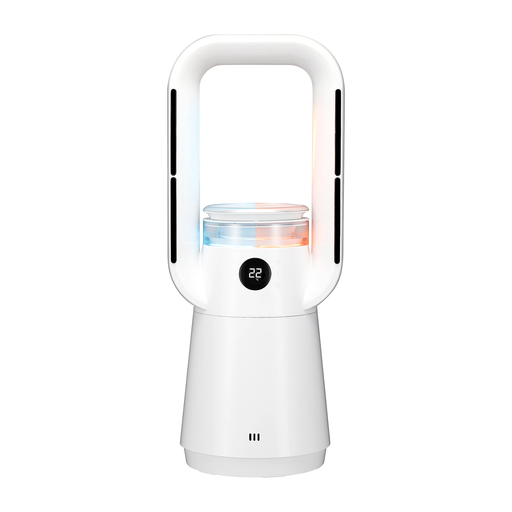
This multifunction air circulator is relevant if you want to move air through a home office and are also considering heating, humidifying or filtration. Check whether those extra functions suit your room before choosing it over a simpler fan.
 No image available
For a home office where you want adjustable airflow, this cooling fan lists 65° oscillation.
The title also specifies a heater, humidifier, air purifier and included HEPA filter. Check the space it needs, noise at your usual fan setting and the upkeep of the additional functions; follow the heater’s safety instructions when using it.
An air circulator moves air and may improve comfort, but it is not a complete answer to an overheating room. The UK Health Security Agency also advises managing heat entering the home and considering ventilation during hot weather.
Choose a compact desk fan when airflow is mainly for one workstation and space is tight. A pedestal circulator is worth considering when you need to adjust airflow towards more of the occupied room; check its base footprint before buying.
Check that the fan and its cable are suitable for where you plan to use them, and do not use equipment with a damaged plug, cable or casing. The Health and Safety Executive advises switching off and unplugging electrical equipment before inspecting it.
No: moving air around a room is different from bringing in fresh air or filtering particles. If filtration is a separate priority, compare a purpose-designed purifier or purifier-fan hybrid and account for its filter maintenance.