
24/7 Customer Support

Free returns

Same-day & Next-day Delivery

Quality Guaranteed

Unlock Your Welcome Offers: FREE Delivery | Up to 80% OFF | Free 30-day JoyPlus trial
Download the APP
An air purifier can be useful for managing airborne dust, pet particles and household odours, but choosing the right model requires more than comparing filter labels or app features. The wrong unit may be too weak for the room, too noisy for sleep or expensive to maintain once the original filter needs replacing.
This guide explains the specifications that matter, highlights common buying traps and matches several options to different UK household needs.
A product may advertise coverage for a large room, but that figure often depends on assumptions such as ceiling height and the number of air changes per hour. A purifier rated for 18m² may be appropriate for a bedroom or home office, but not an open-plan lounge.
The more useful figure is CADR, or Clean Air Delivery Rate. Measured in cubic metres per hour, it indicates how quickly filtered air is delivered. A higher CADR generally suits a larger room, provided the rating is based on a comparable measurement standard.
Wi-Fi control, UV features, ionisers, colour indicators and touchscreens can be convenient, but they do not replace suitable airflow and a properly maintained filter. A smart air purifier should still be assessed by its CADR, filter construction, noise levels and replacement costs.
If you are buying an air purifier for allergies, dust or pet dander, check whether it has a pre-filter and particle filtration. For cooking smells, smoke or pet odours, an activated carbon air purifier may be more suitable than a particle-only model.
A low purchase price can become less attractive if a compatible replacement is difficult to find. Look for an air purifier with replacement filter support and check whether the manufacturer specifies a replacement interval or usage-hour reminder.
Never assume filters can be washed and reused. Many composite filters contain layers that should be replaced rather than rinsed. Always check the model number before ordering a replacement air purifier filter.
Use the stated coverage as a starting point, not a guarantee. For compact bedrooms and offices, the Homintell Kilo and Ormos models are rated around 150m³/h CADR. The Homintell Mercury offers 200m³/h, while the Callisto reaches 300m³/h for rooms listed up to 36m².
For a larger living room or open-plan area, a higher-capacity model such as the Xiaomi Smart Air Purifier Elite lists 600m³/h particle CADR and coverage up to 125m² under its specified conditions. Keep doors and windows in mind: a purifier generally works more efficiently in an enclosed room than across several connected spaces.
A practical three-stage arrangement usually consists of:
A HEPA air purifier with carbon filtration can therefore offer broader everyday coverage than a particle filter alone. However, no purifier removes the need for ventilation, cleaning or addressing the source of damp and odours.
Noise figures are normally given in decibels (dB), but check whether the figure refers to sleep mode or maximum speed. The Homintell Mercury lists sleep-mode noise as low as 20dB in its product information, while the Callisto lists 26dB in sleep mode. Maximum-speed figures can be considerably higher.
Place the unit on a stable, dry surface with clear space around the air inlets and outlet. Avoid bathrooms and areas exposed to splashes. For a bedroom, a quiet air purifier with a timer, dimmable display or night mode is more practical than a model that must run loudly throughout the night.
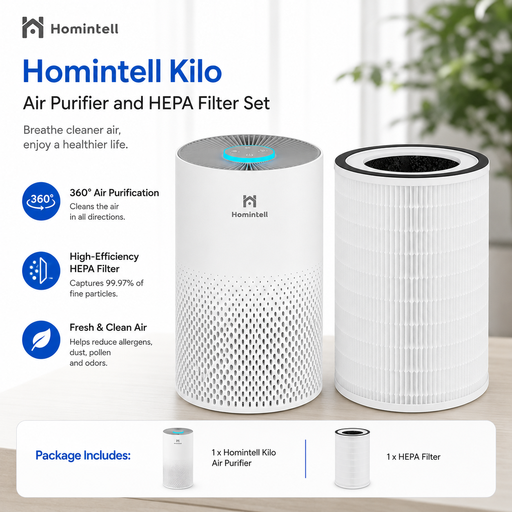
Why This Fits Their Persona: Its compact footprint and stated coverage of up to 16–18m² suit a bedroom, study or small rented flat where space and upfront practicality matter.
The listed 150m³/h CADR and three-in-one pre-filter, H11 HEPA and carbon filter provide clearer information than a vague room-size claim. An extra replacement filter is included.
Three fan settings, PM2.5 sensing, 2/4/8-hour timer and touch controls. The seven-colour light can be switched or adjusted for bedroom use.
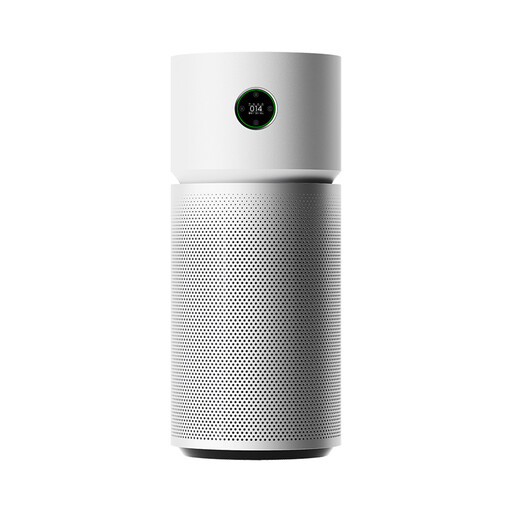
Why This Fits Their Persona: It is designed for larger UK homes and users who want app, voice and on-device monitoring rather than basic manual control.
The product lists 600m³/h particle CADR, PM2.5/PM10 sensors and a replaceable filter, making capacity and maintenance easier to assess.
UK plug, Mi Home app support, voice control, OLED display and a three-in-one HEPA and activated carbon filtration system.
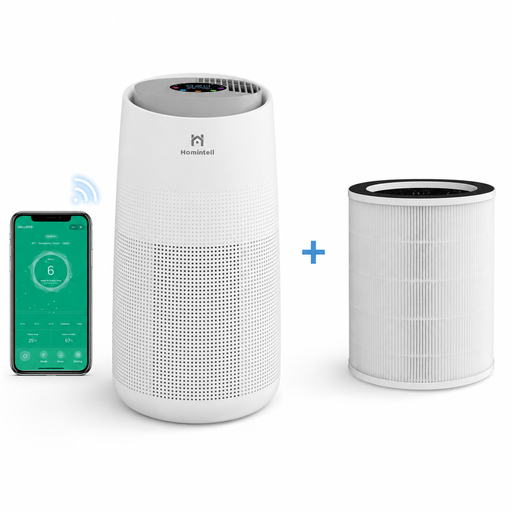
Why This Fits Their Persona: Families, pet owners and home-office users with a larger enclosed room may value its higher airflow, air-quality display and remote control.
Its stated 300m³/h CADR is paired with a listed 36m² coverage figure, while the included spare H13 filter makes the next maintenance step visible at purchase.
Wi-Fi control, child lock, temperature and humidity display, activated carbon filtration and a stated 26dB sleep mode.
We have compiled a complete, real-time list of products that fully satisfy these strict selection criteria and UK safety regulations.
For wardrobes, shoe storage, cars or small pet areas, odour absorber bags filled with bamboo charcoal can provide fragrance-free odour and moisture adsorption without mains electricity. They are not a substitute for an air purifier in a living room, and their stated coverage is limited, so use the quantity recommended on the product page.
If you already own a compatible unit, buying a replacement air purifier filter is usually more economical than replacing the whole appliance. Confirm the exact model: the TRULIVA KJ260 and KJ450 filters are not interchangeable, despite both using H13 HEPA and activated carbon layers.
There is no single interval for every home. Usage hours, indoor dust, cooking, smoking and pets all affect filter life. Follow the appliance reminder or manual, inspect the pre-filter regularly and replace the filter when the indicator signals a change. Switch off and unplug the device before maintenance.
A purifier can be used overnight if the manufacturer’s instructions permit it and the unit is placed on a stable, unobstructed surface. Select sleep mode or a lower fan setting, and check the stated dB figure rather than assuming that every “quiet” model will sound the same.
Running cost depends on wattage, electricity tariff and operating time. For example, a 23W unit running continuously uses approximately 0.552kWh per day before tariff calculations. Auto mode or a timer may reduce usage, but a larger model can draw more power at high speed. Check the rated wattage and compare it with your intended schedule.