Bedroom users who need quiet operation
If airborne dust is a concern overnight, the purifier needs to be comfortable to run while you sleep. Check its noise claim at the fan speed you expect to use, not just its quietest setting.


Choose a portable purifier with particle filtration and enough clean-air delivery for the room where airborne dust matters most. Compare a published clean air delivery rate (CADR), or check the basis of a room-coverage claim, then consider whether you can tolerate the required fan speed and obtain replacement filters. A purifier can reduce particles suspended in its operating room, but it cannot remove settled dust or replace cleaning and appropriate ventilation.
If airborne dust is a concern overnight, the purifier needs to be comfortable to run while you sleep. Check its noise claim at the fan speed you expect to use, not just its quietest setting.
For a main occupied room, clean-air delivery and the basis of any coverage claim matter more than compact dimensions alone. AHAM Verifide explains that CADR measures the volume of filtered air delivered and provides a separate rating for dust.
Consider particle filtration for airborne dust and pet-related particles. A pre-filter may address larger debris, while a carbon stage serves a separate odour-related need; neither feature establishes that the purifier is adequately sized for the room.
Match clean-air delivery to the room first, then assess the filter system, usable noise level and replacement-filter arrangements for the way you will run the purifier.
| Concern | What to check | Who this matters to |
|---|---|---|
| Room capacity | Compare a dust CADR where available. Otherwise, check the stated room area together with its air-change basis and fan mode; account for ceiling height. | If my main room is large, I need enough filtered air at a fan speed I will actually use. Around 36% of consumers put room capacity first. |
| Particle filtration | Check the exact model's particle-filter claim and whether it has a pre-filter. Assess carbon filtration separately if odours also matter. | Where dust comes with airborne pet-related particles or pollen, I want to understand what the filter system is designed to capture. For around 29% of consumers, particle filtration is the primary concern. |
| Overnight operation | Check which fan mode a noise figure describes and whether that mode provides suitable airflow for your room. | In a bedroom, I need a purifier I can leave running without the sound disturbing my sleep. Quiet operation comes first for around 21% of consumers. |
| Filter upkeep | Identify the correct replacement-filter code, its availability and the manufacturer's recommended change interval. | If I plan to use the purifier regularly, I need to know how I will maintain it over time. Roughly 14% of consumers make filter upkeep their first priority. |
CADR figures and room-area claims do not mean the same thing. AHAM Verifide describes CADR as filtered-air delivery, with a distinct dust rating; a manufacturer's area figure is more useful when its air-change assumptions and operating mode are clear. A very quiet mode may also move less air than the mode used for a headline capacity claim.
Coverage figures can use different assumptions about air changes and fan speed, so two area claims may not describe comparable cleaning performance.
Look for a dust CADR where available. If you rely on a coverage figure, check its air-change basis, operating mode and ceiling-height assumptions before matching it to your room.
A portable purifier filters air passing through it; dust on furniture, carpets and bedding still needs physical cleaning. The United States Environmental Protection Agency also cautions that air cleaners cannot remove all indoor pollutants.
Keep damp dusting and suitable vacuuming in your routine, alongside filtration in the room where airborne dust is a concern.
A purifier is less useful if its correct filter is difficult to obtain or its maintenance requirements are impractical. Levoit recommends replacing its Core 300/300S filter every 6–8 months; the interval for another model needs to be checked separately.
Find the exact filter code and recommended interval before choosing a purifier. AHAM Verifide warns that a poorly performing replacement filter can reduce airflow or particle-removal efficiency.
Carbon filtration, sensors and combined functions can address separate needs, but they do not establish that enough air passes through the particle filter for your room.
Establish the room match and particle-filtration specification first. Then decide whether odour control, monitoring or dehumidification addresses another need in your home.
Its Core 300S is relevant to buyers considering a compact purifier with a quiet operating mode.
The 1000i AC1715/30R1 provides a published clean-air figure for buyers assessing a medium-room purifier.
Its range is relevant both to dedicated air-purifier shoppers and to households also considering humidity control.
Its purifier range is relevant to buyers considering filtration alongside sensing or a multifunction fan format.
These portable purifiers span larger-room and smaller-room choices for airborne household dust. Compare their stated clean-air delivery with your room and intended fan speed; the figures below are product-listing claims, not like-for-like independent test results.
 No image available
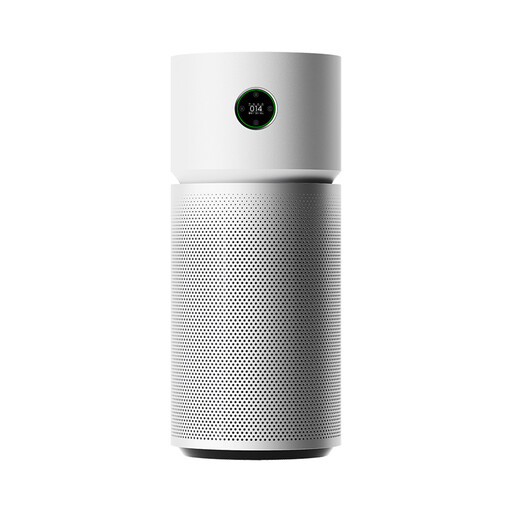
Consider this model when clean-air delivery for a larger room is your main concern. Its listing states a 600 m³/h particle CADR and coverage of up to 125 m² at two air changes per hour.
The listing also describes three-in-one filtration, PM2.5/PM10 sensing and a minimum sleep-mode noise figure of 20.2 dB(A). Check whether the airflow at a tolerable fan speed suits your room, and confirm the correct replacement filter and change interval.
 No image available
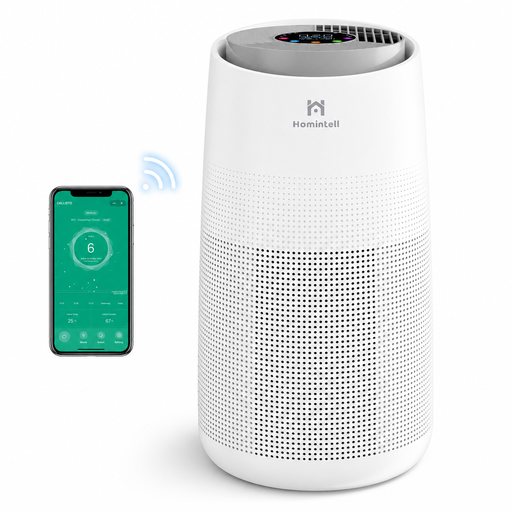
Consider this variant when you want a stated clean-air delivery figure and both particle and odour-related filtration. Its listing describes a pre-filter, H13 HEPA and activated-carbon stages, with a 300 m³/h CADR.
Check the air-change basis behind its room-coverage claim and identify the replacement filter. The product title and description give different sleep-mode noise figures, so confirm the figure and operating mode before choosing it for a bedroom.
 No image available
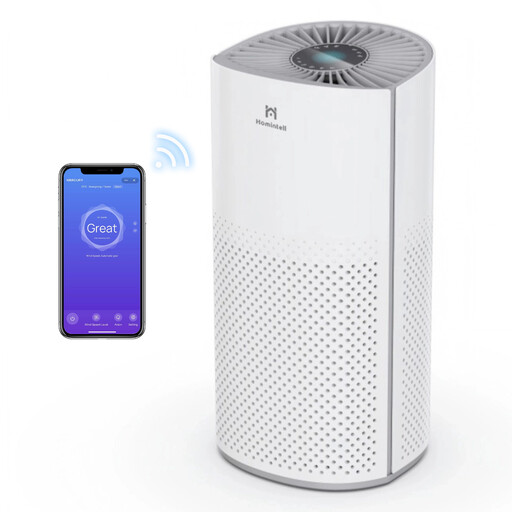
For a smaller room, this variant offers a different stated clean-air delivery figure from the 300 m³/h Homintell model. Its listing describes a 200 m³/h CADR with pre-filter, H13 HEPA and activated-carbon stages.
Confirm how the room-coverage claim was calculated and which replacement filter it takes. Its title and description also disagree on sleep-mode noise, so check the applicable figure before relying on it for overnight use.
 No image available
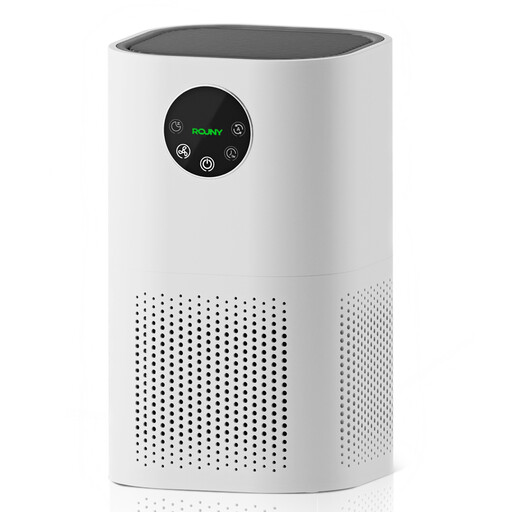
Consider this model for a room where particle filtration and a quieter operating option both matter. Its listing states a 150 m³/h CADR, H13 HEPA filtration, a pre-filter and a sleep-mode figure of no more than 25 dB.
The listed 20–50 m² coverage range needs an air-change basis before you use it to judge room fit. The listing gives a 6–8 month filter-change interval; confirm the exact replacement-filter code.
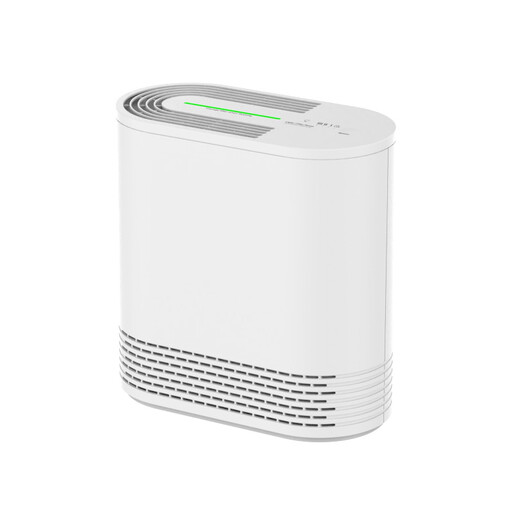 No image available
Consider this compact model for a smaller room rather than assuming it will suit a large living space. Its listing states an 85 m³/h CADR and describes a washable pre-filter, H13 HEPA and carbon stages.
The listing also gives a 25 dB noise claim and describes a sleep mode. Confirm the room match and operating mode, as well as the exact replacement-filter code; its stated typical filter-change interval is 6–8 months.
No: a portable purifier filters air passing through it, not dust that has settled on surfaces or in fabrics. Continue damp dusting and suitable vacuuming; the United States Environmental Protection Agency cautions that air cleaners cannot remove all indoor pollutants.
Start with the room where you will use it most and compare a published dust CADR with that room's dimensions. AHAM Verifide's rule of thumb calls for a CADR in cubic feet per minute of at least two-thirds of the room area in square feet for an 8-foot ceiling; a higher ceiling calls for greater capacity. Also check which fan speed you can comfortably run.
Not necessarily: regular use at a tolerable fan speed may be more practical when airborne dust is an ongoing concern in the room. Cleaning can disturb settled particles, but it remains necessary; follow the purifier's filter-maintenance instructions as well.
No: filtration is a supplementary way to address airborne particles, not a substitute for managing pollution sources and providing appropriate ventilation. The Air Quality Expert Group for Defra and the devolved UK governments identifies source reduction and increased ventilation as often-effective actions for indoor air quality.