
24/7 Customer Support

Free returns

Same-day & Next-day Delivery

Quality Guaranteed

Unlock Your Welcome Offers: FREE Delivery | Up to 80% OFF | Free 30-day JoyPlus trial
Download the APP
Dust, pollen, pet dander, cooking smells and smoke can make indoor spaces uncomfortable, particularly during colder months when windows stay closed. However, choosing an air purifier for home use is not simply a matter of selecting the highest particle-removal percentage on a product page.
Marketing descriptions often combine different measurements, room-size assumptions and optional features. The right model depends on your room, airflow needs, noise tolerance and willingness to maintain the filter. This guide explains the specifications that matter and highlights suitable options for different UK households.
Coverage figures are often calculated under specific conditions, such as a particular ceiling height and number of air changes per hour. A purifier advertised for a large room may work more slowly in an open-plan space, a room with high ceilings or an area connected to a hallway.
CADR, or Clean Air Delivery Rate, is usually more useful than coverage alone. A higher CADR means the machine can deliver filtered air more quickly, although fan speed and noise may also increase.
A HEPA air purifier can use different filter grades and designs. Several products in this guide specify an H13 HEPA filter, while the Homintell Kilo lists an H11-grade HEPA layer. These labels describe filter classifications, but real-world performance also depends on the filter’s size, sealing and the amount of air passing through it.
Do not assess a purifier from the HEPA grade alone. Check the CADR, replacement-filter availability and whether the filter is supplied with protective packaging that must be removed before use.
A low purchase price can become less attractive if replacement filters are difficult to source or need frequent changing. A washable pre-filter can capture larger dust, hair and lint, but it does not usually replace the main HEPA or carbon filter.
Before buying, check:
For a bedroom or home office, a compact unit with a lower CADR may be adequate if the door is generally closed. For a living room, pet area or larger open space, look for a higher airflow rating.
As a practical comparison:
Always compare the manufacturer’s room guidance with the room’s actual size. The Homintell Kilo is listed with a 150m³/h CADR and coverage of up to 16–18m², so it is more appropriate for a compact room than a large lounge.
A typical three-stage design combines:
This makes a three-in-one design useful for homes with pets, cooking smells or general dust. Carbon performance depends on the quantity and quality of carbon, so avoid assuming that every thin carbon layer will handle strong or persistent odours equally.
A quiet air purifier for bedroom use should have a clearly stated sleep-mode noise level, not just a general “quiet” description. The Homintell Mercury lists sleep operation as low as 20dB, while the Homintell Callisto lists 26dB in sleep mode. Maximum noise can be considerably higher.
An air purifier with air quality sensor can automatically adjust fan speed and show changing air conditions. An air purifier with app control may also offer scheduling, remote operation and filter reminders. These features are useful, but they should not distract from the core airflow and filter specifications.
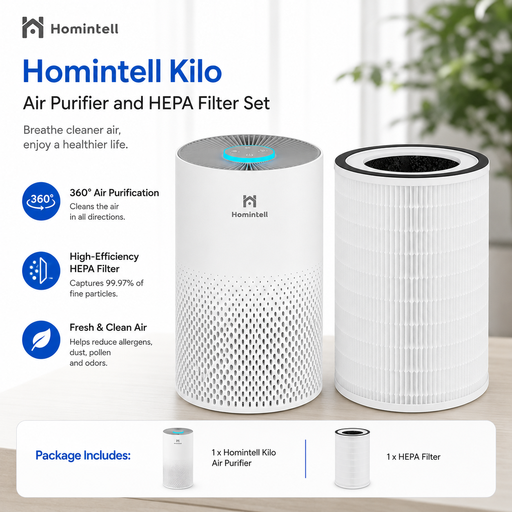
Why This Fits Their Persona: Its compact format, 23W rated power and 150m³/h CADR suit a small UK bedroom, study or enclosed office where straightforward touch controls are preferred.
The listing states both CADR and a compact-room recommendation, rather than relying only on a broad coverage claim. An extra replacement filter is included.
Three fan settings, PM2.5 sensing, an air-quality ring and 2/4/8-hour timers provide practical daily control.
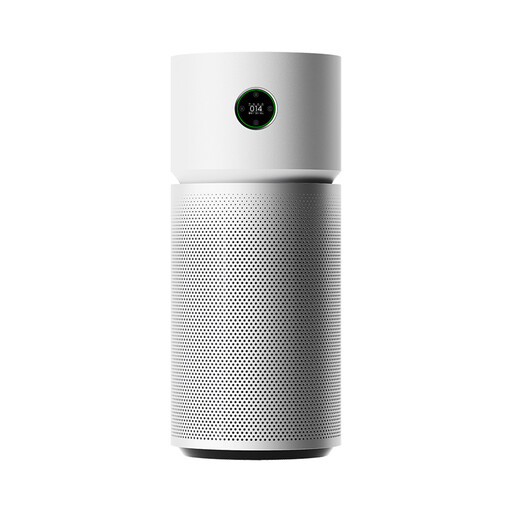
Why This Fits Their Persona: UK households wanting app and voice control, detailed sensor information and substantial airflow may prefer this larger connected model.
Its stated 600m³/h particle CADR and 592m³/h pollen CADR give more useful context than coverage alone. The listing also specifies the compatible replacement filter.
PM2.5/PM10 sensing, an OLED display, Xiaomi Home App access and a stated 20.2dB(A) minimum sleep level.
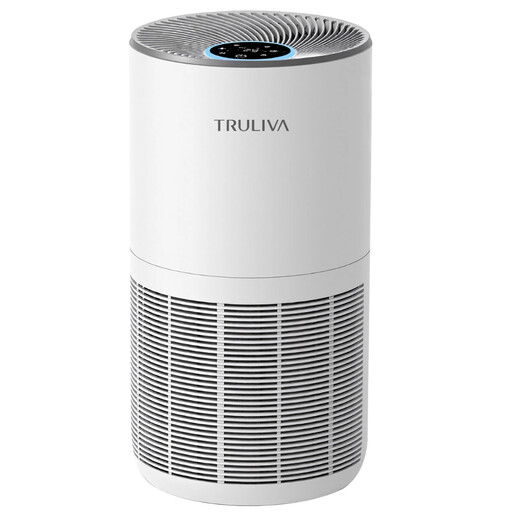
Why This Fits Their Persona: The 450m³/h CADR and stated 32–55m² working area make it suitable for larger living rooms, offices or homes with more demanding airflow needs.
It provides both CADR and a working-area range, helping buyers judge suitability without depending on a single oversized coverage statement.
H13 HEPA and activated carbon filtration, PM2.5 display, child lock and 24-hour timer.
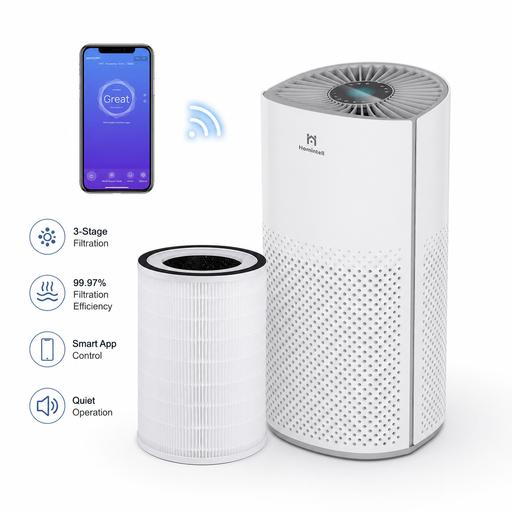
Why This Fits Their Persona: This model suits bedroom or home-office users who want Wi-Fi operation, automatic adjustment and a compact footprint for rooms up to 24–25m².
The product lists a 200m³/h CADR, a defined room range and a replacement reminder after 2,200 hours, making ongoing care easier to plan.
Wi-Fi and app control, PM2.5 indication, 360-degree air circulation and a stated sleep-mode level as low as 20dB.
We have compiled a complete, real-time list of products that fully satisfy these strict selection criteria and UK safety regulations.
Place the purifier on a stable, dry surface with clear space around the air inlet and outlet. Follow the product manual’s clearance guidance; some models specify at least 30cm, while the Xiaomi listing advises 50cm.
Before first use:
Vacuum or wash only the pre-filter where the manual permits. Do not wash a HEPA or activated carbon filter unless the manufacturer specifically says it is washable. For homes with pets, smokers or frequent cooking, inspect the filter more often than the general reminder suggests.
Running cost depends on wattage, electricity tariff and usage time. A 25W purifier running continuously uses approximately 0.6kWh per day before applying the electricity unit rate. Sleep or auto modes may reduce consumption compared with constant high-speed operation. Check the rated power and avoid running a unit larger than necessary for the room.
There is no single lifespan for every household. Many models provide a reminder based on operating hours; the Homintell Mercury and Callisto list a reminder after 2,200 hours, while other products specify different intervals. Heavy dust, smoke and pet use can shorten practical filter life. Replace the filter when prompted, visibly clogged or noticeably less effective, and use the exact compatible replacement model.
A purifier can be used overnight if the manufacturer permits continuous operation and the unit is correctly positioned. Choose a sleep mode with a stated noise level, dimmable display and suitable timer. Keep the appliance dry, unobstructed and away from bedding or curtains, and supervise children around electrical appliances.