For ordinary fabric or paper lint, choose a particle-filtering purifier whose clean air delivery rate (CADR) suits the room, with a pre-filter you can maintain and a fan setting you can tolerate while working. Compare room-coverage claims on the same air-change basis, and check replacement-filter availability for the exact model. For sanding dust, sprays or solvent vapours, a room purifier is supplementary: ventilation and capture close to the source need separate attention.
Who is this for?
Textile and fibre crafters
If sewing, cutting fabric, knitting or felting leaves fibres floating in the room, look for particle filtration and a pre-filter you can access for cleaning. Check the replacement-filter requirements as well: a purifier will not remove lint that has already settled on surfaces.
Small-room hobbyists
For a desk in a bedroom, spare room or compact studio, check both the purifier’s footprint and its noise at a fan setting that moves enough air for the room. A quiet sleep-mode figure alone does not describe how it will sound during a hobby session.
Mixed-material makers
If an activity also creates fine dust, sprays or solvent vapours, identify those materials before choosing a purifier. Health and Safety Executive guidance on workplace contaminants describes extraction close to the source; a recirculating room unit should not be treated as a replacement for suitable ventilation or source control.
What matters when choosing?
Start with the room and the material producing the lint, then check filtration, maintenance and noise at the speed you expect to use. A larger coverage figure is not automatically more useful if it assumes fewer air changes per hour.
| Concern |
What to check |
Who this matters to |
| Room airflow |
Compare particle CADR, room volume and the air-change rate behind each coverage claim. |
When lint spreads beyond my worktable, I want air to pass through the filter throughout the room; around 36% of consumers put room capacity first. |
| Lint capture and upkeep |
Check pre-filter access, cleaning instructions and the exact replacement-filter model. |
If fibres build up after regular craft sessions, I need a filter routine I can keep up with; around 29% of consumers prioritise lint capture and upkeep. |
| Noise and placement |
Compare noise by fan setting and allow the intake and outlet clear space. |
I want the purifier running while I concentrate, not switched off because it is distracting; around 21% of consumers put quiet operation first. |
| Other airborne contaminants |
Identify any sanding dust, sprays or vapours and check the material’s safety instructions and suitable source controls. |
When a project creates more than lint, I need to address what happens at the work surface as well as in the room; around 14% of consumers put mixed-pollutant control first. |
Buying pitfalls
-
Comparing coverage figures with different air-change rates
A quoted area at one air change per hour does not promise the same cleaning frequency as that area at two air changes per hour. Levoit, for example, specifies the Core 300 at 40 m² for two air changes per hour and the Core 600S at 147 m² on that basis.
Compare CADR and the stated air-change basis for each exact model before deciding whether its coverage fits your room.
-
Judging working noise by sleep mode
A low figure for sleep mode does not tell you how loud a purifier will be at the setting needed to move more air during or after a craft session.
Check which fan setting each noise figure describes and compare it with the airflow you intend to use.
-
Leaving filter replacement until later
Lint-producing sessions make access to the pre-filter and the main filter’s maintenance instructions relevant to everyday use.
Find the replacement-filter code for the exact purifier and check how its pre-filter should be cleaned before buying.
Allow time for pre-filter cleaning and periodic filter changes.
-
Relying on a room purifier for sanding dust or vapours
A purifier filters air that reaches it; it does not capture every contaminant as it is generated. Health and Safety Executive guidance describes local exhaust ventilation for controlling workplace dust, fumes and vapours close to their source.
Assess the task and material first. Follow its safety instructions and use appropriate ventilation or source capture rather than relying solely on a recirculating purifier.
Brands to consider for hobby-room use
Levoit
Levoit has compact and higher-airflow purifier lines with published model-level airflow and coverage figures.
- Levoit specifies a CADR of 187 m³/h for the Core 300 and 697 m³/h for the Core 600S. Its Core 300S product page describes a primary filter for dust, pet fur and lint.
- These are manufacturer specifications and descriptions, not independent measurements of hobby-room lint removal. Compare the air-change basis, operating noise and replacement filter for the model you choose.
Philips
The Philips 1000i AC1715/30R1 is a medium-room example with published airflow and filtration details.
- Philips lists a 300 m³/h CADR and HEPA plus activated-carbon filtration for this model.
- The cited AC1715/30R1 page describes a refurbished product. Check its condition, warranty and compatible replacement filter; do not apply this model’s specifications to other Philips purifiers.
Dyson
Dyson’s TP09 purifier-fan is relevant when the question extends beyond lint to gases or odours.
- Dyson describes the TP09 as combining HEPA H13 and activated-carbon filtration with formaldehyde-focused features.
- Those product claims do not establish that it is the right choice for lint alone or a substitute for ventilation. Check airflow, noise, physical fit and replacement-filter requirements against your actual task.
Joybuy air purifiers for hobby rooms
These particle-filtering purifiers span compact and higher stated-airflow options for rooms where lint is a concern. Use their listed figures as starting points, then check coverage conditions, working noise and filter maintenance for the model that fits your room.
 No image available
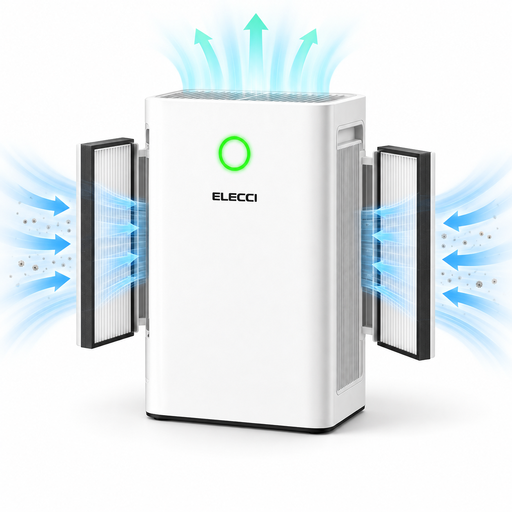
ELECCI Dual-HEPA Filter Air Purifier, 550 m³/h CADR
Consider its stated airflow if your hobby room needs a higher-capacity option. The product name lists dual-HEPA filtration, a 550 m³/h CADR and coverage of up to 48 m² or 120 m³; check how those coverage figures relate to your room and the intended fan speed.
Check noise at that speed and identify the compatible replacement filter before buying.
View on Joybuy
 No image available
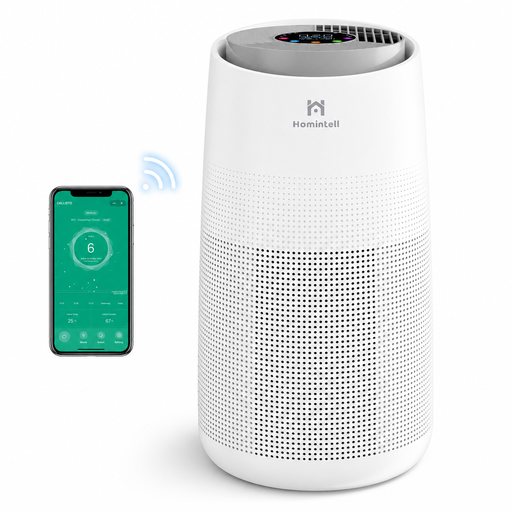
Homintell Smart Air Purifier, 300 m³/h CADR
This is another option to assess where room airflow and particle filtration are priorities. Its product name lists a 300 m³/h CADR, H13 HEPA and activated-carbon filtration, Wi-Fi control and a stated 36 m² room size.
Check the air-change basis behind that room size, noise at your intended setting and the compatible replacement filter.
View on Joybuy
 No image available
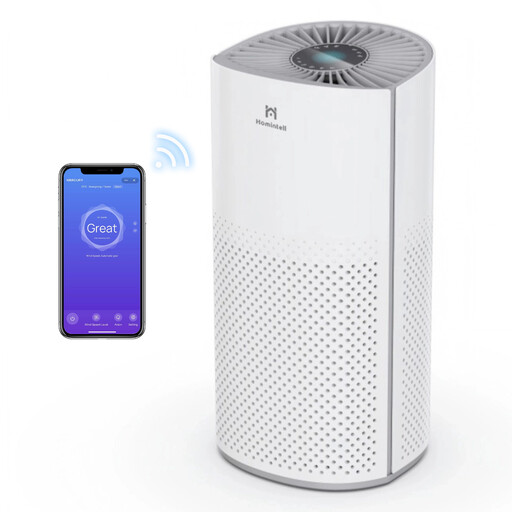
Homintell Smart Air Purifier, 200 m³/h CADR
For a smaller hobby room, compare its stated airflow and footprint with the space available. The product name lists a 200 m³/h CADR, H13 HEPA and activated-carbon filtration, Wi-Fi control and coverage of 25 m².
Check which coverage figure applies to this model, the air-change basis and noise at the setting you would use; also confirm the replacement-filter model.
View on Joybuy
 No image available
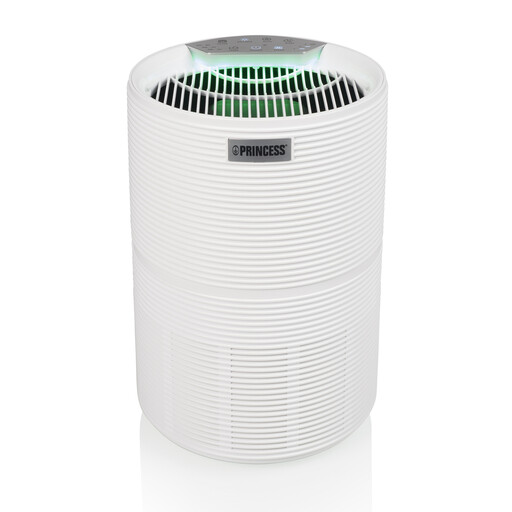
Princess Smart Air Purifier 160
Consider this model if app control matters alongside particle filtration. Its product name lists a 160 m³/h CADR, H13 HEPA filter, air-quality sensor and coverage of 55 m².
Check the air-change basis behind that coverage claim, noise at the airflow you need and the compatible replacement filter.
View on Joybuy
 No image available
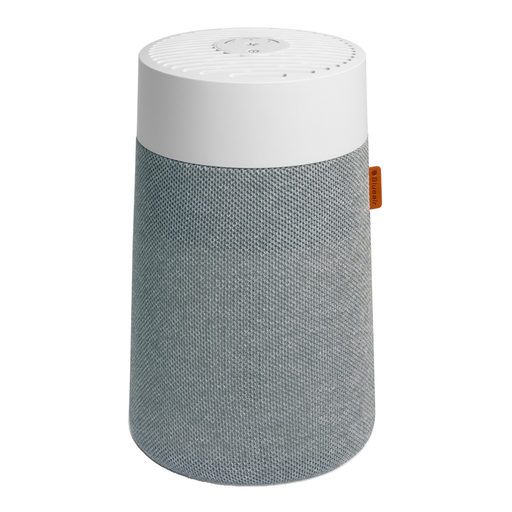
Blueair Blue Pure Mini Max Air Purifier, Grey, 111524
Its compact format makes it worth assessing for a smaller hobby room. The product name states coverage of up to 20 m².
Before choosing it for regular lint-producing sessions, check the airflow and air-change basis for your room, how the pre-filter is maintained and which replacement filter fits.
View on Joybuy
Common questions
Will an air purifier remove all the lint in my hobby room?
No: it can filter airborne particles that pass through it, but you will still need to clean lint settled on surfaces, fabric and equipment. The Borough Council of King's Lynn & West Norfolk advises damp dusting and regular vacuuming alongside considering a HEPA purifier for airborne dust.
Should I prioritise HEPA filtration, a pre-filter or CADR?
Check all three for different reasons: particle filtration addresses airborne dust and fibres, a pre-filter can intercept larger debris, and CADR helps you assess clean-air airflow. When comparing coverage claims, check that they use the same air-change rate rather than relying on room area alone.
Can a purifier replace ventilation or extraction for dusty crafts?
No. UK government guidance says air cleaners are not a substitute for ventilation, while Health and Safety Executive guidance describes local exhaust ventilation as a way to capture workplace contaminant clouds near their source. For sanding, spraying or solvent-based tasks, assess the material and use suitable controls rather than relying on a domestic room purifier alone.
How often should I replace the filter?
Follow the instructions for the exact purifier and filter, because the interval depends on the model and conditions of use. Levoit recommends a 6–8 month replacement interval for the Core 300 and Core 300S; check the applicable manual and filter indicator rather than treating that interval as a rule for other models.


