Pet households with large or open-plan rooms
If the purifier must clean air across a spacious living area, room volume and stated airflow matter more than a floor-area figure on its own. Include connected spaces when assessing an open-plan room.


Choose an air purifier by comparing its stated clean-air delivery rate (CADR) with the full volume of your living room, rather than relying on a maximum floor-area claim alone. For airborne pet dander, look for a specified particle filter, then check whether the airflow you need is tolerable during everyday use and whether replacement filters are available. A purifier may reduce airborne allergen exposure, but it does not replace cleaning and other ways of managing pet allergens.
If the purifier must clean air across a spacious living area, room volume and stated airflow matter more than a floor-area figure on its own. Include connected spaces when assessing an open-plan room.
Allergy UK explains that pet allergy involves proteins from saliva, urine or dander, not just visible hair. A particle-filtering purifier addresses the airborne part of the problem; cleaning and other allergen-control measures still matter.
For conversation, television or home working in the living room, compare noise at a useful cleaning speed as well as the quietest setting. Check the exact replacement filter and its stated maintenance interval before choosing a model.
Work out the air volume the purifier needs to serve, then assess particle filtration and the settings you would actually use while pets are in the room.
| Concern | What to check | Who this matters to |
|---|---|---|
| Room-size fit | Measure length, width and ceiling height, including connected open-plan space. Compare the resulting volume with stated CADR and the time or air-change basis of any coverage claim. | I need the purifier to serve the whole living room, not just the seating area; around 50% of consumers put room-size fit first. |
| Airborne pet particles | Look for a clearly specified particle-filter stage and sufficient airflow. Treat a hair-catching pre-filter or an odour-focused carbon stage as a separate feature. | Visible hair is not my main concern when pet allergens can remain airborne; roughly 30% of consumers make particle filtration their primary need. |
| Everyday operation | Compare noise at the fan setting needed for your room, and check the exact replacement filter and its stated interval. | I want to keep the purifier running without disrupting conversation or losing track of filter changes; about 20% of consumers prioritise day-to-day usability. |
The same airflow produces fewer air changes in a larger volume. Coway UK illustrates this in its air-changes guidance: a stated coverage area is most useful when its cleaning-time or air-change basis is clear.
Measure the full room, including connected open-plan space, and compare CADR alongside the basis used for each coverage claim.
Allergy UK identifies proteins in pet saliva, urine and dander as causes of pet allergy. Catching larger debris alone does not establish how a purifier handles airborne particles.
Check the specified particle filter and airflow, while continuing to clean furnishings, floors and pet bedding.
A quiet-mode figure describes that setting, not necessarily the fan speed needed to clean a large room while a pet is present.
Compare published noise figures across operating speeds and relate them to the airflow available at those speeds.
Filters are model-specific, and manufacturer-stated replacement intervals vary with the product and its use.
Identify the exact replacement filter, check its availability and follow the model's maintenance instructions.
These brands offer useful model examples for comparing published specifications; a brand name alone does not establish fit for your room.
The UK Airmega 150 listing provides a model-specific example of how airflow, filtration and operating figures can be presented together.
Blueair describes its Blue Pure 211i Max as a model for large homes and open living spaces.
Levoit's UK Vital 200S line is another model family to assess for a pet household.
These particle-filtering models offer different stated airflow and maintenance details to compare for a pet household. Check each one against your living room's full volume; inclusion here does not establish that it is large enough for your particular space.
 No image available
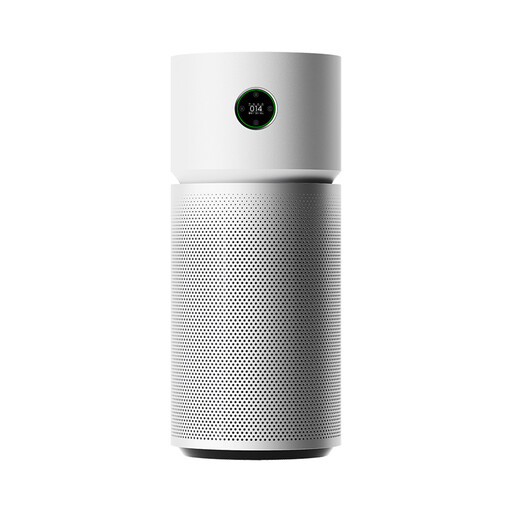
Consider this model when stated airflow and the basis of a large-room claim are priorities.
The listing states a particle CADR of 600 m³/h, HEPA filtration and activated carbon. Its coverage claim of up to 125 m² assumes two air changes per hour and a 2.4 m ceiling; compare that basis with your actual room volume.
The stated noise runs from 20.2 dB(A) in sleep mode to 68 dB(A). Check noise at the setting you would need and confirm the replacement-filter interval and availability.
 No image available
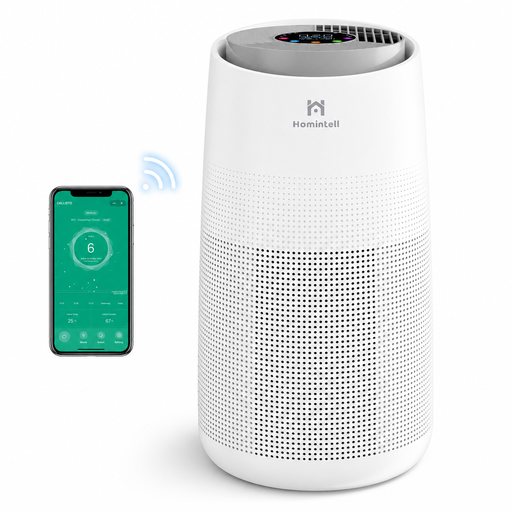
This is a particle-filtering option to assess if its stated output can serve your measured living-room volume.
The listing specifies 300 m³/h CADR, an H13 HEPA filter, a pre-filter and activated carbon. Its 36 m² coverage claim needs an air-change or cleaning-time basis before it can be used to judge large-room fit.
Sleep mode is stated as 26 dB; check noise at a useful cleaning speed and identify the replacement filter. The listing also advises against looking directly at its UV light and tells people with a pacemaker or other medical implant to consult a physician before using the ioniser.
 No image available
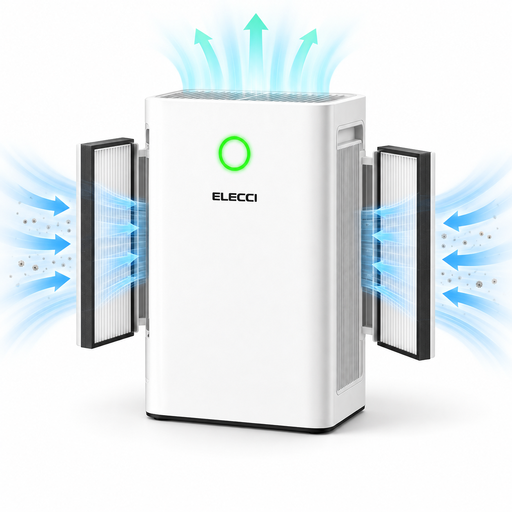
Compare this model if clean-air output is central to your large-room decision.
Its title states 550 m³/h CADR, while the listing describes dual HEPA layers and a washable pre-filter. The stated coverage is up to 48 m² (120 m³), but assess the claim against your room volume and its air-change basis.
The listing gives 24 dB for sleep mode and 69 dB as another noise figure; check the sound level at an everyday cleaning speed. Confirm the replacement-filter details and UK plug and conformity information before purchase.
 No image available
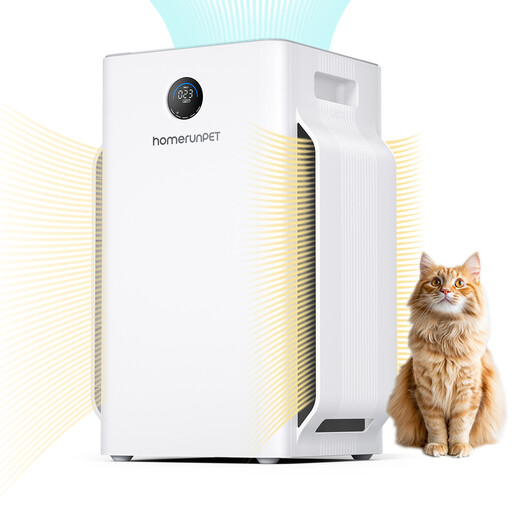
This pet-oriented model is worth assessing if particle filtration and filter maintenance are important to you.
The listing specifies a True HEPA filter, a washable pre-filter and coverage up to 40 m². Confirm its CADR and the air-change basis of that coverage before relying on it for a large living room.
The stated composite-filter interval is 6–12 months, depending on use, and the 25 dB noise figure applies to sleep mode. A dedicated deodorisation filter is described as optional; check whether it is included if odour control matters to you.
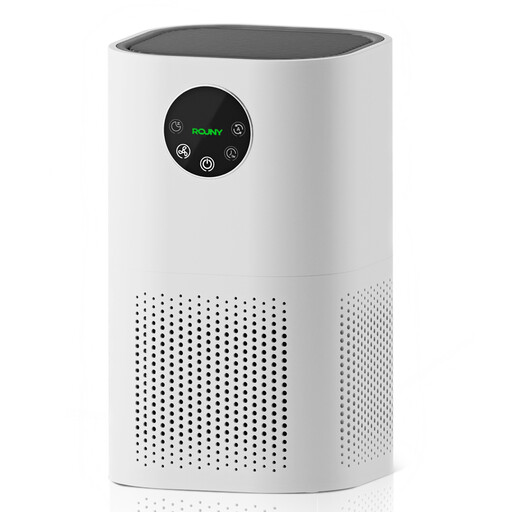 No image available
Assess this model by its stated airflow rather than assuming its coverage range will suit every large room.
The listing gives 150 m³/h CADR, H13 True HEPA filtration and a 20–50 m² coverage range. Compare CADR with the full room volume, particularly if the space is open-plan.
The stated filter interval is 6–8 months; identify the exact replacement filter and check its availability. Noise is listed as no more than 25 dB in sleep mode and no more than 52 dB at high speed.
Calculate the volume from the room's length, width and ceiling height, including connected open-plan space, then compare it with the purifier's stated CADR and coverage basis. As Blueair's room-sizing guidance explains, ceiling height changes the amount of air in a room; floor-area claims alone can therefore obscure an important difference.
For airborne dander, prioritise a specified particle filter and enough airflow for the room. A pre-filter can catch larger debris, but Allergy UK explains that pet allergy involves proteins from saliva, urine and dander rather than visible hair alone.
No: it may reduce airborne pet allergens, but it does not remove their source. University Hospitals Coventry and Warwickshire NHS Trust discusses air filtering alongside broader avoidance measures, while Asthma + Lung UK notes that evidence for reductions in asthma symptoms is less clear.
Follow the instructions for the exact filter and model, because intervals differ and depend on use. Coway UK states a one-year life expectancy for the Airmega 150 HEPA and carbon filters; Blueair says its 211i Max SmokeBlock replacement filter can last up to nine months, depending on usage. Check that the replacement specified for your chosen model is available.