For airborne lint, choose a purifier with a pre-filter you can maintain and a declared clean air delivery rate (CADR) suited to the room where you will use it. A particle-filter stage can address finer airborne material, but a purifier cannot collect lint already settled on bedding, floors or furniture; cleaning those surfaces remains part of the job.
Who is this for?
Households managing textile lint or pet hair
If fibres build up around clothing, bedding, upholstery or pet areas, an accessible pre-filter makes routine care easier to plan. Blueair, for example, advises cleaning its fabric pre-filter when dust builds up.
Bedroom and small-room users
For a bedroom, home office or craft area, compare declared airflow with the room and the speed you expect to use. Levoit gives different coverage figures for the Core 300 depending on how many air changes per hour are assumed.
Households concerned about other particles
If dust, dander or other airborne material matters alongside lint, check the particle-filter stage as well as the pre-filter. Allergy UK notes that indoor allergens can be present both in the air and on furnishings.
What matters when choosing?
Start with the room and its airflow requirement, then check how you will maintain the pre-filter and run the purifier day to day. A maximum room-area claim is less useful without its operating conditions.
| Concern | What to check | Who this matters to |
|---|
| Airflow for the room |
Compare declared CADR in m³/h with your room dimensions, and check the air-change basis behind any coverage claim. |
If lint moves around a larger or open-plan room, I need airflow suited to that space rather than a maximum-area figure alone. Around 36% of consumers put room capacity first. |
| Pre-filter maintenance |
Identify the outer pre-filter, its permitted cleaning method and the compatible replacement filter. |
When fibres or pet hair collect at the intake, I want a filter I can reach and care for as instructed. For around 29% of consumers, managing that build-up is the primary concern. |
| Long-running use |
Check sound levels at the speed you intend to use and allow room for an unobstructed intake. |
A bedroom or workspace purifier needs to be comfortable to run for long periods, not just acceptable at its lowest setting. Low-disruption use comes first for around 21% of consumers. |
| Wider particle concerns |
Check the particle-filter stages and distinguish airborne material from lint or dust already settled on furnishings. |
If dust or dander worries me as well as lint, I want to understand what the filter addresses without giving up surface cleaning. Around 14% of consumers place this wider particle concern first. |
Buying pitfalls
-
Choosing by maximum room area alone
A coverage figure depends on its air-change assumptions. Levoit states that the Core 300 covers up to 80 m² at one air change per hour, or 40 m² at two.
Measure the room, compare declared CADR and check the conditions behind the stated coverage before deciding whether the airflow suits you.
-
Expecting a purifier to clean settled lint
A purifier filters material that reaches its intake; lint remaining on textiles or furniture still needs attention. Allergy UK distinguishes allergens in the air from those on furnishings.
Keep cleaning lint-producing textiles and surfaces alongside using the purifier, and clear the outer pre-filter as its instructions require.
-
Cleaning every filter layer the same way
Blueair advises vacuuming its fabric pre-filter when dust builds up, but says its particle-and-carbon filter should not be vacuumed or washed.
Find the instructions for the exact model and identify which layer can be cleaned before touching the main filter.
-
Overlooking replacement filters
Filter care continues after the appliance is bought. Dyson recommends replacing the Purifier Cool PC1 combined HEPA-and-carbon filter every 12 months; that interval applies to that filter, not to every purifier.
Check the replacement part, current availability and manufacturer guidance for the model you are considering.
Brands to consider for these features
Levoit
The Core 300 provides a compact-model reference point for comparing declared airflow and coverage conditions.
- Levoit states a CADR of 187 m³/h for the Core 300.
- Its stated 80 m² and 40 m² coverage figures assume one and two air changes per hour respectively; neither describes every room or fan setting.
Philips
The AC1715/30R1 is a medium-room option for comparing declared airflow and filter stages.
- Philips lists a 300 m³/h CADR, HEPA and active-carbon filtration, and Air+ app connectivity for this model.
- The cited AC1715/30R1 listing is for a certified refurbished unit; check the condition, warranty and filter status of any individual offer.
Dyson
The Purifier Cool PC1 combines a purifying appliance with a fan for consumers who want both functions.
- Dyson specifies a combined HEPA-and-carbon filter for the PC1.
- Dyson recommends replacing that filter every 12 months; check whether the fan format and replacement routine suit your room.
Blueair
Blueair’s fabric pre-filter guidance is useful when visible fibres tend to build up around a purifier.
- Blueair advises vacuuming its relevant fabric pre-filter when dust accumulates.
- Blueair says the associated particle-and-carbon filter should not be vacuumed or washed. Confirm the care instructions for the exact model.
Joybuy air purifiers
These models offer different approaches to room airflow, pre-filter care and everyday controls. Check each model’s stated conditions and filter instructions against the room where lint is generated.
 No image available
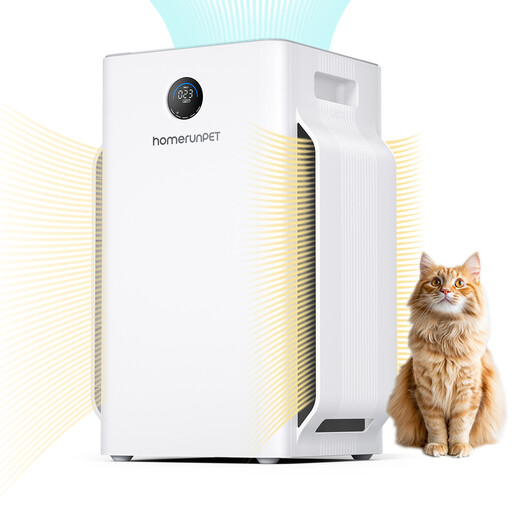
homerunPET D1 Air Purifier
Consider this model if you are comparing purifiers for an area where pet hair or textile fibres collect near the intake. Its title identifies a six-sided, U-shaped airflow channel; confirm the pre-filter care instructions and declared airflow for your room before choosing it.
View on Joybuy
 No image available
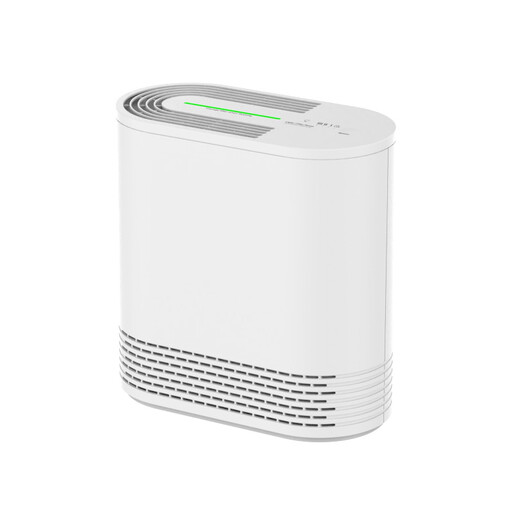
Lavieair K01 Air Purifier
For a smaller room, this model gives you a declared airflow figure to compare with the space. Its title states an 85 m³/h CADR, a washable pre-filter, H13 HEPA filtration, three speeds, sleep mode and a night light; check the cleaning instructions for the exact filter.
View on Joybuy
 No image available
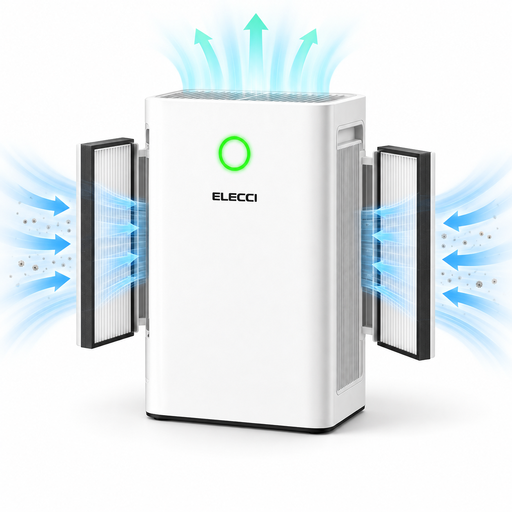
ELECCI Dual-HEPA Air Purifier
If room airflow is your priority, compare this model’s stated figures with the speed you plan to use. Its title advertises dual HEPA filtration, coverage up to 48 m² and an eight-hour timer; confirm the CADR unit and the conditions behind the coverage figure before relying on them.
View on Joybuy
 No image available
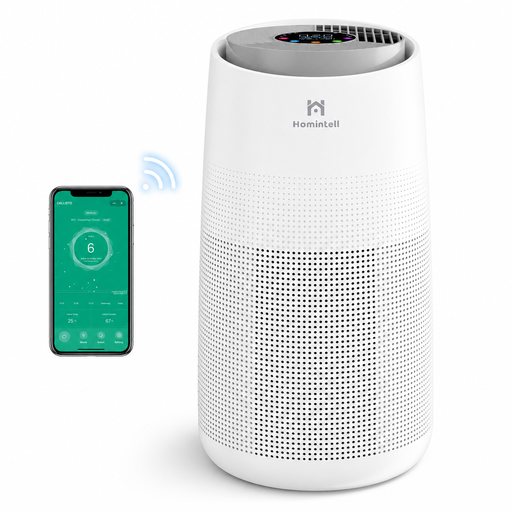
Homintell Smart Air Purifier, 300 m³/h CADR
For a room where declared airflow and connected controls matter, this model is worth comparing with your room dimensions. Its title lists a 300 m³/h CADR, 36 m² coverage, H13 HEPA and activated-carbon filtration, Wi-Fi control and an eight-hour timer; check pre-filter care before buying it for frequent lint build-up.
View on Joybuy
 No image available
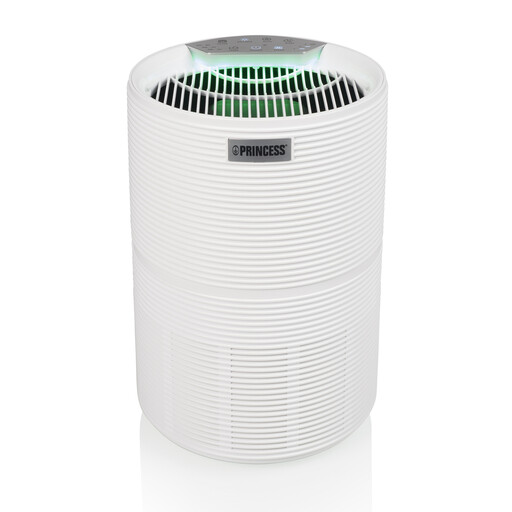
Princess Smart Air Purifier 160
Consider this model if you want a declared airflow figure alongside app controls. Its title lists a 160 m³/h CADR, coverage up to 55 m², H13 HEPA filtration, an air-quality sensor and an eight-hour timer; check the coverage conditions, operating noise and pre-filter care for your intended room.
View on Joybuy
Common questions
Will an air purifier remove lint already on carpets or bedding?
No. A portable purifier filters material that becomes airborne and passes through it, so continue cleaning the surfaces and textiles where lint collects. Allergy UK also distinguishes indoor allergens in the air from those on furnishings.
Do I need a HEPA filter if visible lint is my main concern?
Start by checking whether the purifier has an accessible pre-filter for larger fibres, then consider its particle-filter stage if finer airborne material also matters. A HEPA stage does not remove lint that has already settled on surfaces.
Can I vacuum or wash every purifier filter?
No. Cleaning rules depend on the model and filter layer: Blueair advises vacuuming its relevant fabric pre-filter when dust builds up, but says its particle-and-carbon filter should not be vacuumed or washed. Check the instructions for your exact filter.
How often do air-purifier filters need replacing?
Replacement intervals depend on the specific filter and its use. Dyson recommends every 12 months for the Purifier Cool PC1 combined HEPA-and-carbon filter, while Levoit recommends every 6–8 months for its Core 300 pet-allergy replacement filter; follow the guidance for the filter you actually buy.


