
24/7 Customer Support

Free returns

Same-day & Next-day Delivery

Quality Guaranteed

Unlock Your Welcome Offers: FREE Delivery | Up to 80% OFF | Free 30-day JoyPlus trial
Download the APP
Buying an air purifier can seem straightforward until you compare CADR figures, HEPA grades, room-size claims and replacement-filter costs. A compact bedroom air purifier may be unsuitable for an open-plan lounge, while a powerful unit can be unnecessarily noisy or expensive to run in a small office.
The following guide explains the specifications that matter, highlights common buying traps and matches selected products to practical household needs.
Manufacturers may quote coverage in square metres, cubic metres or square feet, but these figures are not always calculated in the same way. A purifier’s CADR (Clean Air Delivery Rate) is a more useful comparison because it indicates how quickly filtered air is delivered.
For example, a unit rated at 85m³/h, such as the Lavieair K01, is more suited to a bedroom or small office than a large open-plan space. A model with a CADR of 260m³/h or 300m³/h may move more air, but its actual performance still depends on ceiling height, doors, windows and fan speed.
“HEPA” describes a filter type, but product listings can vary in how clearly they state the grade, testing conditions and particle size. An H13 HEPA air purifier is commonly selected for fine airborne particles, while H12 or H11 filters may be used in other products.
Look for a clearly stated filtration system, such as pre-filter + HEPA filter + activated carbon filter. The pre-filter catches larger dust and hair, the HEPA layer handles finer particles, and activated carbon is intended for some household odours and gases. No filter should be treated as a complete solution for every indoor pollutant.
A low purchase price can become less attractive if the compatible air purifier replacement filter is difficult to find or costly. Washable pre-filters can usually be cleaned according to the manual, but the main HEPA and carbon layers generally have a limited service life.
Check whether the product has a filter reminder, what replacement interval is suggested and whether the exact model number is stated for compatible filters. Never wash a filter unless the instructions specifically say it is washable.
Use CADR to compare airflow between products. As a practical starting point:
These are comparison points rather than fixed guarantees. Keep doors and windows closed when using an air purifier for a specific room, and leave clear space around the air inlet and outlet.
For general household use, a three-stage filter is a sensible configuration. A washable pre-filter is useful in pet-owning homes because it can collect larger particles such as hair and lint before they reach the main filter.
An activated carbon filter can help manage certain household odours, including cooking or smoke odours, but its performance depends on the amount and quality of carbon. Check the replacement instructions rather than relying on broad claims about “removing everything”.
A quiet air purifier can be more practical in a bedroom or home office. Look for a stated sleep-mode noise figure, but remember that the quietest rating normally applies at the lowest fan speed. Higher speeds will generally be more audible.
Timers, child locks, air-quality indicators and auto modes can make daily use easier. A smart air purifier with Wi-Fi or app control may suit users who want remote scheduling, while a simple control panel can be preferable if you want fewer connected features and less setup.
Electricity use depends on power rating, fan speed and operating time. A 15W or 25W model may use less electricity at its rated input than a 60W model, but the actual cost depends on how often and at which speed it operates.
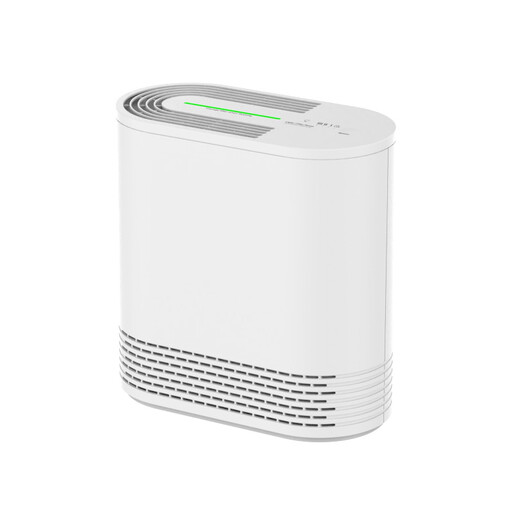
Why This Fits Their Persona: Its 85m³/h CADR is aimed at bedrooms, small rooms and home offices, where a compact footprint and straightforward controls are practical for everyday use.
The stated CADR gives a clearer indication of scale than a broad room-size promise. Its washable pre-filter also makes routine maintenance more manageable.
3-in-1 filtration, three fan speeds, sleep mode, night light and filter replacement reminder.
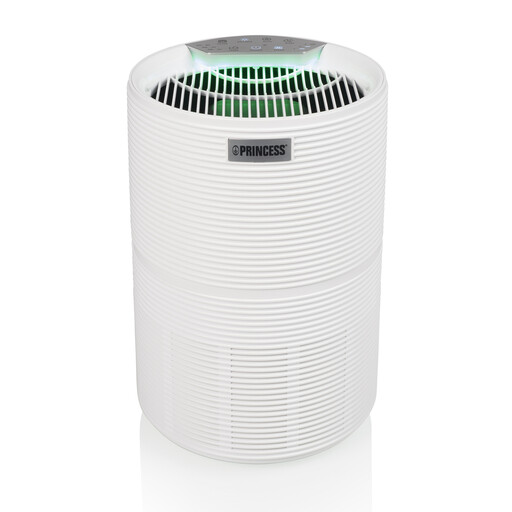
Why This Fits Their Persona: App and voice-control compatibility suits connected UK homes where scheduling and remote adjustment are useful.
It states both CADR and filtration layers, rather than relying only on a headline coverage figure.
160m³/h CADR, H13 HEPA and activated carbon filtration, air-quality indicator, temperature and humidity display and a 2-year manufacturer’s warranty.
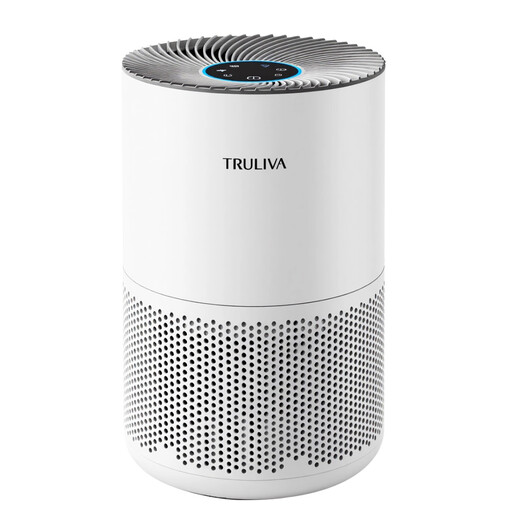
Why This Fits Their Persona: The higher CADR is suited to larger living areas, offices and households dealing with pets, smoke or frequent indoor activity.
Its specification includes a measurable CADR and a stated four-stage filter arrangement, helping buyers assess airflow and maintenance more realistically.
260m³/h CADR, H13 HEPA filtration, timer, child lock and a listed sleep-mode noise level of 24dB.
Existing owners should match the filter to the purifier’s exact model number. Examples include the TRULIVA replacement filter for KJ260, the Blueair FMINI replacement filter for Blue Pure Mini Max, and the Blueair F5MAX replacement filter for Blue Pure 511i Max.
A washable fabric pre-filter, such as the Blueair pre-filter for the Blue Pure 511i Max, is a separate component from a washable main filter. Confirm which part needs cleaning and which part must be replaced. Filters for pet households, including composite pre-filter, H13 HEPA and activated carbon designs, should be checked for the correct purifier before ordering.
We have compiled a complete, real-time list of products that fully satisfy these strict selection criteria and UK safety regulations.
Many households run a purifier for several hours daily, increasing the fan speed during cooking, cleaning or periods of poorer indoor air quality. Auto mode can adjust airflow on models with a suitable sensor. Follow the manufacturer’s instructions and avoid blocking the air inlet or outlet.
The interval varies with usage, dust levels, pets and smoking. Some products specify approximately 6–8 months, while others suggest 6–12 months or around 12 months. Use the filter reminder where available, inspect the filter and follow the product manual rather than relying on a universal timetable.
Running cost depends mainly on the appliance’s wattage, selected speed and daily operating time. A lower-power bedroom air purifier may use less electricity, while a higher-CADR model can require more power at maximum speed. Compare the rated wattage and choose a size appropriate for the room rather than running an oversized unit unnecessarily.