Sofa-side airflow planners
If a sofa arm or backrest obstructs a low fan, you need to check whether the fan can aim above or across the seating area without holding a direct stream on one person.


Choose an air circulator that can stand securely near the sofa and direct air across or above the seating area, rather than relying on an airflow claim alone. Adjustable height and directional control matter when furniture obstructs the air stream; if you watch television or talk nearby, also check noise at the speed you expect to use. Allow room for the base and cable, and confirm the exact model’s electrical rating and plug before buying.
If a sofa arm or backrest obstructs a low fan, you need to check whether the fan can aim above or across the seating area without holding a direct stream on one person.
If you read, watch television, talk or work from the sofa, usable low-speed control and the sound at that setting matter alongside airflow.
If the fan will move between a table and a floor-standing position, check its height options and whether each position has a stable place in the room.
Work out where the fan can stand and aim first; then assess the sound, controls and practicalities of using it beside the sofa.
| Concern | What to check | Who this matters to |
|---|---|---|
| Airflow placement | Compare usable height with the sofa arm and backrest; check tilt and whether vertical movement is manual or automatic. | I want air to pass around the seats, not strike the sofa base or blow continuously at one person. Around 36% of consumers put airflow placement first. |
| Sound during use | Check which speed any stated noise figure describes, and look for sound and airflow assessed together where independent testing is available. | Conversation or television should not require me to turn the fan off whenever I need more airflow. Quiet operation comes first for around 29% of consumers. |
| Changing room use | Check table and standing heights where applicable, plus whether the remote or timer would be useful from the sofa. | I may move the fan to another position and want controls I can use without repeatedly getting up. Around 21% of consumers prioritise that flexibility. |
| Safe placement and upkeep | Check the exact model’s electrical rating and plug, a clear route for the cable, and the cleaning instructions. | A freestanding fan and its cable will sit near a regularly used walkway, so I need a position that avoids pulling or tripping. Safe placement and upkeep are the primary concern for around 14% of consumers. |
A low-mounted fan may direct air into the sofa base, while a fixed direction may concentrate the breeze on one seat.
Check the proposed position against the sofa arm and backrest. Compare usable height, tilt and oscillation, including whether vertical movement is manual or automatic.
A manufacturer’s low-noise figure may describe a low setting rather than the setting you would use for stronger airflow.
Check the speed and conditions attached to a decibel figure. Which? assesses fan noise and wind speed separately, which can help when comparing how a fan sounds while moving air.
One HOMCOM listing states 220–240 V, 60 Hz, whereas UK electricity distribution uses 50 Hz. The discrepancy does not establish whether that exact fan is suitable for UK use.
Before buying that model, obtain its rating label, manual or manufacturer confirmation covering 50 Hz use, and check the supplied plug.
A timer can stop a fan after a chosen period, but it does not address placement, cable condition or faults. Electrical Safety First advises against leaving electric fans running overnight or while nobody is home.
Switch off and unplug the fan when it is not in use. Stop using it if the unit or cable is damaged, smells of burning or makes unusual noises.
These product lines illustrate different height and control options; check the exact model rather than assuming that every fan from a brand has the same features.
A reference point for adjustable pedestal placement beside a sofa.
Pedestal and convertible models for consumers who want to adjust airflow from their seat.
Pedestal circulators with directional movement and controls intended for floor-standing use.
A fixed-height pedestal option for consumers who need basic directional adjustment.
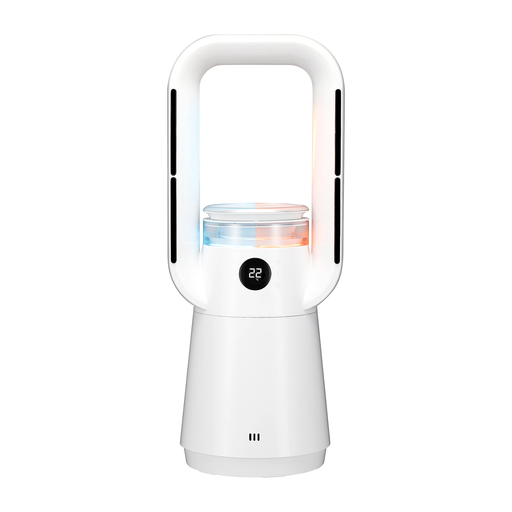
This multifunction air circulator offers oscillation for a nearby seating area. Check whether its height and airflow direction suit your particular sofa.
 No image available
Consider this model if you want an oscillating cooling fan near the sofa and would use its other stated appliance functions.
The product name specifies 65° oscillation and an included HEPA filter.
Before buying, check whether its height and vertical aiming suit the seating position, how it sounds at your intended fan setting, and the exact model’s UK electrical rating and plug.
Choose an adjustable-height pedestal circulator if the air needs to clear a sofa arm or backrest and there is room for its base. A desk circulator may work on a secure nearby surface, but check its height and aim; Electrical Safety First notes that pedestal fans take up significant room space.
Electrical Safety First advises against leaving an electric fan running overnight or while nobody is home. Use a timer to control a period of attended use, not as a substitute for switching the fan off when it will be unattended.
Place the cable where it will not be tripped over, pulled by a child or chewed by a pet, and keep the fan where it is unlikely to be knocked over. Electrical Safety First also advises against overloading extension leads, cable reels and block adaptors.
Check the exact fan’s rating label for a suitable voltage and frequency, the supplied plug and its instructions before buying. A marketplace title alone cannot resolve a conflict such as a listing that states 60 Hz for a fan intended for use with the UK’s 50 Hz electricity supply.
Keep your proof of purchase and register the fan if the manufacturer offers registration. Electrical Safety First says registration can help owners receive recall information and arrange repairs or replacements.