What matters when choosing?
For consumers seeking to reduce airborne household dust in a large living room, start with room-wide clean-air output, then decide which filter features and everyday operating demands matter most to you.
| Concern |
What to check |
Who this matters to |
| Room-wide clean-air output |
Measure floor area and ceiling height. Compare CADR figures for the same particle category and test basis, and check the air-change rate behind room-area claims. |
If my living room is spacious, I need to know whether the purifier can clean its air at the frequency I want. Around 36% of consumers put adequate room-wide output first. |
| Dust-focused filtration |
Check the model’s particulate filter and any pre-filter for larger debris; look for a dust-specific CADR where one is published. |
When airborne household dust is my main concern, I want a clearly specified path for larger debris and finer particles. Dust-focused filtration comes first for around 29% of consumers. |
| Noise and automatic operation |
Check noise at the fan speed needed for the room, not just in sleep mode, and whether sensing or scheduling offers the control you want. |
I am more likely to keep a purifier running in a shared living space if its controls need little attention and its working speed is tolerable. Around 21% of consumers put everyday operation first. |
| Filter upkeep and other pollutants |
Confirm the exact replacement filter and recommended interval. Consider carbon or formaldehyde-focused filtration only if those pollutants are part of your brief. |
Before choosing a model, I want to know what replacing its filter involves, or whether it addresses concerns beyond dust. For around 14% of consumers, these needs take priority. |
Relevant brands to consider
These examples show different large-room product approaches; each claim applies to the named model, not every purifier from its brand.
Levoit
The Core 600S is a large-room smart purifier with app and voice control.
- Levoit UK states a 697 m³/h CADR and describes a pre-filter for larger debris alongside a HEPA filter for airborne particles.
- Its stated room coverage changes with cleaning frequency: 294 m² once per hour or 147 m² twice per hour. Levoit recommends filter replacement every 6–8 months, depending on conditions.
Philips
The 3000i AC3033/30R1 combines a published clean-air rate with HEPA and active-carbon filtration and Air+ app control.
- Philips UK states a 520 m³/h CADR and coverage up to 135 m² for this model.
- Check the air-change basis before comparing its coverage with another brand’s area claim, as well as filter availability and noise at your intended fan speed.
Dyson
The Purifier Big+Quiet Formaldehyde BP04 combines particle and gas-focused filtration with a cooling fan.
- Dyson UK states coverage up to 100 m² and specifies HEPA H13-grade, activated-carbon and catalytic filters for the BP04.
- Before choosing it for airborne dust, compare room-performance information on a suitable basis with other models; the additional filtration features are a separate consideration.
Joybuy air purifiers to consider
These purifiers offer different stated clean-air rates and room-coverage claims for dust-focused use. Measure your living room before choosing among them: a coverage figure for a smaller space may not suit a particularly large living area.
 No image available
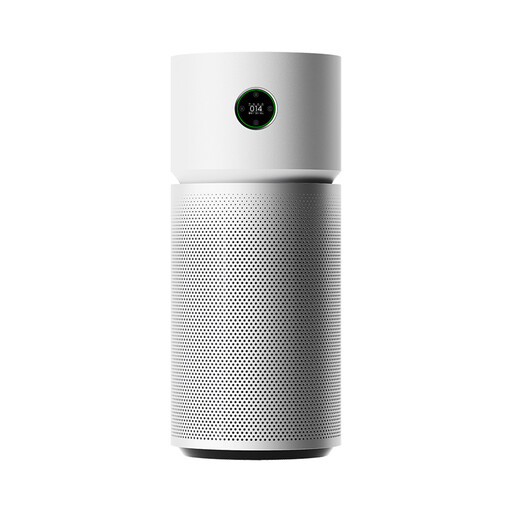
Xiaomi Smart Air Purifier Elite, white, UK plug
Consider this model if you need a stated large-room cleaning rate and want sensor-led controls.
The listing states a 600 m³/h particle CADR and coverage up to 125 m² at two air changes per hour, alongside HEPA filtration, PM2.5/PM10 sensing and app and voice control.
Check that the stated cleaning frequency suits your room. The listed 20.2 dB figure is for minimum sleep-mode operation, not faster cleaning; confirm the replacement filter before purchase.
Joybuy
 No image available
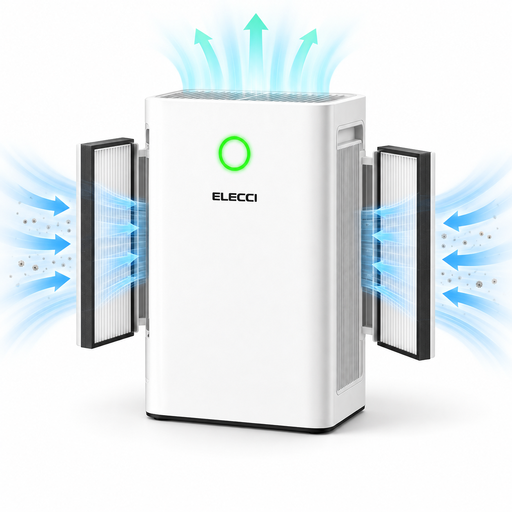
ELECCI Dual-HEPA Air Purifier, up to 48 m²
Consider this model if your measured living room fits its stated 48 m² or 120 m³ coverage.
The listing states a 550 m³/h CADR, a washable pre-filter and dual-HEPA filtration for airborne particles including dust.
Check the cleaning-rate basis behind the room claim, the noise at your intended setting and the compatible replacement filter.
Joybuy
 No image available
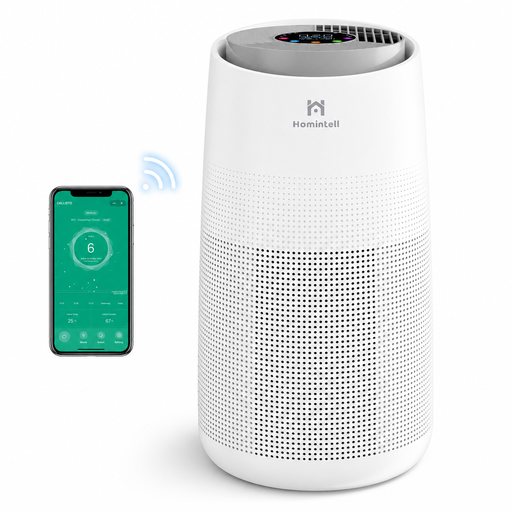
Homintell Smart Air Purifier, 300 m³/h CADR
Consider this model if automatic operation matters and your living room suits its stated 36 m² coverage.
The listing specifies a 300 m³/h CADR, a pre-filter and H13-grade HEPA filtration, plus Wi-Fi control, air-quality detection and auto mode.
Check the coverage claim against your room and desired cleaning frequency. Its stated 26 dB figure applies to sleep mode, so assess noise at the speed you expect to use.
Joybuy
 No image available
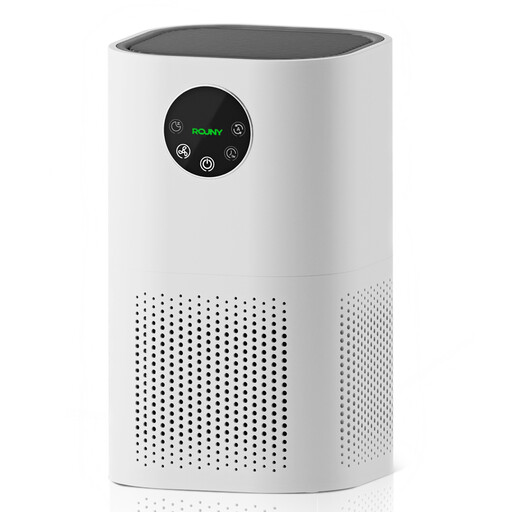
ROUNY AP-T1 Air Purifier, 20–50 m²
Consider this model only after checking whether its stated clean-air rate meets the cleaning frequency you want for your living room.
The listing gives a 150 m³/h CADR, 20–50 m² coverage, an H13 HEPA filter, four fan speeds and an air-quality display.
The stated noise figure of ≤25 dB applies to sleep mode. Check the coverage basis, noise at a faster setting and the compatible replacement filter.
Joybuy
Common questions
How do I size an air purifier for a large living room?
Measure the room’s floor area and ceiling height, then check the purifier’s CADR and the air-change rate behind its coverage claim. AHAM Verifide describes CADR as a measure of how quickly an air cleaner filters dust, pollen and tobacco-smoke particles; compare figures for the same particle category and on a comparable test basis.
Will an air purifier remove dust already on furniture?
No. It filters particles from air drawn through the unit, so settled dust still calls for ordinary surface cleaning and vacuuming.
How often will I need to replace the filter?
Follow the instructions for your exact purifier and replacement filter. Levoit recommends replacing the Core 600S filter every 6–8 months depending on use frequency and environment; that interval should not be applied to other models.
Can an air purifier replace ventilation?
No. Ventilation exchanges indoor air with fresh outdoor air, while a purifier filters air passing through it. Keep using the home’s intended ventilation alongside the purifier.
Which product marking should I check in Great Britain?
For relevant goods placed on the Great Britain market, Department for Business and Trade guidance published on 31 March 2026 says CE marking continues to be recognised alongside or instead of UKCA marking. That guidance covers England, Scotland and Wales; Northern Ireland follows different processes, so check the rules applicable there separately.


