What to check before buying
Start with the allergen that matters to your household, then compare the current pack declaration, precautionary wording and quantity before choosing a format.
| Priority |
What to check |
Your needs |
| Exact allergen declaration |
Read the current ingredients and emphasised allergen information. Compare wheat or gluten, milk, egg, nuts and other relevant allergens with the requirement you are managing. |
I need to know whether this specific croissant contains the allergen I am avoiding, rather than assuming all butter croissants use the same recipe. |
| Precautionary statements |
Look separately for wording such as “may contain”. Check whether the product is prepacked or sold from a shared bakery counter. |
A declared ingredient and a possible trace warning are different pieces of information. I need to follow the allergy plan already provided for the relevant precautionary statement. |
| Gluten-free claims |
Confirm that the pack is labelled gluten free where gluten-containing cereals must be avoided. Then check milk and egg separately. |
If I need gluten-free croissants, I still need a product whose milk and egg information works for my household. |
| Pack size and storage |
Compare croissant count or servings, storage instructions and any freezing guidance. A 380g croissant loaf has approximately 10 servings and is not equivalent to a half loaf. |
I want a quantity that suits one or two people without choosing a format whose allergen profile is unsuitable. |
Joybuy product options
Joybuy product options for ordinary prepacked butter croissants, including a frozen bake-from-frozen format for households able to prepare croissants at home.
 No image available
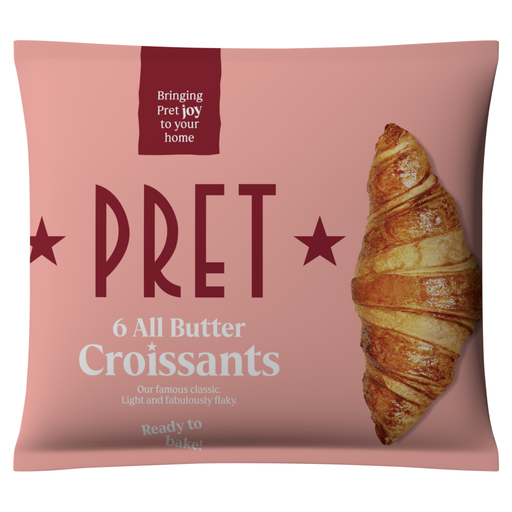
Pret A Manger Butter Croissants 330g
A frozen, bake-from-frozen option for shoppers comparing prepacked croissants rather than fresh-counter pastries.
The product states wheat or gluten, milk and egg ingredients, with a precautionary statement for nuts, sesame and soya. It has a stated 20-minute bake time; check croissant count, opened-pack storage and freezing instructions for a smaller household.
Joybuy
Frequently asked questions
Are ordinary butter croissants suitable for a wheat, milk or egg allergy?
Usually not when the current label lists the relevant allergen. Tesco and Waitrose ordinary croissant examples list wheat, milk and egg, and Lidl’s All Butter Croissant also lists milk, wheat and egg; always assess the current product label for the specific allergy.
Does a gluten-free croissant also avoid milk and egg?
Not necessarily. The Sainsbury’s gluten-free croissants and M&S Made Without Wheat croissants discussed here contain butter or milk and egg, so gluten-free status addresses gluten-containing cereals rather than every allergen.
Should I choose a prepacked croissant instead of one from a bakery counter?
A prepacked product is useful when you need the clearest pack-specific ingredients and allergen declaration. Waitrose advises shoppers affected by allergy or intolerance to select prepacked ranges because fresh-counter items may be affected by traces from other products, although loose foods must still have allergen information available under UK rules.
What does a “may contain nuts” statement mean?
It is precautionary allergen labelling indicating that an allergen could be unintentionally present through cross-contamination. The Food Standards Agency explains that this wording relates to an unavoidable cross-contamination risk that cannot be sufficiently controlled; follow the allergy-management advice you have been given.
Is a croissant loaf a practical half-loaf option for one or two people?
The St Pierre Croissant Loaf is not a half loaf: it is 380g with about 10 servings. It contains wheat and milk and may contain hazelnuts, mustard and soya, so compare both its quantity and allergen information with a smaller pack or an appropriate freezable product.


