Small-household pancake cooks
If you are making one or two batches, start with the recipe quantity rather than buying four pints by default. The National Trust’s traditional pancake recipe uses 300ml milk for 6–8 pancakes.


Buy almond drink according to the milk volume in your pancake recipe, not the size of a four-pint dairy bottle: the National Trust’s recipe uses 300ml for 6–8 pancakes, while the almond drinks in Tesco’s cited listing are 1L cartons. Tesco labels four pints as 2.272L, so two 1L cartons fall short if you genuinely need that amount; three provide enough, with some left over. Choose the exact drink’s sweetness and ingredients to suit your batter and toppings, and check its allergen label before serving.
If you are making one or two batches, start with the recipe quantity rather than buying four pints by default. The National Trust’s traditional pancake recipe uses 300ml milk for 6–8 pancakes.
Add up the milk required across your planned batches. If the total is close to four pints, two 1L cartons will not reach the 2.272L volume shown on Tesco’s four-pint milk label; three will exceed it.
Compare the exact carton if sweetness, a short ingredient list or added calcium matters to your purchase. Almond is a tree-nut allergen, so also check who will eat the pancakes before making a shared batter.
Calculate the batter volume first; then choose a carton by its formulation and allergen information.
| Priority | What to check | Your needs |
|---|---|---|
| Quantity | Add up the milk in each recipe. The National Trust uses 300ml for 6–8 pancakes; Tesco labels four pints as 2.272L. Two 1L cartons provide 2L, while three provide 3L. | For a small batch, I would rather buy for the recipe than for a four-pint target. If I need about four pints across several batches, I need more than two 1L cartons. |
| Sweetness | Check whether the exact carton is Original, Unsweetened or No Sugars, and read its ingredients and nutrition panel. Tesco lists distinct variants; Joybuy’s Alpro No Sugars 8 x 1L listing states that it contains no sugars or sweeteners. | I want to choose how much sweetness comes from the batter and how much comes from the toppings. |
| Ingredients and calcium | Compare the exact ingredients and any calcium declaration. Plenish describes its almond drink as water, organic almonds and salt; Rude Health lists calcium carbonate in its chilled calcium-enriched drink. | A short ingredient list matters for this batch, but if I also use the drink regularly, I want to check calcium on the carton rather than assume it is added. |
| Allergens | Read the allergen statement on the exact pack and check ingredients used elsewhere in the batter. The Food Standards Agency identifies almonds as tree nuts. | Before making pancakes for other people, I need to know whether anyone has an almond or relevant nut allergy. |
Tesco labels a four-pint milk bottle as 2.272L, so two 1L cartons leave a 272ml shortfall if your recipes require the full four pints.
Add up the quantities in your recipes. If they call for about four pints, three 1L cartons provide enough, though some drink will remain.
Plenish describes a three-ingredient drink, while Rude Health’s standard organic drink lists rice and sunflower oil alongside almonds. Joybuy’s Alpro No Sugars listing describes a different formulation again.
Read the ingredients on the variant you intend to buy rather than choosing by the word “almond” alone.
Rude Health lists calcium carbonate in its chilled calcium-enriched drink; Plenish’s stated three-ingredient recipe does not list added calcium.
If calcium fortification matters to your purchase, check the declaration on the exact carton.
The Food Standards Agency identifies almonds as tree nuts. Almond-based batter is therefore unsuitable for someone with an almond allergy.
Check guests’ allergies before choosing ingredients, and keep any almond-based batter separate from food prepared for someone with a relevant nut allergy.
Tesco lists Original, No Sugar and Barista Almond variants in 1L formats, so the variant name matters when choosing for batter.
Plenish describes its almond drink as made with water, organic almonds and salt, and lists an 8 x 1L multipack.
Rude Health lists different recipes across its Pure Almond, standard organic and chilled calcium-enriched drinks.
Tesco lists its own-label Unsweetened Almond Drink in a 1L format.
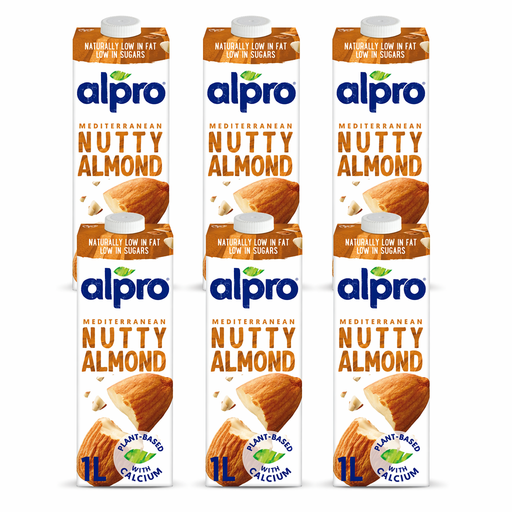
These Alpro options have different purchase quantities: check the pack count on the listing marked 1L, or consider the 8 x 1L No Sugars pack if you expect to use the additional cartons beyond Pancake Day.
 No image available
For a recipe using 300ml milk, the stated 1L quantity is enough for one National Trust-style batch of 6–8 pancakes. The listing title begins with “6” but gives 1L as the net quantity, so confirm the pack count and total volume before buying. Contains almond.
 No image available
For cooks choosing a no-sugars formulation, Joybuy lists this drink as eight 1L cartons and states that it contains no sugars or sweeteners. The listing also states calcium and vitamins B2, B12 and D. At 8L in total, this pack exceeds a four-pint requirement; check whether you will use the remaining cartons and follow each carton’s storage instructions. Contains almond.
No. Tesco labels four pints as 2.272L, while two 1L cartons provide 2L: a shortfall of 272ml. Three 1L cartons provide 3L, leaving 728ml after a four-pint quantity is used.
Follow the quantity in your chosen recipe. The National Trust’s traditional recipe uses 300ml milk for 6–8 pancakes, so 1L covers that quantity with about 700ml remaining.
Choose an unsweetened or no-sugars variant if you want to set the batter’s sweetness separately from its toppings. Check the exact carton: Tesco lists both Original and No Sugar Alpro variants, which should not be treated as the same formulation.
No single ingredient or fortification profile applies to every almond drink. Rude Health lists calcium carbonate in its chilled calcium-enriched drink, while Plenish describes its almond drink as water, organic almonds and salt. Check the exact carton if added calcium matters to you.
No. Almond is a tree-nut allergen identified by the Food Standards Agency, so do not serve almond-based batter to someone with an almond allergy. Check all ingredients before preparing a separate batter for anyone with a relevant allergy.