Carers of babies under 12 months
Weaning introduces foods alongside milk; it does not make almond drink a replacement for a baby’s main milk. The NHS says breast milk or first infant formula remains the suitable main milk during the first year.


Do not buy ordinary almond drink to replace a baby’s main milk during weaning: the NHS says breast milk or first infant formula remains the suitable main milk during the first 12 months. From age 1, an unsweetened, calcium-fortified almond drink can be part of a balanced diet, but check the exact product’s age statement, nutrients and allergens before choosing it.
Weaning introduces foods alongside milk; it does not make almond drink a replacement for a baby’s main milk. The NHS says breast milk or first infant formula remains the suitable main milk during the first year.
The NHS includes unsweetened, calcium-fortified almond drinks among milk alternatives that can be given from age 1 as part of a balanced diet. Check the particular drink’s nutrients and any more restrictive age statement.
Almond is a nut allergen. NHS guidance says foods that can trigger allergies can be introduced one at a time from around 6 months, making a possible reaction easier to identify. This is a food-introduction decision, not a reason to change a baby’s main milk.
Start with the child’s age and the drink’s intended role. For a child aged 1 or over, compare the exact variant rather than relying on the brand name.
| Priority | What to check | Your needs |
|---|---|---|
| Age and main milk | Identify whether the product is ordinary almond drink or first infant formula. The NHS says first infant formula is the suitable alternative to breast milk during the first 12 months. | While my baby is under 1, I need to keep almond drink separate from the decision about their main milk. |
| Fortification | From age 1, look for an unsweetened drink with added calcium. Compare declared calcium, iodine, vitamin D, vitamin B12 and protein on the exact pack; the UK SACN and COT assessment notes that plant-drink nutrient content varies considerably. | I want to compare what each drink actually contains as part of my child’s wider diet, rather than assume all almond drinks have the same nutrients. |
| Allergens | Read the current almond, nut and peanut allergen statements. For a new allergenic food, NHS guidance recommends introducing foods that can trigger reactions one at a time from around 6 months. | If almond is a new food for my baby, I need to consider allergy introduction separately from choosing a drink for an older child. |
| Variant and age statement | Check the sugar declaration and any product-specific minimum age. Alpro UK lists 0 g sugars per 100 ml for its Roasted Almond No Sugars drink and 2.3 g per 100 ml for its Original Chilled drink; those are different variants. The UK SACN and COT assessment says organic plant-based drinks in the UK cannot be fortified. | An Original, No Sugars or organic label changes what I need to check; I cannot transfer one variant’s nutrition or age information to another. |
Calcium fortification does not turn an ordinary almond drink into first infant formula. The NHS says first infant formula is the suitable alternative to breast milk in the first 12 months.
Keep breast milk or first infant formula as the baby’s main milk during the first year; do not make an off-the-shelf almond drink its replacement.
Fortification varies between plant drinks. The UK SACN and COT assessment says organic plant-based drinks in the UK cannot be fortified, so organic status does not establish that a drink meets the NHS calcium-fortified criterion for use from age 1.
For a child aged 1 or over, check the current pack for unsweetened status and added calcium, then compare other declared nutrients in the context of the wider diet.
General NHS guidance does not erase a narrower product statement. Sainsbury’s says its Unsweetened Long Life Almond Drink is not suitable as a main milk alternative for children under 3; Rude Health labels its Chilled Almond Drink with Calcium for adults and children from age 5.
Check the statement on the exact pack instead of applying another brand’s age guidance to it.
Almond is a nut allergen, and individual products may also carry peanut or other-nut warnings. An unsweetened label says nothing about allergy suitability.
Read the current pack before use. Do not choose an almond drink for a child with almond or relevant nut allergy without advice from their clinician.
These are references for comparing specific drinks, not a claim that every variant from a brand has the same ingredients or age guidance.
Alpro lists both Original and No Sugars almond drinks; compare the variant named on the pack.
Tesco lists an Unsweetened Almond Drink with added calcium, iodine and vitamins.
Sainsbury’s Unsweetened Long Life Almond Drink lists added calcium, iodine, vitamin D and vitamin B12.
M&S Plant Kitchen Unsweetened Almond Drink lists added calcium, iodine, vitamin D and vitamin B12.
Rude Health’s Chilled Almond Drink with Calcium lists calcium carbonate among its ingredients.
Plenish describes its Almond M*lk as containing water, organic almonds and salt.
These almond drinks are relevant to comparing variants for a child aged 1 or over who can have almonds. Neither is a replacement for a baby’s main milk during the first year; check each pack against the unsweetened, calcium-fortified criterion and its own age statement.
 No image available
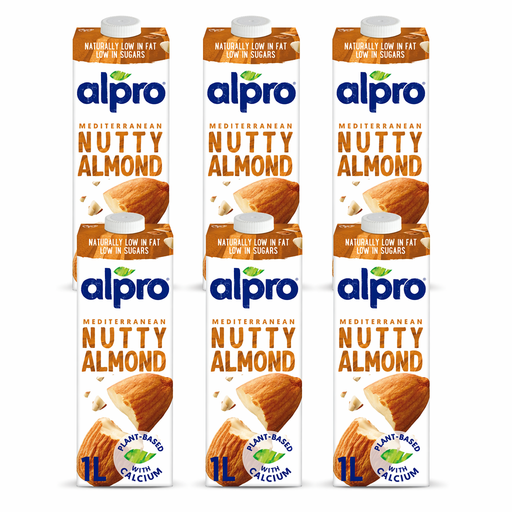
For a child aged 1 or over who can have almonds, this is a No Sugars variant to assess against the NHS unsweetened, calcium-fortified criterion. Its product description declares 0.0 g sugars and 0.5 g protein per 100 ml and lists calcium carbonate and vitamins B2, B12 and D2. Check the current pack for the calcium amount, iodine declaration, age statement and allergens; it is not a substitute for an infant’s main milk.
 No image available
This variant lists calcium, iodine and vitamins B12, D2 and E, but also lists sugar as an ingredient. For a child aged 1 or over, do not assume it meets the NHS unsweetened criterion: check the current pack’s sugar and calcium declarations, age statement and allergens. It is not a substitute for an infant’s main milk.
No. The NHS says first infant formula is the suitable alternative to breast milk during the first 12 months. Ordinary almond drink should not replace a baby’s main milk while they are weaning.
The NHS says an unsweetened, calcium-fortified almond drink can be given from age 1 as part of a balanced diet. Check the exact product’s age statement too: Sainsbury’s, for example, says its Unsweetened Long Life Almond Drink is not suitable as a main milk alternative for children under 3.
A Frimley Healthier Together NHS milk-free-diet resource says fortified plant drinks can be used in cooking from 6 months, but not as the main milk drink before age 1. That advice is given in a milk-free-diet context; ask a health visitor, GP or dietitian about an individual baby’s feeding needs, particularly if an allergy is suspected.
Start with unsweetened status, added calcium and the product’s age statement. Compare its declared nutrients and allergens on the current pack; the UK SACN and COT assessment notes that plant-drink nutrient content varies considerably.
Treat almond as a new allergenic food, not as a way to replace the baby’s milk. The NHS advises introducing foods that can trigger allergic reactions one at a time from around 6 months so that a reaction can be identified.