NHS guidance says almond drinks should be avoided before 12 months. From age 1, an unsweetened, fortified almond drink can be considered for cereal if the child can safely have almonds, but it should not automatically replace their main milk: North West Knowledge Now NHS guidance for children aged 1 and over with cow’s milk protein allergy identifies fortified soya or pea drinks as the first-choice plant alternatives. For a larger household supply, check the stated litres, carton count and storage instructions rather than assuming that “6 pint” describes the pack.
Who is this for?
Parents serving almond drink with breakfast from age 1
If almond drink is going on cereal or into porridge, check the current carton for an unsweetened formulation and added calcium, iodine, vitamin D and B12. Using it with breakfast is a different decision from relying on it as the child’s main milk.
Families managing a dairy-free toddler diet
When cow’s milk is excluded, the regular milk alternative needs more consideration than its breakfast use alone. North West Knowledge Now NHS guidance notes that plant alternatives vary in energy, protein and micronutrients; discuss a child’s individual requirements with a healthcare professional or dietitian.
Households buying several cartons at once
Check the total volume and the number of individual cartons before ordering. The Alpro No Sugars listing here is marked 8 x 1L; each opened carton still needs to be used according to its own storage instructions.
What matters when choosing?
Start with the child’s age and whether the drink is for occasional breakfast use or a regular main milk alternative; then compare the carton label and the quantity you will use.
| Priority | What to check | Your needs |
|---|
| Age and role |
NHS guidance says to avoid almond drinks before 12 months. From age 1, distinguish use with food from replacing the child’s main milk. |
If my child is under 1, almond drink is not a breakfast milk option. For an older toddler, I need to decide how regularly they would have it. |
| Main milk alternative |
Consider energy and protein as well as fortification. For children aged 1 and over with cow’s milk protein allergy, North West Knowledge Now NHS guidance identifies unsweetened fortified soya or pea drinks as first-choice plant alternatives, subject to individual needs. |
When dairy is excluded, I need a regular alternative assessed for my child’s diet and allergies, not chosen simply because it is plant-based. |
| Fortification |
Read the current label for calcium, iodine, vitamin D and B12. A short ingredients list or an organic label does not establish that these nutrients have been added. |
For almond drink used with breakfast, I want to know what the particular carton contains rather than assume all almond drinks are alike. |
| Sugar and nutrients |
Check whether the product is unsweetened, then read its sugar, protein and energy values per 100ml. A no-sugars name alone does not establish suitability as a main milk alternative. |
I would rather compare the whole nutrition panel than choose a breakfast drink on its sugar description alone. |
| Almond allergy |
Check the allergen declaration and any precautionary warnings. The Food Standards Agency classifies almonds as nuts; ask a nursery or school about its current food-allergy policy before packing the drink. |
If almond allergy is relevant to my child, this drink is not an option. For a packed breakfast, I also need to follow the setting’s rules. |
| Household quantity |
Confirm the stated litres and carton count separately. Check the date, refrigeration instructions and use period for each opened carton. |
I need a quantity the household can use without treating a “6” in a listing title as proof of six cartons or a six-pint bottle. |
Buying pitfalls
-
Treating almond drink as interchangeable with a child’s main milk
Fortification does not make every plant drink equivalent in energy or protein. North West Knowledge Now NHS guidance notes that plant alternatives vary, which matters particularly when a child relies on one regularly.
Do not use almond drink before 12 months. If it would replace dairy as a toddler’s regular main drink, discuss the choice with a healthcare professional or dietitian.
-
Using “organic” as a shortcut for fortification
Plenish’s listed organic almond drink contains water, almonds and sea salt. That ingredients list is not evidence of added calcium, iodine or vitamins.
For a child aged 1 or over, check the current ingredients and nutrition panels for the fortification you need rather than relying on the product name.
-
Confusing a large order with a large bottle
An 8 x 1L listing describes individual cartons, not a six-imperial-pint bottle. Buying more cartons also leaves the household with an opened-carton use period to manage.
Confirm both carton count and total litres, then check how each carton must be stored after opening.
Opening several cartons at once may leave drink unused when their stated use periods end.
-
Assuming every nursery or school follows the same nut rule
Almond is a nut allergen. Department for Education guidance for England says schools may discourage particular foods through nut-free policies; it does not establish one rule for every setting across the UK.
Do not give almond drink to a child with a relevant nut allergy. Ask the individual nursery or school about its current allergy and packed-food policy before sending it.
Brand and product-line references
These examples show why the exact carton matters; a brand name alone does not establish a drink’s fortification or its role in a toddler’s diet.
Alpro
Alpro lists a Roasted Almond No Sugars 1L drink, while the Joybuy option below is an Almond No Sugars 8 x 1L multipack. Check the label on the variant you buy.
- Alpro’s Roasted Almond No Sugars product page lists calcium and iodine per 100ml.
- Fortification alone does not establish that an almond drink is suitable as a toddler’s regular main milk.
Tesco
Tesco lists a 1L Unsweetened Almond Drink with added calcium, iodine and vitamins.
- The listed additions include vitamin B12 and vitamin D2.
- It is an almond product, so check its allergen declaration before considering it for a child.
Sainsbury’s
Sainsbury’s lists a 1L Unsweetened Long Life Almond Drink with explicit child-use wording.
- Its label says it can be used as part of a balanced diet from age 1.
- The same label says it is not suitable as a main milk alternative for children under 3.
M&S
M&S lists an Unsweetened Almond Drink with added calcium, iodine, vitamin D and B12.
- Its stated fortification gives shoppers specific nutrients to check on the carton.
- Check the product’s allergy and post-opening instructions for the household using it.
Rude Health
Rude Health lists almond drinks including a chilled version with added calcium.
- The brand identifies added calcium in its chilled product.
- Rude Health states that product is suitable as part of a balanced diet for adults and children from age 5, not for the toddler-breakfast use considered here.
Plenish
The reviewed Plenish organic almond drink lists water, organic almonds and sea salt.
- Its ingredients are stated plainly for shoppers comparing formulations.
- Do not mistake a short ingredients list for evidence of calcium, iodine, vitamin D or B12 fortification.
Almond drinks on Joybuy
These Alpro listings relate to buying almond drink for breakfast and planning a household supply. Check the current carton before choosing one for a child; neither listing should be treated as an automatic main milk replacement.
 No image available
Alpro Almond No Sugars Long Life Drink 8 x 1L
The 8 x 1L format is relevant if your household uses separate cartons over time rather than needing one large bottle. For a toddler’s cereal, check the current carton for iodine and the other nutrients you require, follow its storage instructions and do not treat the drink as a default main milk replacement.
View on Joybuy
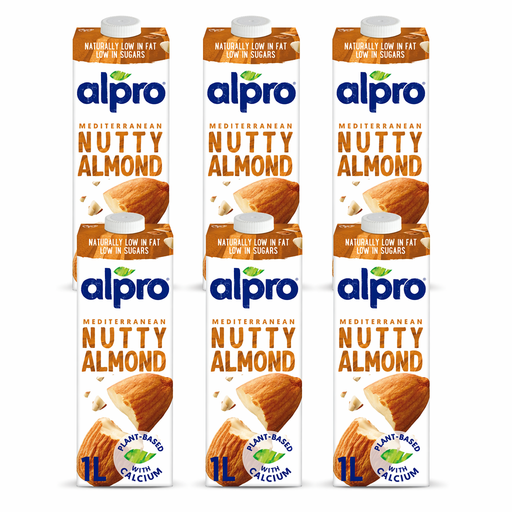 No image available
Alpro Almond Drink 1L, listing marked “6”
This almond drink is another listing to assess for breakfast use, but “6” in its title does not establish the number of cartons delivered. Confirm the pack quantity, ingredients, nutrition panel and child-use instructions before deciding whether it meets your household’s needs.
View on Joybuy
Common questions
Can a baby under 12 months have almond drink at breakfast?
No. NHS guidance says even unsweetened, calcium-fortified plant drinks should be avoided before 12 months. Breast milk or first infant formula remains the milk drink during the first year unless a healthcare professional advises a specialist alternative.
Is fortified almond drink suitable as a toddler’s main milk?
Do not assume it is. North West Knowledge Now NHS guidance for children aged 1 and over with cow’s milk protein allergy notes that plant alternatives vary in energy and protein, and identifies unsweetened fortified soya or pea drinks as first-choice plant alternatives. A child’s allergies and wider diet still need individual consideration.
What should I check for almond drink used on a toddler’s cereal?
For a child aged 1 or over who can safely have almonds, check that the current carton is unsweetened and lists calcium, iodine, vitamin D and B12. Read the nutrition panel too; added nutrients do not make every almond drink equivalent to a main milk alternative.
Can I send almond drink to a nut-free nursery or school?
Ask the individual setting before sending it. Almond is a nut allergen, and Department for Education guidance says schools in England may discourage foods through nut-free policies; it does not set a single packed-food rule for every nursery and school in the UK.
How should I store opened cartons from a larger order?
Follow the instructions on each carton, including refrigeration and its stated period for use after opening. Buying multiple 1L cartons does not give every opened carton the same storage life.


