Households using several cartons a week
An 8 x 1L pack, such as Plenish’s listed multipack, lets you buy several cartons together. Check the storage instructions and whether you will use that quantity.


For a large family shop, choose a pack size that matches how many cartons your household uses, then check the individual drink’s fortification if it regularly replaces dairy. Plenish lists an 8 x 1L organic multipack, but the UK SACN and COT assessment says organic plant-based drinks cannot be fortified with nutrients; a separate barista carton addresses a different need if coffee foam matters. Check nut warnings before committing to several cartons.
The useful carton depends on how often your household uses almond drink and what it uses it for.
An 8 x 1L pack, such as Plenish’s listed multipack, lets you buy several cartons together. Check the storage instructions and whether you will use that quantity.
Check fortification on each carton rather than relying on the words “dairy-free”. The UK SACN and COT assessment says nutrient content varies considerably between plant-based drinks; M&S Unsweetened Almond Drink, for example, lists added calcium, iodine and vitamins D and B12.
An everyday carton may cover cereal and cooking, while a coffee-specific carton is worth considering if foam is important. Plenish markets its barista almond drink as foamable; that claim does not establish how it compares nutritionally with an everyday carton.
Start with the quantity you will use, then compare the exact cartons for nutrients, ingredients and suitability for everyone at home.
The Vegan Society’s April 2025 UK survey, conducted by Attest with 2,000 people selected using nationally representative targeting, reports motivations among regular consumers of dairy alternatives. Its figures concern dairy alternatives generally, not almond drink or large families specifically, and the motivations can overlap.
| Priority | What to check | Your needs |
|---|---|---|
| Pack and storage | Compare the stated number and size of cartons. Check storage directions and how quickly you use an opened carton. | Several of us use almond drink, so I want enough cartons for the shop without buying more than we will use. |
| Fortification | Read the individual carton’s nutrient panel for added calcium, iodine and vitamins. The UK SACN and COT assessment says organic plant-based drinks cannot be fortified with nutrients. | If this regularly replaces dairy at home, I want to know which nutrients the chosen drink actually provides. In the Vegan Society’s April 2025 UK survey, 46% of regular dairy-alternative consumers cited health as a motivation; that figure does not measure demand for fortification. |
| Ingredients and sugars | Compare ingredient lists and declared sugars per 100g or 100ml, using the unit on each label. Check “no added sugar” and “unsweetened” claims against the particular recipe. | Our household may prefer a particular recipe or flavour. Taste was a stated motivation for 28% of regular dairy-alternative consumers in the Vegan Society’s April 2025 UK survey, not a rating of any almond drink. |
| Everyday use or coffee | Check the maker’s suggested uses for cereal, cooking and hot drinks. If foam matters, look for a coffee-specific product claim rather than assuming an everyday carton will behave the same way. | I would rather choose a second, barista-style carton only if we regularly make coffee that calls for foam. |
| Allergens | Read the almond declaration and any precautionary warnings about other nuts. Check each different product, including cartons bought in a multipack. | Everyone who might use these cartons needs to be able to consume them safely. |
| Environmental preferences | Check the specific product information for the attributes you care about; a motivation for choosing dairy alternatives does not establish the environmental impact of a particular carton. | Environmental reasons were cited by 35% of regular dairy-alternative consumers in the Vegan Society’s April 2025 UK survey. If that is also important to me, I need product-specific information before comparing options. |
A large pack is only useful if its ingredients, labelling and intended use work for the household.
The UK SACN and COT assessment says plant-based drinks vary considerably in nutrient content and that organic plant-based drinks cannot be fortified with nutrients.
If almond drink regularly replaces dairy, compare the exact carton’s listed calcium, iodine and vitamins rather than treating “almond” or “dairy-free” as a nutrient specification.
The Food Standards Agency identifies almonds as tree nuts. Individual drinks can also carry precautionary warnings about other nuts; Rude Health’s No Sugars Organic Almond Drink does so.
Read the allergen declaration and precautionary wording for the chosen product before buying a multipack. Do not give almond drink to someone with an almond allergy.
Plenish presents its barista almond drink as a coffee-focused, foamable product. That description does not tell you whether it supplies the nutrients you want from a routine dairy replacement.
Choose a coffee-specific carton for that preparation need, and check any everyday carton separately for its ingredients, fortification and allergens.
These examples show why a brand name alone is not enough to identify a drink’s recipe or fortification.
Tesco Groceries lists Alpro Original, No Sugar and Barista Almond 1L drinks in its almond-drink category.
Rude Health lists distinct standard, No Sugars Organic and chilled calcium-enriched almond drinks.
Plenish lists an 8 x 1L regular almond-drink multipack and a separate 6 x 1L barista multipack.
Tesco Groceries lists its own Unsweetened Almond Drink 1L alongside branded almond drinks.
M&S lists sweetened and unsweetened almond drinks, including a 1L unsweetened carton.
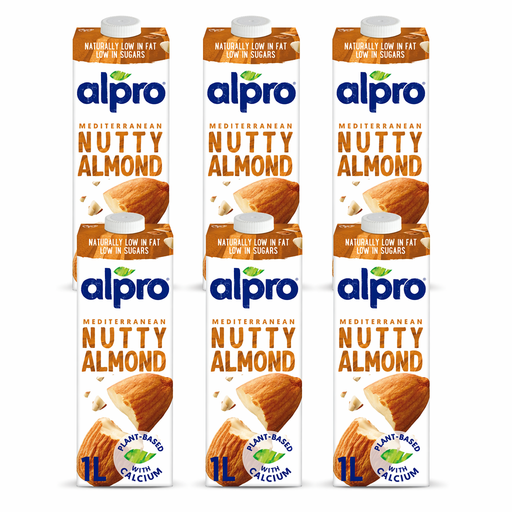
These Alpro almond-drink listings offer an 8 x 1L No Sugars long-life option and a separate 1L drink listing. Check the quantity in the second listing before treating it as a multi-carton shop.
 No image available
The listed 8 x 1L format is worth considering when several cartons are used regularly. Check the allergen declaration and the carton’s nutrient panel if it is routinely replacing dairy.
 No image available
For a large shop, confirm how many 1L cartons the listing covers before ordering. Check the specific carton’s ingredients, allergen declaration and nutrient panel if those details affect your choice.
No. Almond is a tree nut, so almond drink is unsuitable for someone with an almond allergy. Check the chosen carton’s allergen declaration and any “may contain” statement, even if you have bought the product before.
If it regularly replaces dairy, compare the nutrients listed on the exact carton. The UK SACN and COT assessment says plant-based drinks vary considerably and recommends fortification with vitamin A, riboflavin, vitamin B12, calcium and iodine at levels comparable with semi-skimmed cows’ milk; it also says organic plant-based drinks cannot be fortified with nutrients.
It may cover several uses, but check the product’s directions and whether coffee foam matters to you. Plenish presents its regular almond multipack for uses including cereal and baking, while it markets the separate barista multipack as foamable for coffee.
Check the exact drink and the rest of the child’s diet rather than assuming an almond drink supplies the same nutrients as cows’ milk. The UK SACN and COT assessment covers children aged one year and over and says that, when cows’ milk is absent from the diet, other foods and drinks are needed to replace its nutrients. Seek individual advice from an appropriate healthcare professional for a child with an allergy, restricted diet or medical needs.
Follow its own storage instructions, as they differ by product. For example, M&S instructs shoppers to refrigerate its Unsweetened Almond Drink at 0°C to +5°C after opening and consume it within three days.