Parents planning snack-time drinks
If you are serving almond drink with cereal, in a smoothie or on its own, look for a flavour your child accepts while checking the carton’s age guidance and allergy statement.


Start with unsweetened almond drinks for half-term snacks, then use flavour descriptions only to shortlist what your child might like: mildness is a matter of taste. If the drink will regularly replace dairy for a child, check calcium and iodine fortification, age guidance and nut warnings rather than relying on a short ingredient list.
If you are serving almond drink with cereal, in a smoothie or on its own, look for a flavour your child accepts while checking the carton’s age guidance and allergy statement.
When almond drink is used regularly in place of dairy for a child, calcium and iodine fortification become important checks. Kingston and Richmond NHS Foundation Trust also notes that some dairy substitutes are low in protein or energy.
A lightly nutty manufacturer description may help you choose a carton to try. Check fortification and allergen information separately: few ingredients do not tell you whether a drink meets those needs.
Choose for the way the drink will be used: an occasional snack accompaniment calls for different checks from a regular dairy replacement for a child.
| Priority | What to check | Your needs |
|---|---|---|
| Taste and sugar | Compare the ingredients and declared sugars per 100ml. Treat words such as “subtly nutty” as the maker’s description, not a taste guarantee. | I want something my child might enjoy with cereal or in a smoothie, without choosing solely on a flavour claim. |
| Fortification | Look for calcium and iodine on the current carton. Kingston and Richmond NHS Foundation Trust’s parent guidance describes 120mg calcium per 100ml as an ideal level for a fortified dairy substitute. | If this will regularly replace dairy for my child, the added nutrients matter more to me than a short ingredient list alone. |
| Age and allergens | Read the product’s child-use statement and check for almond, peanut and other-nut warnings, including “may contain” wording. Follow the child’s individual allergy advice. | I need to know whether this particular carton fits my child’s age and allergies before serving it. |
| Storage | Check the carton’s refrigeration and after-opening instructions. Choose a quantity your household can use within its stated period. | A smaller amount may fit our snack plans better if we will not finish an opened carton quickly. |
Kingston and Richmond NHS Foundation Trust notes that some dairy substitutes are not fortified and some are low in protein or energy. An ingredient list alone cannot answer that question.
If a child regularly avoids dairy, check the drink’s calcium and iodine labelling and seek individual advice where a main milk replacement is involved.
Almond is a tree nut. The listed Tesco drink also carries a warning that it may contain peanuts and other nuts.
Read the current carton’s ingredients and allergy statement, including cross-contact warnings, against the person’s allergy advice.
A sugars value does not establish a drink’s calcium or iodine content, protein or energy contribution, or suitability as a young child’s main milk drink.
Compare those details separately if the drink will be used frequently in place of dairy.
An opened carton has product-specific storage instructions, which matter when almond drink is only used for occasional snacks.
Check the stated refrigeration and consumption period before choosing a carton size.
A carton that cannot be finished within its stated period may lead to food waste.
These brand examples show different label and ingredient approaches; the details apply to the named products, not every drink from each brand.
Alpro lists an Almond No Sugars option for shoppers considering an unsweetened drink.
Its almond drinks offer different ingredient lists for shoppers comparing taste descriptions and formulation.
Plenish Almond M*lk is an option for shoppers looking for a short stated ingredient list.
Tesco Unsweetened Almond Drink 1L has a stated sugars figure and added micronutrients.
Sainsbury’s Unsweetened Long Life Almond Drink 1L gives both fortification figures and child-use guidance.
The listed unsweetened almond drink includes added calcium, iodine and vitamins D and B12.
These Alpro options can be considered for cereal, smoothies or other half-term snack occasions. Check each carton against your sugar, allergy and child-use requirements.
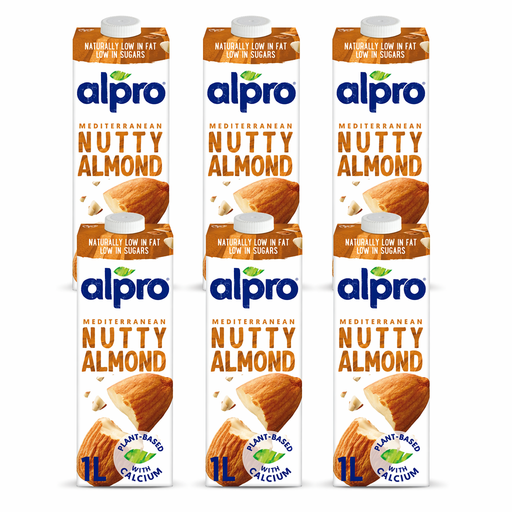 No image available
An almond drink to consider for snack-time cereal or smoothies. This variant lists sugar among its ingredients, so check the carton’s sugars figure if avoiding added sugar. It contains almond; check the age guidance before serving it to a child.
 No image available
The No Sugars variant is an option to compare for cereal, smoothies or sipping. It contains almond. If it will regularly replace dairy for a child, check the carton’s calcium and iodine information and age guidance.
It describes a taste preference, not a guaranteed flavour. Unsweetened drinks are a useful place to start comparing labels, but a maker’s description cannot tell you what a child will enjoy. Rude Health, for example, describes its No Sugars Organic Almond Drink as “subtly nutty”; that is Rude Health’s own description.
Check calcium and iodine fortification, age guidance and the wider diet, not just whether the drink is unsweetened. Kingston and Richmond NHS Foundation Trust advises that calcium- and iodine-fortified substitutes are necessary when a child cannot consume dairy, and notes that some substitutes are low in protein or energy.
Do not assume a plant-based drink is suitable as a main milk drink for a young child. Frimley Healthier Together’s NHS guidance says plant-based alternatives can be used in cooking from six months but not as a main milk drink until after age 1. Product guidance may be narrower: Sainsbury’s says its Unsweetened Long Life Almond Drink is not suitable as a main milk alternative for children under 3. Seek individual professional advice where a child has a milk allergy or nutritional concerns.
Check the current carton against their individual allergy advice before serving almond drink. Almond is a tree nut, while warnings for peanuts or other nuts differ between products. Tesco’s listed drink may contain peanuts and other nuts; Marks & Spencer says its listed drink is not suitable for people with a nut or peanut allergy.
Follow the storage and after-opening period printed on that carton, as instructions vary by product. Choose a quantity you expect to finish within the stated period, particularly if almond drink is only an occasional snack accompaniment.