Breakfast eaters comparing fat and sugars
If almond drink is mainly for cereal, porridge or fruit, an unsweetened carton with clearly stated nutrition values gives you a firmer basis for comparison than front-of-pack wording alone.


For cereal or fruit at a continental breakfast, start with an unsweetened almond drink and compare fat and sugars on the same nutrition-label basis. Tesco lists 1.1g fat per 100g for its Unsweetened Almond Drink, while M&S lists 0.9g per 100g for its Unsweetened Almond Drink. If the drink regularly replaces dairy, check its calcium and iodine declarations too; a short ingredient list does not establish whether it is fortified.
If almond drink is mainly for cereal, porridge or fruit, an unsweetened carton with clearly stated nutrition values gives you a firmer basis for comparison than front-of-pack wording alone.
Alongside fat and sugars, check the exact drink for calcium, iodine and other added nutrients. Frimley Healthier Together NHS guidance places particular emphasis on calcium and iodine when children use plant-based alternatives.
Plenish and Rude Health offer almond drinks with short ingredient lists for cereal or coffee. If fat values or fortification affect your choice, check those separately on the carton.
Choose the drink for its intended breakfast use, then compare like-for-like nutrition labels and the ingredients or added nutrients that matter to your household.
| Priority | What to check | Your needs |
|---|---|---|
| Fat and energy | Compare fat and energy using the same stated basis, preferably per 100ml on the cartons. Tesco Groceries lists 1.1g fat and 15 kcal per 100g for Tesco Unsweetened Almond Drink; Marks & Spencer lists 0.9g fat and 14 kcal per 100g for M&S Unsweetened Almond Drink. | I pour almond drink over cereal or fruit and want to compare the figures rather than assume every unsweetened carton has the same fat content. |
| Sugars and ingredients | Distinguish a no-sugars claim from a no-added-sugar claim; read both the sugars value and ingredient list. Rude Health lists rice for sweetness in its standard Almond Drink, despite describing it as having no added sugar. | One carton needs to work with breakfast and coffee, but I would rather know whether it contains ingredients used for sweetness before choosing it. |
| Added nutrients | Check calcium, iodine and vitamin declarations on the exact carton. For children using plant-based alternatives, Frimley Healthier Together NHS advises fortified products, particularly with at least 120mg calcium per 100ml and iodine. | If this regularly takes the place of dairy at breakfast, I want to check what nutrients the specific drink contributes, not judge it by fat content alone. |
| Allergens | Read the current almond and cross-contact statements. Tesco says its Unsweetened Almond Drink contains almond and may contain peanuts and other nuts; M&S says its Unsweetened Almond Drink is unsuitable for people with nut or peanut allergy. | Before serving a carton to someone with a nut or peanut allergy, I need to check that product's label rather than rely on its dairy-free description. |
Almond drinks differ in their ingredients and added nutrients. A low fat value alone does not tell you how much calcium, iodine or protein a regular dairy replacement provides.
Check those declarations on the exact carton. For a child or someone with a restricted diet, seek advice appropriate to their circumstances rather than choosing solely by fat content.
A sugars claim does not specify a drink's fat or energy value. Rude Health's standard Almond Drink, for example, lists rice and sunflower oil among its ingredients.
Use the nutrition panel for a like-for-like fat comparison, and the ingredients list to understand the formulation.
Almond is a nut allergen, and individual products can also carry warnings about peanuts or other nuts.
Read the current carton's allergen and cross-contact information before serving it to anyone with a relevant allergy.
A multipack may contain more cartons than a household will use promptly once each one is opened.
Check the individual carton's storage and consume-within instructions, then choose a pack size that fits your breakfast use.
These examples describe particular almond drinks, not every formulation sold under each brand.
Tesco Unsweetened Almond Drink is an own-label option with stated nutrition values and added nutrients.
M&S Unsweetened Almond Drink combines stated nutrition values with added calcium, iodine and vitamins.
Alpro Almond No Sugar is an option when a no-sugars formulation and stated fortification matter.
Plenish Almond M*lk is a short-ingredient option presented by Plenish for cereal, porridge and coffee.
Rude Health No Sugars Organic Almond Drink is a four-ingredient option presented for cereal, tea and coffee.
These Alpro multipacks offer two ways to stock almond drink for cereal. Check the exact nutrition label if a numerical low-fat comparison will decide between them; the second option is not unsweetened.
 No image available
The No Sugars variant suits a breakfast choice where avoiding sugars matters. This is an 8 × 1L multipack; plan for opened-carton use and check the current pack for allergen information. If it regularly replaces dairy, check the calcium amount and iodine declaration on the carton.
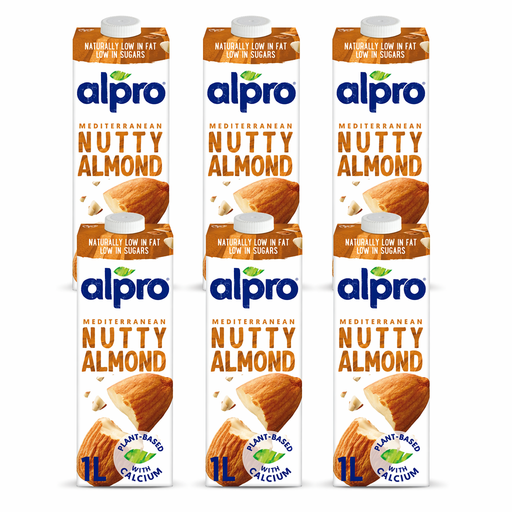 No image available
This 6 × 1L pack is an almond-drink option for cereal or hot drinks. Sugar appears in its ingredient list, so it is not the unsweetened choice here. Compare the carton's energy, fat and sugars values per 100ml before choosing it for a low-fat breakfast, and check its allergen statement.
Compare total fat and energy on the same nutrition-label basis, then check sugars and whether the drink is unsweetened. Tesco Groceries lists 1.1g fat and 15 kcal per 100g for Tesco Unsweetened Almond Drink; Marks & Spencer lists 0.9g fat and 14 kcal per 100g for M&S Unsweetened Almond Drink.
No. A no-added-sugar claim does not give you the fat value, so check the nutrition panel of the exact drink. Read the ingredients too: Rude Health lists rice and sunflower oil in its standard Almond Drink, which it describes as having no added sugar.
Yes—check the specific drink's calcium, iodine and other nutrient declarations rather than relying on its fat value. For children using plant-based alternatives, Frimley Healthier Together NHS guidance advises fortified products, particularly with at least 120mg calcium per 100ml and iodine; a child's age and dietary circumstances also matter.
Do not assume so: the Food Standards Agency classifies almonds as nuts. Tesco says its Unsweetened Almond Drink contains almond and may contain peanuts and other nuts, while M&S says its Unsweetened Almond Drink is unsuitable for people with nut or peanut allergy. Check the current product label.
Match the number of cartons to how often your household uses almond drink, then follow each carton's storage and consume-within instructions after opening. Do not assume that different brands or long-life and chilled drinks have the same opened-carton instructions.