Families planning several snack uses
A carton may be used for cereal, smoothies and drinks across the week. Compare the volume you need with the storage instructions for each carton once opened.


For cereal and half-term snacks, consider an unsweetened almond drink with calcium and iodine if those nutrients matter to your household, and check the exact carton because formulations differ. If a young child needs a regular main milk substitute, the British Society for Allergy & Clinical Immunology favours fortified, unsweetened soya, pea or oat drinks over tree-nut drinks. Six UK pints are about 3.4L, so plan by carton volume rather than assuming a six-pint bottle.
A carton may be used for cereal, smoothies and drinks across the week. Compare the volume you need with the storage instructions for each carton once opened.
An occasional ingredient and a regular main milk substitute are different decisions. For the latter, the British Society for Allergy & Clinical Immunology advises considering fortified, unsweetened soya, pea or oat drinks ahead of tree-nut drinks for children aged one and over.
An organic almond drink with few ingredients may suit a recipe or flavour preference. If the drink is also expected to replace dairy in meals, check its calcium and iodine information separately.
Decide whether the drink is mainly for snacks or will regularly replace milk, then compare labels per 100ml and work out how many cartons the household can use.
| Priority | What to check | Your needs |
|---|---|---|
| Sugars | Compare ‘of which sugars’ per 100ml and read the ingredients. ‘No added sugar’ does not necessarily mean zero sugars: Ocado lists 4.7g sugars per 100ml for the rice-containing Rude Health Organic Almond Drink. | For drinks offered repeatedly at snack time, I would check the sugar figure rather than rely on wording on the front of the carton. |
| Fortification | Check the exact carton for calcium, iodine and vitamins. Tesco lists added calcium, iodine and vitamins in its Unsweetened Almond Drink; Sainsbury’s lists 120mg calcium per 100ml in its own unsweetened version. | If almond drink is taking the place of dairy in meals, I want to know which nutrients that particular drink supplies. |
| Child’s use | Distinguish a snack ingredient from a regular main milk substitute. For children aged one and over, the British Society for Allergy & Clinical Immunology identifies tree-nut drinks as its least-preferred plant-drink option on nutritional grounds. | A little in cereal is one decision; if my young child will drink it regularly instead of milk, I need to consider a suitable alternative and seek individual advice where dietary restrictions or growth are a concern. |
| Allergens | Read the current ingredients and other-nut statements on the exact pack. Sainsbury’s warns that its Unsweetened Almond Drink is not suitable for customers with an allergy to other nuts because of manufacturing methods. | Before serving a snack to someone with a nut allergy, I need to check more than whether the carton is dairy-free. |
| Quantity and storage | Compare total litres with the number and size of cartons, then follow each pack’s directions after opening. The Department for Business and Trade describes a UK pint as 568ml, making six pints about 3.4L. | Four 1L cartons would cover that volume. I would open them as needed, especially if different snacks call for different amounts. |
Added minerals do not settle whether a tree-nut drink is suitable as a young child’s regular main milk substitute. The British Society for Allergy & Clinical Immunology places tree-nut drinks behind fortified, unsweetened soya, pea and oat drinks for children aged one and over.
Choose a snack ingredient for its intended use, but consider the child’s wider diet and seek individual advice where there are dietary restrictions or growth concerns.
Ocado lists 4.7g sugars per 100ml for Rude Health Organic Almond Drink, whose ingredients include rice. Sainsbury’s describes Alpro Almond No Sugars as containing zero sugars; the two labels do not mean the same thing.
Compare ‘of which sugars’ per 100ml on the cartons you are considering.
Sainsbury’s lists spring water, almonds and salt as the three ingredients in Plenish’s long-life organic almond drink. A short ingredient list does not establish that calcium or iodine has been added.
If fortification affects your choice, check the current ingredients and nutrition information rather than using ‘organic’ as a substitute for that check.
Six UK pints are about 3.4L, based on the 568ml pint described by the Department for Business and Trade. A ‘6’ in a listing title does not, by itself, confirm either a six-pint bottle or six cartons.
Check the carton count and total volume. Four 1L cartons exceed six pints; use each carton according to its instructions once opened.
These label examples show why the exact variant matters; a feature of one carton should not be assumed across a brand’s range.
Sainsbury’s lists Alpro Almond No Sugars as a long-life 1L drink with zero sugars and added calcium, iodine and vitamins.
Tesco lists its Unsweetened Almond Drink as a 1L carton with added calcium, iodine and vitamins E, B12, B2 and D2.
Sainsbury’s lists 120mg calcium per 100ml for its 1L Unsweetened Almond Drink, alongside iodine and vitamins.
Marks & Spencer describes its Unsweetened Almond Drink as enriched with calcium, iodine and vitamins D and B12.
Sainsbury’s describes the Plenish long-life organic almond drink as containing spring water, almonds and salt.
Rude Health has a long-life Organic Almond Drink containing rice and a separate chilled almond drink that the brand describes as calcium-fortified.
These Alpro listings are options for buying almond drink for half-term snacks. Compare the named pack size and the current carton label with the amount and type of drink your household needs.
 No image available
For households using almond drink in cereal or smoothies throughout half term, the named pack contains eight 1L cartons. Sainsbury’s describes the 1L Alpro Almond No Sugars drink as containing zero sugars with added calcium and vitamins; check the current multipack cartons for their full nutrient and allergen details. Eight litres is considerably more than six UK pints, so consider how you will use the cartons after opening.
 No image available
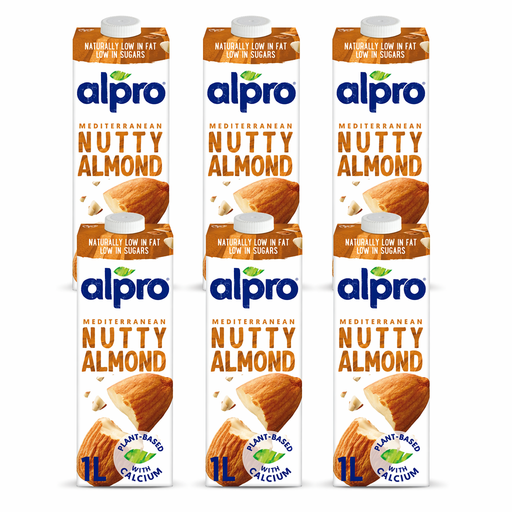
For snack preparation, check what the leading ‘6’ in this listing means before using it to plan a family quantity: the title alone does not establish the carton count or total volume. This is not labelled the No Sugars variant. Check the current ingredients, sugars per 100ml and allergen information if those details affect your choice.
Not as a default choice. For children aged one and over, the British Society for Allergy & Clinical Immunology favours fortified, unsweetened soya, pea or oat drinks over tree-nut drinks on nutritional grounds. Seek individual advice if dietary restrictions, prescribed products or growth concerns affect the decision.
Check whether the exact drink is unsweetened and which nutrients it contains, including calcium and iodine. Kingston and Richmond NHS Foundation Trust advises that calcium- and iodine-fortified dairy substitutes matter when a child cannot consume dairy; the wider diet and any individual advice still matter.
An almond drink is not suitable for someone allergic to almonds. Check the exact pack for other-nut statements too: Sainsbury’s says its Unsweetened Almond Drink is not suitable for customers allergic to other nuts because of manufacturing methods.
Four 1L cartons provide more than six UK pints. The Department for Business and Trade describes a UK pint as 568ml, so six pints are about 3.4L. Check the actual carton count and total volume of any multipack rather than interpreting a ‘6’ in its title as six pints.
Follow the storage and use-within directions on that carton. Sainsbury’s listing for Plenish long-life organic almond drink says to consume it within four days of opening; other products may have different instructions.