Who needs to check what?
The child’s age and the intended use matter more than a family-size pack description.
Parents starting baby-led weaning
The NHS advises introducing foods from around six months alongside breast milk or first infant formula. Almond is an allergen, so distinguish its introduction as a food from giving almond drink as a baby’s usual milk.
Families with a dairy-free child aged one or over
Check the particular drink’s age guidance and fortification. Kingston and Richmond NHS Foundation Trust advises looking for calcium in dairy-free alternatives and notes that soya, oat and pea drinks provide more energy and protein than almond drinks.
Households buying several cartons
Confirm the number and size of cartons, the exact variant and its storage instructions. A product intended for coffee or general household use should not be assumed suitable as a young child’s main drink.
What matters when choosing almond drink?
Decide whether the drink is for a recipe, an older child or general household use; then read the specific carton rather than relying on its pack name.
| Priority | What to check | Your needs |
|---|
| Age and use |
Check whether the drink is for cooking or drinking, and read any child-specific age statement. Frimley Healthier Together distinguishes cooking from six months from use as a main milk drink after age one. |
For a baby under one, I need a recipe ingredient, not a replacement for breast milk or first infant formula. |
| Almond allergen |
Read the current almond declaration and any precautionary nut warning. The NHS advises introducing allergenic foods one at a time, in very small amounts, from around six months; nuts should be served crushed or ground. |
If my baby has not tried almond, I need to plan its introduction separately rather than make a large batch of almond-containing food. |
| Fortification and nutrition |
For a dairy-free child over one, check calcium and iodine on the individual carton, plus its age guidance. Kingston and Richmond NHS Foundation Trust suggests looking for around 120mg calcium per 100ml and notes energy and protein differences between plant-drink types. |
When a child will have a plant drink regularly, I want to compare the labelled nutrients rather than choose by an ‘unsweetened’ claim alone. |
| Quantity and storage |
Confirm the total volume and carton count: ‘6’, six pints and six 1L cartons are different descriptions. Check how long each carton keeps once opened; Tesco instructs users of its Unsweetened Almond Drink 1L to refrigerate and use it within five days. |
I want enough unopened cartons for the household without opening more than we can use within each carton’s stated period. |
Brand and product-line references
These examples show why variant names and carton guidance need checking; a brand name alone does not establish child suitability.
Alpro
Tesco and Sainsbury’s list different 1L Alpro almond-drink variants, including No Sugars chilled and Original long-life products.
- The listed variants describe added calcium, iodine and vitamins.
- Those additions do not make an almond drink a substitute for breast milk or first infant formula during weaning.
Rude Health
Its Chilled Almond Drink with Calcium is a distinct product from its Organic Almond Drink.
- The chilled product’s ingredient list includes calcium carbonate.
- Rude Health states that this chilled product is suitable as part of a balanced diet for adults and children from five years onwards; do not treat it as a baby-led-weaning drink.
Plenish
Plenish lists an 8 x 1L Organic Almond M*lk multipack and a separate 6 x 1L Barista Almond M*lk multipack.
- Plenish describes its standard Organic Almond M*lk as containing water, organic almonds and salt.
- A short ingredient list does not establish calcium or iodine fortification. The six-carton Barista pack is a different variant, positioned for coffee.
Tesco
Tesco Unsweetened Almond Drink is listed as a 1L product with added calcium, iodine and vitamins.
- Its listing identifies fortification that families can compare on the carton.
- The listing declares almond and says the product may contain peanuts and other nuts; it is not an infant-formula substitute.
Sainsbury’s
Sainsbury’s Unsweetened Almond Drink is listed in a 1L format with calcium and iodine.
- Sainsbury’s lists 120mg calcium and 22.5µg iodine per 100ml for this product.
- Its product guidance permits use as part of a balanced diet from age one but says it is not suitable as a main milk alternative for children under three.
M&S
M&S Plant Kitchen Unsweetened Almond Drink is a 1L product described for smoothies and cereals as well as drinking.
- M&S lists added calcium, iodine and vitamins D and B12.
- Fortification alone does not establish whether this product is appropriate as a particular child’s main milk drink; check its carton guidance.
Joybuy almond-drink options
These almond-drink listings are relevant to family recipes and household use. Check the actual pack quantity and the carton’s guidance before choosing one for a child.
 No image available
Alpro Almond No Sugars Long Life Drink 8 x 1L
The 8 x 1L format is a way to keep unopened cartons for family cooking and household use. Check the current carton for iodine if that fortification matters to your choice, and follow its instructions after opening. It contains almond and must not replace breast milk or first infant formula for a baby under one.
View on Joybuy
 No image available
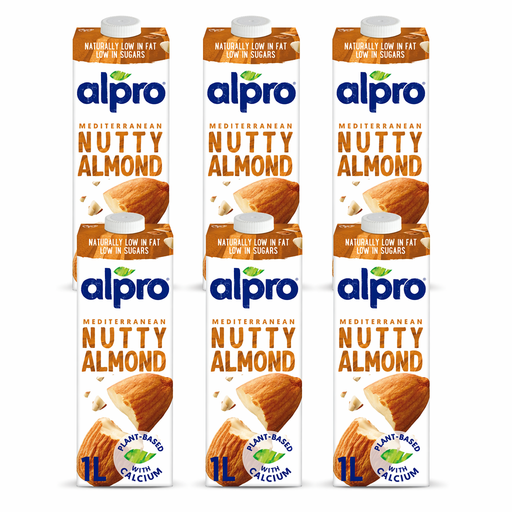
Alpro Almond Drink 1L — ‘6’ listing
This 1L almond-drink listing may suit recipe or household use, but the leading ‘6’ does not establish how many cartons are included: confirm the pack count before ordering. For a child, check the current carton’s calcium amount and age guidance. It contains almond and is not a replacement for a baby’s usual milk.
View on Joybuy
Questions about almond drink and weaning
Can almond drink be my baby’s main milk during baby-led weaning?
No. The NHS advises introducing foods from around six months alongside the baby’s usual breast milk or first infant formula. Frimley Healthier Together distinguishes using a fortified plant drink in cooking from six months from giving it as a main milk drink before the child is over one.
Can I use almond drink in a recipe for a baby of around six months?
Frimley Healthier Together says a fortified plant drink can be used in cooking from six months, but not as the baby’s main milk drink. Check the ingredients and account for almond as an allergen when introducing the recipe.
How should I introduce almond for the first time?
The NHS advises introducing allergenic foods one at a time, in very small amounts, from around six months so that a reaction can be spotted. Its advice is to serve nuts and peanuts crushed or ground; an almond drink does not remove the need to plan an age-appropriate introduction.
What should I check for a dairy-free child over one?
Read the individual carton’s age guidance and check calcium and iodine fortification. Kingston and Richmond NHS Foundation Trust suggests looking for around 120mg calcium per 100ml and notes that soya, oat and pea alternatives provide more energy and protein than almond drinks. A fortified label alone does not override a product-specific age restriction.
Does ‘6 pint’ mean six cartons of almond drink?
Not necessarily. Confirm the listing’s total volume, carton size and carton count before buying. For comparison, Plenish lists an 8 x 1L standard Almond M*lk multipack and a separate 6 x 1L Barista Almond M*lk multipack; neither description means six pints.


