Hosts serving a mixed spread
If the same carton will go with cereal, smoothies and other dishes, check its suggested uses and whether an unopened long-life carton fits your plans for preparing ahead.


For a mixed brunch spread, choose an unsweetened long-life almond drink if you want to keep an unopened carton ready; choose a barista version if foamed coffee is central to the menu. A short-ingredient-list drink suits that particular preference, but check its fortification separately. Do not rely on “filtered” wording alone: check the exact carton for ingredients, allergens, nutrition and storage instructions before serving guests.
If the same carton will go with cereal, smoothies and other dishes, check its suggested uses and whether an unopened long-life carton fits your plans for preparing ahead.
For flat whites or cappuccinos, look for a drink intended for frothing or steaming rather than assuming every almond drink will behave alike in coffee.
Dairy-free or vegan wording does not settle an almond-allergy question. Ask guests about allergies and check the particular carton’s ingredients, allergen information and nutrition.
Choose the type of drink for the food and coffee you plan to serve, then compare individual cartons for storage, ingredients, nutrition and allergens.
Choose when: You want an unopened carton ready for a varied brunch and prefer an unsweetened drink with stated fortification.
Bear in mind: Long-life storage and a no-sugars label do not establish how a drink will froth; check its coffee use separately.
Choose when: Foamed coffees are an important part of brunch. Plenish describes its Barista Almond M*lk as foamable, while Rude Health provides steaming instructions for Barista Almond.
Bear in mind: Check the whole recipe: Rude Health Barista Almond contains gluten-free oats as well as almonds.
Choose when: Ingredients are your deciding factor. Plenish describes its standard Almond M*lk as water, organic almonds and salt.
Bear in mind: A short ingredient list does not establish calcium or iodine fortification; check the nutrition panel if either matters to you.
| Priority | What to check | Your needs |
|---|---|---|
| Storage | Check whether the carton is labelled long-life or UHT, how to store it unopened, and what to do after opening. | I want to buy the drinks ahead of brunch without assuming a chilled carton and a long-life carton have the same storage instructions. |
| Coffee use | Look for a barista or foamable description if you plan to froth it. Read any chilling or steaming instructions for that product. | Flat whites are part of my menu, so coffee use matters more to me than choosing one carton for every dish. |
| Sugars and fortification | Compare sugars per 100 ml and the stated calcium and iodine amounts on the exact carton. NHS guidance identifies unsweetened, calcium-fortified plant drinks as dairy alternatives. | If almond drink regularly takes the place of dairy at my table, I want to check its nutrition rather than assume that every unsweetened or organic recipe is fortified. |
| Ingredients | Read the full list, particularly for barista recipes that may contain ingredients beyond almonds. Check a specific “filtered” claim on the carton rather than using the word to infer its recipe. | I prefer a short ingredient list for cereal or smoothies, but I still need to know what is in the particular drink I serve. |
| Guest allergens | Check the ingredient list, highlighted allergens and precautionary wording for each carton; ask guests about relevant allergies before serving. | A guest may avoid dairy but also have an almond allergy. Vegan wording cannot answer that separate question. |
Almond is an allergen. Vegan wording concerns animal-derived ingredients, not whether an almond drink is suitable for someone with an almond allergy.
Ask guests about allergies, then read the ingredients and allergen wording on the exact carton before serving.
Some plant-based alternatives are not fortified. NHS dietetic guidance notes that many organic or “clean” products lack fortification.
If calcium or iodine matters to your choice, look for the stated amounts on the nutrition panel.
Plenish and Rude Health specifically present their barista almond drinks for foamed coffee; that positioning does not establish the same result for their standard drinks.
If you plan to serve foamed coffees, check that the carton is intended for frothing and follow its preparation instructions.
Chilled and long-life products can carry different storage instructions, and details also differ between recipes.
Before serving, check the carton in hand for ingredients, allergens, its best-before date and instructions after opening.
These brand examples illustrate differences between particular almond drinks; the brand name alone does not tell you a carton’s recipe or storage requirements.
Alpro lists no-sugars and Original almond drinks, including a long-life no-sugar option.
Rude Health has a standard Almond Drink and a coffee-focused Barista Almond recipe.
Plenish distinguishes its short-ingredient-list standard Almond M*lk from a Barista Almond M*lk marketed for coffee.
Tesco lists an own-label Unsweetened Almond Drink alongside branded almond drinks in its UK range.
Sainsbury's describes an Unsweetened Long Life Almond Drink and a separate chilled Unsweetened Almond Drink.
M&S lists an Unsweetened Almond Drink with added calcium, iodine and vitamins D and B12.
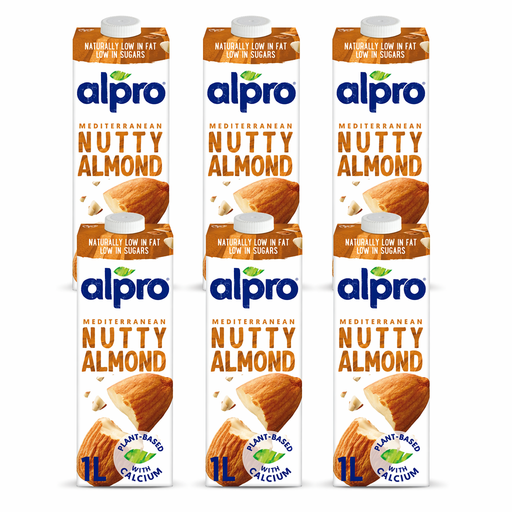
These Alpro multipacks are options for serving almond drink with a mixed brunch spread. Compare their exact cartons if unopened storage, sugars, fortification or a filtered claim will determine your choice.
 No image available
Consider this long-life, no-sugars multipack if you want cartons ready for a mixed brunch. Check the exact carton for its calcium and iodine declarations, allergen wording and storage instructions after opening; do not infer a filtering method from the product name.
 No image available
Consider this multipack for serving almond drink alongside cereal or smoothies. Check the particular carton’s sugar content, calcium and iodine declarations, allergens and storage instructions; its name does not establish that it is a no-sugars, long-life or filtered variant.
Choose a carton labelled for ambient, long-life storage if you need to keep it unopened before guests arrive. ASDA describes Alpro Almond No Sugar Long Life as ambient and UHT; Sainsbury's describes its Unsweetened Long Life Almond Drink as ultra-heat-treated. Follow the carton’s separate instructions once it is open.
Choose one if foamed coffee is an important part of the menu. Plenish markets its Barista Almond M*lk as foamable, while Rude Health supplies steaming instructions for Barista Almond. If you mainly need a drink for cereal and smoothies, check an everyday version’s stated uses instead.
No: vegan wording does not make almonds safe for someone with an almond allergy. The Food Standards Agency identifies almond as an allergen; ask your guest about allergies and check the exact drink’s ingredient and allergen information before serving.
Check its calcium and iodine declarations if you are choosing it to replace dairy regularly. NHS guidance discusses unsweetened, calcium-fortified plant drinks as dairy alternatives, while NHS dietetic guidance notes that some alternatives are not fortified. Read the amounts on the particular carton rather than assuming a short ingredient list answers the question.
Follow the instructions for the carton you bought. M&S says to refrigerate its Unsweetened Almond Drink at 0°C to +5°C and consume it within three days of opening; Sainsbury's also says to use its chilled Unsweetened Almond Drink within three days after opening. Do not apply either period to every almond drink.