Christmas hosts serving dairy-free guests
Match the drink to breakfast, baking or hot drinks, and check each guest’s allergen needs before serving. Dairy-free does not mean nut-free.


For a Christmas food shop, choose an almond drink by its intended use and who will drink it: compare fortified cartons for regular dairy replacement, a barista formulation for foamed coffee, and short-ingredient recipes if that is your preference. Check the exact carton for allergen warnings and storage instructions; almond drink is not suitable for a guest with an almond allergy.
The right carton depends on whether you are serving guests, replacing dairy regularly or making a particular recipe.
Match the drink to breakfast, baking or hot drinks, and check each guest’s allergen needs before serving. Dairy-free does not mean nut-free.
If it will often replace dairy, compare the carton’s calcium, iodine, vitamin D and B12 information rather than choosing by flavour or ingredients alone. University Hospitals Sussex NHS Foundation Trust advises checking fortification when selecting milk alternatives.
A short ingredient list may matter for a recipe, while a coffee-focused purchase calls for checking whether the particular drink is intended to foam and how it should be added to hot liquid.
Start with guest safety, then choose for regular use or a specific Christmas serving job; plan opened cartons around when you will use them.
| Priority | What to check | Your needs |
|---|---|---|
| Guest allergens | Read the exact pack’s almond and other allergen statements. Check again before serving, particularly if a guest has another nut or peanut allergy. | I need a drink every intended guest can have; a dairy-free label alone cannot answer a nut-allergy question. |
| Fortification | Compare calcium, iodine, vitamin D and B12 on the individual carton. If nutritional replacement matters, check protein and energy per 100 ml too; University Hospitals Sussex NHS Foundation Trust notes that almond drinks can be low in protein. | If almond drink will replace dairy regularly, I want to compare its nutrients rather than assume every almond recipe is equivalent. |
| Serving use | For foamed coffee, check for a barista formulation. For standard drinks in hot drinks, follow the carton’s preparation directions: Tesco advises against boiling water for its unsweetened drink, while Sainsbury’s advises letting water cool slightly for its long-life drink. | I may need one carton for cereal or cooking, but a coffee gathering makes foaming and hot-drink directions more important. |
| Ingredients | Read both the ingredient list and nutrition panel. Rude Health Pure Almond lists water and 5% organic Italian almonds; Plenish describes its standard Almond M*lk as a three-ingredient recipe. Neither description establishes fortification. | A short ingredient list matters to me for this recipe, but I do not want to mistake it for a complete nutrition comparison. |
| Carton planning | Check the unopened carton’s date and storage directions, then its refrigeration and consumption instructions after opening. Tesco specifies 5 days for its unsweetened almond drink; Sainsbury’s specifies 3 days for its unsweetened long-life drink. | For several Christmas meals, I want to open cartons when I can use them within their individual pack instructions. |
Almond is a tree nut. Sainsbury’s warns that its unsweetened long-life drink is unsuitable for people allergic to other nuts because of its manufacturing methods; M&S warns against its unsweetened drink for people with a nut or peanut allergy.
Ask about relevant allergies and read the physical pack before buying and serving. Do not serve almond drink to someone with an almond allergy.
Ingredient simplicity does not establish whether a drink contains added calcium, iodine, vitamin D or B12. University Hospitals Sussex NHS Foundation Trust advises choosing fortified milk alternatives when these nutrients matter.
For regular dairy replacement, compare the nutrition information on the exact cartons under consideration.
Plenish markets its Barista Almond M*lk for foaming, while Tesco and Sainsbury’s give preparation cautions for their standard drinks in hot liquid.
If foam is the reason for buying, consider a barista-specific carton. Otherwise, follow the standard drink’s hot-drink directions.
Opened-carton instructions differ: Tesco specifies refrigeration and consumption within 5 days for its unsweetened drink, while Sainsbury’s specifies 3 days for its unsweetened long-life drink.
Plan openings around guests and recipes, and follow each pack’s refrigeration instructions.
Opening several cartons at once can leave unused drink beyond its stated consumption period.
These examples illustrate differences between specific drinks, not properties shared by every product from a brand.
Its Almond No Sugars long-life drink is listed for cereal, shakes, tea and coffee.
Pure Almond is a distinct short-ingredient option within the brand’s almond-drink range.
Its standard Almond M*lk and Barista Almond M*lk serve different ingredient and coffee preferences.
Its Unsweetened Almond Drink 1L is a UHT carton with added nutrients.
Its Unsweetened Long Life Almond Drink 1L is fortified and intended for unopened storage according to its pack directions.
Its Unsweetened Almond Drink lists added calcium, iodine, vitamin D and B12.
These Alpro options are relevant when stocking almond drink for Christmas cereal, drinks or cooking. Check the individual product details and pack before choosing for a guest.
 No image available
The 8 x 1L long-life format may suit a shop covering several Christmas servings, including cereal and hot drinks. Check the exact pack for allergen information, fortification and instructions for each carton after opening; it contains almond.
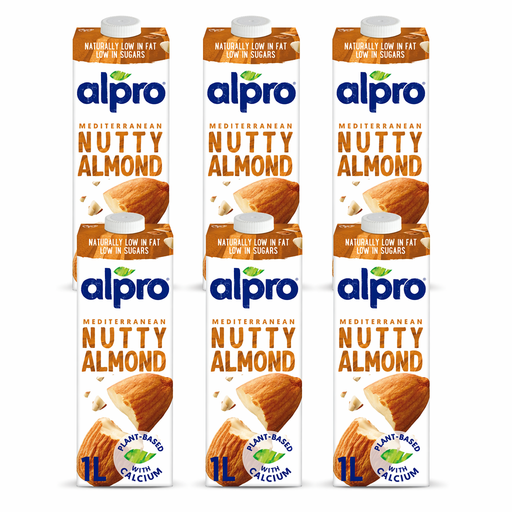 No image available
This almond drink is described for cooking and hot or cold serving. Sugar appears in its listed ingredients, so check the nutrition panel rather than assuming it is unsweetened; also check the pack’s allergen and opened-carton instructions.
Do not serve almond drink to someone with an almond allergy. Check other nut and peanut warnings on the exact pack too: Sainsbury’s warns that its unsweetened long-life drink is unsuitable for people allergic to other nuts, while M&S says its unsweetened drink is unsuitable for people with a nut or peanut allergy.
Compare fortification when the drink will replace dairy regularly rather than appear in one recipe. University Hospitals Sussex NHS Foundation Trust advises choosing milk alternatives fortified with nutrients such as calcium, vitamin D, B12 and iodine; check the individual carton, including its protein and energy information, rather than assuming nutritional equivalence.
Look for a drink specifically intended to foam; Plenish markets its Barista Almond M*lk for that use. If using a standard drink in a hot coffee, follow its carton directions: Tesco advises against boiling water for its unsweetened drink, and Sainsbury’s advises allowing water to cool slightly for its long-life drink.
Follow the exact carton’s refrigeration and consumption instructions. Tesco specifies consumption within 5 days of opening for its Unsweetened Almond Drink, while Sainsbury’s specifies 3 days for its Unsweetened Long Life Almond Drink.