What should you check before buying?
Start with allergens and your main use, then compare the ingredients and nutrient declarations of the exact variants you are considering.
| Priority | What to check | Your needs |
|---|
| Allergens |
Read the dairy-free statement, ingredients and current allergen information. Almond drinks contain almonds; also check any precautionary allergen wording. |
I need to avoid dairy, but I cannot treat that label as reassurance about a nut allergy. |
| Regular replacement |
Compare declared calcium, vitamin D, B12 and iodine on each carton, along with its sugar declaration. NHS guidance on vegan diets identifies fortified dairy alternatives as one way to obtain nutrients that need planning. |
When I use almond drink regularly instead of dairy, I want to know which nutrients this particular variant declares. |
| Ingredients |
Read the full recipe rather than relying on an organic or dairy-free description. Check separately for fortification; the British Society for Allergy & Clinical Immunology notes in its guidance on plant drinks for children that organic products are not fortified. |
A shorter ingredient list matters more to me for general pouring, but I will not assume it supplies the nutrients of a fortified drink. |
| Coffee |
Look for a variant explicitly intended to foam. Check its ingredients and nutrient declaration separately if you also use it in place of dairy throughout the day. |
For cappuccinos or flat whites, I care about whether the drink is formulated for frothing. |
| Young children |
The British Society for Allergy & Clinical Immunology advises that tree-nut drinks are least preferred for children aged one and over because of their lower nutritional content. Its guidance discusses fortified, unsweetened soya, pea and oat drinks where a plant drink is used. |
If I am choosing a main milk drink for a young child, I need to consider the child-specific guidance rather than use an adult almond-drink preference as the deciding factor. |
What do the relevant brands offer?
Compare individual variants, not just brand names: a standard recipe, a fortified drink and a barista product answer different needs.
Alpro
The Joybuy listings for Alpro Almond Drink and Alpro Almond No Sugars show different ingredient and nutrient declarations.
- Alpro Almond No Sugars is labelled dairy-free and lists calcium and vitamins B2, B12 and D.
- The separately listed Alpro Almond Drink contains sugar and lists iodine. Check which variant you are buying; both contain almond.
Rude Health
Rude Health lists a standard organic Almond Drink and a separate Chilled Almond Drink with Calcium.
- The standard drink lists spring water, organic rice, organic Italian almonds (1%), organic cold-pressed sunflower oil and sea salt.
- The chilled calcium-enriched version has a different recipe, including calcium carbonate. Check the exact product if fortification is important; both contain almonds.
Plenish
Plenish describes its Barista Almond M*lk as a drink made for foaming in coffee.
- For coffee use, the brand describes this barista variant as foamable and made without oils or additives.
- A claim about foaming does not establish its nutrient fortification. Check the exact carton if it is also your regular dairy replacement.
Almond drinks on Joybuy
These two Alpro almond drinks are options for everyday pouring when you want to compare declared nutrients and sugar ingredients. Their labels differ, so choose the variant that matches what you need to check.
 No image available
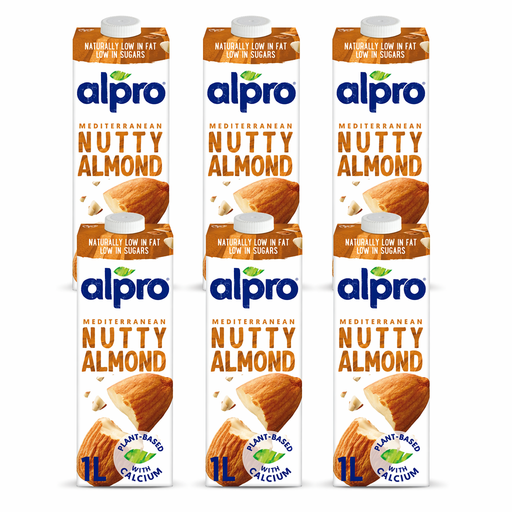
Alpro Almond Drink, 6 × 1L
For everyday pouring, this listing declares calcium, vitamins B12 and D2, vitamin E and iodine. Its ingredients include almond (2.3%) and sugar; check the nutrition panel if the amount of sugar matters to you. It is not suitable for someone with an almond allergy.
View on Joybuy
 No image available
Alpro Almond No Sugars Long Life Drink, 8 × 1L
For a dairy-free everyday drink without sugars or sweeteners, this listing declares calcium and vitamins B2, B12 and D. It contains almond (2.5%) and ingredients including soluble corn fibre, sunflower lecithin and gellan gum. If iodine matters to your choice, check its declaration on the current carton; it is not suitable for someone with an almond allergy.
View on Joybuy
Common questions
Can I choose almond drink if I avoid dairy?
A product labelled dairy-free may suit dairy avoidance if its exact ingredients meet your requirements, but almond drink is not suitable for someone with an almond allergy. Check the current pack’s ingredients, allergen declaration and any precautionary wording.
What should I check if almond drink regularly replaces dairy?
Check the exact carton for declared calcium, vitamin D, B12 and iodine rather than assuming every almond drink is fortified. NHS guidance on vegan diets highlights fortified dairy alternatives, while the British Dietetic Association identifies iodine-fortified plant alternatives as one potential iodine source when planning a vegan diet.
Does an organic almond drink contain added nutrients?
Do not infer fortification from an organic description. The British Society for Allergy & Clinical Immunology states in its guidance on plant drinks for children that organic products are not fortified; check the individual carton for its declared nutrients.
Is almond drink a suitable main milk for a young child?
The British Society for Allergy & Clinical Immunology considers tree-nut drinks least preferred in its guidance on plant drinks for children aged one and over because of lower nutritional content. Where a plant drink is used, its guidance discusses fortified, unsweetened soya, pea and oat alternatives; seek individual advice if there are concerns about a child’s diet or growth.
Which almond drink should I consider for frothed coffee?
Start with a barista-labelled variant when foam is the priority. Plenish describes its Barista Almond M*lk as foamable for coffee, but that brand description does not establish how a standard almond drink will froth.


