Hosts serving a gluten-free guest
If an almond drink is going into dessert, a sauce or an after-dinner drink, check the exact carton for a gluten-free statement. Dairy-free and vegan claims answer different questions.


For a gluten-free guest, choose an almond drink whose exact carton says ‘gluten free’, rather than relying on a dairy-free or plant-based claim; the Food Standards Agency says this label applies to food containing no more than 20 mg/kg of gluten as sold. If the dinner ends with a foamed coffee drink, also look for a foamable barista product; if the guest wants independent certification, check the carton for Coeliac UK’s Crossed Grain Trademark.
If an almond drink is going into dessert, a sauce or an after-dinner drink, check the exact carton for a gluten-free statement. Dairy-free and vegan claims answer different questions.
If the menu depends on froth for a cappuccino or coffee-based dessert, look for a product described as foamable as well as checking its gluten-free claim.
If the guest specifically wants third-party certification, look for Coeliac UK’s Crossed Grain Trademark on the carton. Coeliac UK says its scheme includes checks of gluten analysis certificates and independent manufacturing audits.
Start with the guest’s gluten-free requirement, then choose a formulation for the dish or drink you plan to serve.
| Priority | What to check | Your needs |
|---|---|---|
| Gluten-free label | Look for ‘gluten free’ on the exact carton. The Food Standards Agency states that the claim applies when food as sold contains no more than 20 mg/kg of gluten. | I’m serving someone who needs a gluten-free dinner, so a dairy-free, vegan or organic label alone will not answer this question. |
| Certification | If independent certification matters, check the carton for Coeliac UK’s Crossed Grain Trademark. It is separate from a gluten-free claim. | My guest has asked for a certified product, not just one labelled gluten free. |
| Coffee foam | For drinks that need froth, check both a foamability claim and the gluten-free statement. Alpro describes Barista Almond as foamable; Sainsbury’s lists that product as gluten free. | I’m planning cappuccinos or another coffee course where foam is part of the drink. |
| Recipe fit | Read the ingredients and per 100 ml nutrition panel for sugar content and additions such as rice, oats or oil. Check the allergen information for the people you are serving. | For a chilled drink, sauce or dessert, I want the carton’s ingredients and flavour to suit the recipe. |
Dairy-free, vegan and organic labels describe different properties. A short ingredient list does not establish that a drink meets the gluten-free labelling threshold.
Check the exact carton for ‘gluten free’. If the guest requests independent certification, check separately for the Crossed Grain Trademark.
Foamability is product-specific. A standard drink’s gluten-free claim does not tell you how it will behave in a cappuccino or coffee dessert.
When froth matters, choose a product described as foamable and confirm that the exact product is also labelled gluten free.
Formulations differ: Alpro lists 2.4 g sugars per 100 ml for Almond Original, while Rude Health lists rice and sunflower oil in its standard Almond Drink.
Compare the carton’s ingredients and nutrition panel with the recipe and diners’ preferences before buying.
These brand examples help distinguish product claims and formulations; check the exact carton you intend to serve.
Alpro offers standard and barista almond drinks with different uses.
Its standard and barista almond drinks have distinct formulations.
Plenish describes its standard Almond M*lk as made with water, organic almonds and salt, and its Barista Almond as foamable.
Tesco lists an own-label Unsweetened Almond Drink in its gluten-free dairy-alternative category.
Sainsbury’s product listings include gluten-free statements for specific Alpro and Rude Health almond drinks.
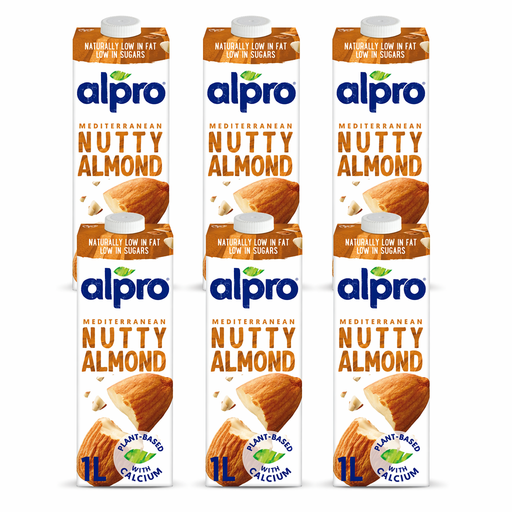
These standard Alpro almond-drink multipacks are options for serving or cooking when coffee foam is not central to the menu. Check the exact cartons for a gluten-free statement before serving them to a gluten-free guest.
 No image available
A standard almond drink for serving or mixing into drinks when froth is not required. The Joybuy listing describes it as gluten free and reports 0.0 g sugars per 100 ml, plus calcium and vitamins B2, B12 and D. Check the carton for the gluten-free statement and, if requested, the Crossed Grain Trademark.
 No image available
The Joybuy listing describes this standard almond drink for hot or cold serving and cooking. Its stated 2.3% almond formulation corresponds to Alpro’s Almond Original product information, which labels that product gluten free; confirm the claim on this multipack’s exact carton before serving it to a gluten-free guest. Check separately for the Crossed Grain Trademark if certification is required.
The Food Standards Agency states that food labelled ‘gluten free’ must contain no more than 20 mg/kg of gluten as sold to the final consumer. Check that the statement appears on the exact drink you are buying.
No. A gluten-free claim and Coeliac UK’s voluntary Crossed Grain Trademark are different. Coeliac UK says certified products undergo additional checks, including review of gluten analysis certificates and independent manufacturing audits; look for the trademark on the carton if the guest requests it.
If the drink needs foam, look for both a foamability claim and a gluten-free statement for the exact product. Alpro describes Barista Almond as foamable, and Sainsbury’s lists it as gluten free; Rude Health also describes its Barista Almond as gluten free and provides steaming instructions.
Not on that basis alone. Organic status and ingredient simplicity do not establish a gluten-free claim, so check the exact carton before using the drink for a gluten-free guest.
Read the exact carton for a gluten-free statement, the ingredients and allergen information. If the guest requires independent certification, also check for Coeliac UK’s Crossed Grain Trademark; a dairy-free or vegan claim does not replace either check.