What should you check on the carton?
Start with who will drink it, then check unopened storage, sugars and added nutrients on the exact product.
| Priority |
What to check |
Your needs |
| Cupboard storage |
Look for long-life or UHT labelling. Check pack quantity and the instructions for refrigeration and use after opening. |
I want unopened cartons ready for cereal or drinks over half term, without buying more than we can use once they are opened. |
| Sugars and fortification |
Compare sugars per 100 ml and read the ingredients for added sugar. Check the exact label for calcium, iodine and vitamins rather than assuming all almond drinks have the same additions. |
If this will be a regular drink at home, I want to distinguish a no-sugars recipe from one containing sugar and see which nutrients have been added. |
| Young children |
Distinguish an occasional snack drink from a routine milk substitute. The British Society for Allergy & Clinical Immunology’s May 2026 guidance advises unsweetened, fortified plant drinks where they are used, while regarding tree-nut drinks as least preferred for children aged 1 to 5. |
For a young child who drinks a plant alternative regularly, I need to consider the whole diet, not just whether one carton is fortified. |
| Nut allergens |
The Food Standards Agency identifies almonds as nuts. Read the ingredient and any ‘may contain’ statements on the exact carton, particularly where other nut allergies are relevant. |
If someone drinking it has an almond allergy, a dairy-free almond drink is not an alternative for them. |
| Ingredient list |
Compare the ingredients on the exact variant. If choosing an organic plant drink, bear in mind the UK government’s 2025 finding that these drinks cannot be fortified in the UK. |
I may prefer a shorter recipe for occasional cereal or cooking, but I do not want to mistake that for added nutrients. |
Almond-drink brands and their differences
Compare named products rather than assuming every recipe from a brand has the same sugars, ingredients or added nutrients.
Alpro
Alpro UK lists both an Almond Roasted No Sugars drink and an Almond Original drink; their nutrition panels differ.
- Alpro UK lists 0 g sugars per 100 ml for Almond Roasted No Sugars, alongside calcium, iodine and vitamins D2 and B12.
- Its Almond Original lists sugar in the ingredients and 2.4 g sugars per 100 ml. Check the exact variant rather than applying either figure to all Alpro almond drinks.
Rude Health
Rude Health lists water and 5% organic Italian almonds as the ingredients of Pure Almond.
- The published Pure Almond recipe has two ingredients.
- A short ingredient list is not a fortification claim. The UK government’s 2025 assessment states that organic plant-based drinks in the UK cannot be fortified.
Plenish
Plenish lists water, organic almonds and salt in its Almond M*lk.
- Plenish describes this recipe for cereal, smoothies, porridge, baking and coffee.
- If added nutrients matter for the intended use, check the exact carton rather than treating its short organic recipe as equivalent to a fortified drink.
Joybuy almond drinks for half-term snacks
These Alpro options cover a no-sugars long-life multipack and an almond drink containing sugar. Compare the exact pack and carton labels before choosing one for cupboard storage or regular use.
 No image available
Alpro Almond No Sugars Long Life Drink 8 x 1L
The UHT long-life format and 8 x 1L pack suit shopping ahead for cereal, smoothies or drinks, provided the household can use the cartons in line with their storage instructions. The product information lists 0.0 g sugars per 100 ml, calcium and vitamins B2, B12 and D; check the exact carton if iodine content matters. Contains almond and should not be treated as nutritionally interchangeable with cows’ milk for a child aged 1 to 5.
Joybuy
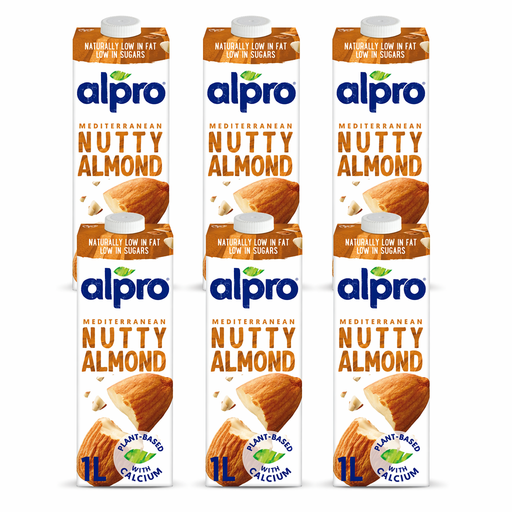 No image available
Alpro Almond Drink 1L
This almond drink is described for cereal, smoothies and hot drinks. Its product information lists sugar, calcium, iodine and vitamins B12, D2 and E, so it is not the no-sugars option; Alpro UK lists 2.4 g sugars per 100 ml for its matching Almond Original formulation. Confirm the pack quantity before buying, as the product title suggests six while the description states a net quantity of 1L. Contains almond; for children aged 1 to 5, do not assume an almond drink is nutritionally interchangeable with cows’ milk.
Joybuy
Questions about almond drinks
Does ‘filtered’ tell me which almond drink to buy?
No: do not use ‘filtered’ as a shortcut for cupboard storage, sugars, fortification or suitability for children. Check the exact carton for long-life or UHT labelling, then read its ingredients and nutrition panel.
What matters for a long-life almond drink over half term?
Check long-life or UHT labelling on the product you intend to buy, along with its pack size and after-opening storage instructions. If sugars or added nutrients affect your choice, compare the figures and ingredients on that same carton rather than relying on the storage description.
Can almond drink routinely replace cows’ milk for a child aged 1 to 5?
Do not assume it can. The British Society for Allergy & Clinical Immunology’s May 2026 guidance advises unsweetened, fortified plant drinks where they are used, but regards tree-nut drinks as least preferred for children aged 1 to 5 because of their lower nutritional content. Seek dietetic advice if the child has wider dietary restrictions or concerns about nutritional status or growth.
Is almond drink suitable for someone with a nut allergy?
An almond drink is unsuitable for someone allergic to almonds. The Food Standards Agency identifies almonds as nuts; read the exact product’s ingredients and any cross-contact statement when other nut allergies are relevant.
How should an opened long-life carton be stored?
Follow that carton’s instructions rather than its unopened-storage description. A Joybuy listing for Alpro Almond Drink 1L says to refrigerate it after opening and use it within five days; instructions for other products may differ.


