Who is choosing the drink?
The first distinction is whether almond drink is an occasional cooking ingredient, a regular dairy replacement or a drink for someone whose swallowing needs have been assessed.
Older adults replacing dairy regularly
If almond drink features often in breakfasts or soft meals, compare its nutrient label rather than choosing by flavour alone. The British Dietetic Association advises people over 65 to pay attention to protein, calcium, folate and vitamin B12 across their diet; one drink does not stand in for the whole meal.
Home cooks preparing easy-chew meals
For someone who can safely drink ordinary thin liquids, an almond drink can be considered for porridge, smoothies or moistening other soft dishes. Choose the exact carton according to the recipe and whether added sugar or a short ingredient list matters.
Carers supporting someone with swallowing difficulty
Chewing needs and liquid consistency are separate decisions. NHS Frimley guidance calls for speech and language therapy assessment when dysphagia is suspected; follow the person’s advised drink consistency rather than selecting a standard carton by appearance.
What should you check?
Establish whether ordinary thin drinks are appropriate, then compare the exact carton’s nutrients, sugar information and allergen statement for the meals you plan to make.
| Priority |
What to check |
Your needs |
| Nutrients |
Compare listed calcium, iodine and vitamins D and B12 on the exact carton. Check protein per 100 ml or 100 g using the unit shown; the 2025 SACN and COT assessment says plant-drink nutrient content varies considerably. |
If I use almond drink in place of dairy most days, I want to know what the drink contributes and what the rest of my meals still need to provide. |
| Sugar and cooking use |
Read both the ingredient list and sugars figure rather than relying on a flavour or barista description. Check the maker’s suggested uses if the carton needs to work in porridge, smoothies or cooking. |
I want a drink that fits the dishes I prepare without adding sugar I did not intend to use. |
| Drink consistency |
For a prescribed fluid plan, follow the advised International Dysphagia Diet Standardisation Initiative (IDDSI) level and preparation instructions. IDDSI gives ordinary milk as an example of a Level 0 thin liquid; a creamy appearance does not establish a different consistency. |
If the person coughs or chokes with drinks, I need swallowing guidance before choosing an ordinary almond drink. |
| Allergens |
Read the current pack’s ingredient and precautionary allergen statements. The Food Standards Agency identifies almonds as tree nuts; warnings about other nuts or peanuts differ between products. |
Where nut or peanut allergy is a concern, I cannot use a dairy-free claim to decide whether this carton is suitable. |
Brand and retailer references
These examples show why checking the particular almond drink matters more than relying on a brand name; they do not indicate which products a retailer currently stocks.
Alpro
Alpro offers different almond-drink variants. Its Roasted Almond No Sugars product is an example to compare when fortification and an unsweetened formulation matter.
- Alpro lists calcium, iodine, vitamins D2 and B12, and 0 g sugars per 100 ml for Roasted Almond No Sugars.
- That product also lists 0.5 g protein per 100 ml and includes stabilisers, natural flavouring and lecithin. Do not transfer its figures to a different Alpro variant without checking that variant’s label.
Rude Health
Rude Health No Sugars Organic Almond Drink is an option to examine if a short ingredient list is the priority.
- Rude Health lists spring water, 3% organic almonds, organic carob seed flour and sea salt for this product.
- Its label warns that it may contain traces of other nuts. The 2025 SACN and COT assessment states that UK plant drinks labelled organic cannot be fortified.
Plenish
Plenish Almond M*lk is a three-ingredient organic option described by its maker for uses including porridge and baking.
- Plenish lists water, organic almonds and salt, with no added sugar, oils or additives.
- For regular dairy replacement, compare its nutrient contribution with a fortified carton: the 2025 SACN and COT assessment says UK organic plant drinks cannot be fortified.
Tesco
Tesco’s almond-drink listings offer a way to compare an own-label unsweetened carton with named brands.
- Tesco lists Tesco Unsweetened Almond Drink 1L alongside Alpro, Plenish and Rude Health options.
- Check the particular carton’s current formulation and nutrition panel rather than assuming the listed drinks have equivalent ingredients or fortification.
M&S
M&S Unsweetened Almond Drink is an own-label fortified option to compare for regular meal use.
- M&S lists added calcium, iodine and vitamins D and B12, with 0.2 g sugars and 0.5 g protein per 100 g.
- M&S marks this product unsuitable for nut and peanut allergy and advises shoppers to read the current label because product information can change.
Almond drinks on Joybuy
These two Alpro almond drinks are options to consider for drinks and meal preparation when ordinary thin liquids are appropriate. Check the particular variant and pack against your ingredient and nutrient priorities.
 Image unavailable
Alpro Almond No Sugars Long Life Drink, 8 × 1L
A no-sugars variant to consider for cereal or smoothies when ordinary thin drinks are suitable. If it will regularly replace dairy, compare the current carton’s calcium, iodine, vitamin and protein information with what you need from the wider diet; check its almond allergen statement too.
View on Joybuy
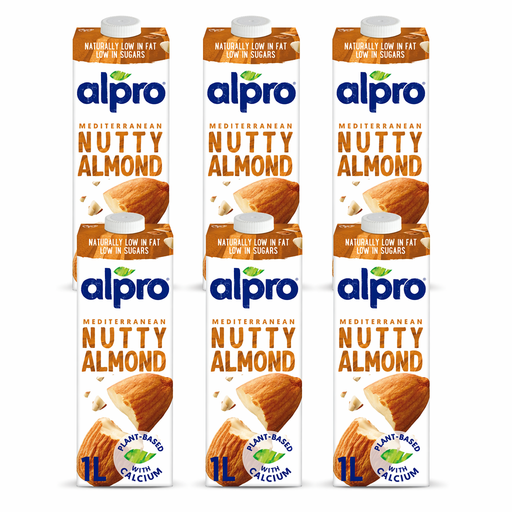 Image unavailable
Alpro Almond Drink 1L (listing marked 6)
This almond drink is described for cooking and for hot or cold use. Its listed ingredients include sugar, so check the current carton if avoiding added sugar matters; compare its nutrient and protein figures before relying on it as a regular dairy replacement. Confirm the pack quantity before ordering, as the listing title indicates “6” while its description gives a net quantity of 1L, and read the almond allergen statement.
View on Joybuy
Common questions
Can almond drink be used in easy-chew meals?
It can be considered for moistening or blending food if the person can safely drink ordinary thin liquids. That does not establish the correct food texture for someone with dysphagia: IDDSI uses ordinary milk as an example of a Level 0 thin liquid, and individual swallowing guidance takes priority.
What if someone coughs or chokes when drinking?
Do not assume a standard almond drink is suitable because it looks creamy. NHS Frimley guidance calls for speech and language therapy assessment when dysphagia is suspected; follow the person’s advised IDDSI level and any instructions for preparing and checking a thickened drink.
Why compare fortification when replacing dairy?
Almond drinks do not all contribute the same nutrients: the 2025 SACN and COT assessment says plant-drink nutrient content varies considerably. The British Dietetic Association advises people over 65 to pay attention to nutrients including protein, calcium and vitamin B12, so check the exact carton and the contribution of the rest of the diet rather than assuming one fortified drink covers everything.
Are organic almond drinks fortified in the UK?
No. The 2025 SACN and COT assessment states that plant-based drinks labelled organic in the UK cannot be fortified with nutrients. If you choose one for its ingredient list, compare how the wider diet provides the nutrients you were seeking from the drink.
Does dairy-free almond drink suit someone with a nut allergy?
Do not assume so. The Food Standards Agency identifies almonds as tree nuts, while individual labels may carry further warnings: M&S marks its Unsweetened Almond Drink unsuitable for nut and peanut allergy, and Rude Health says its No Sugars Organic Almond Drink may contain traces of other nuts. Check the exact pack against the person’s allergy advice.


