Families packing dairy-free lunches
If an almond drink replaces dairy, check the carton for added calcium, iodine, vitamin D and B12 rather than assuming every almond drink has the same nutrient profile.


Check the school’s allergy policy before packing an almond drink: almonds are tree nuts, and Department for Education guidance for England says schools may discourage certain foods and should consider packed lunches in allergy-safety arrangements. If the drink is permitted and replaces dairy, compare unsweetened options for added calcium, iodine, vitamin D and B12. A long-life carton can be stored as its pack directs before opening, but its refrigeration and use-within instructions apply afterwards.
If an almond drink replaces dairy, check the carton for added calcium, iodine, vitamin D and B12 rather than assuming every almond drink has the same nutrient profile.
Almond is a tree nut, as classified by the Food Standards Agency. Check the school’s arrangements and the pupil’s allergy circumstances before considering flavour or ingredients.
Once the allergy and school-policy checks are settled, compare sugars per 100 ml alongside fortification. The word ‘unsweetened’ alone does not tell you what nutrients have been added.
Settle whether almond is appropriate for this school and pupil before comparing nutrition labels or choosing a carton for the lunchbox.
| Priority | What to check | Your needs |
|---|---|---|
| Allergies and school rules | Read the school’s current allergy policy, the ingredient and allergen declaration, and any relevant precautionary allergen statement. The Department for Education says schools in England may discourage certain foods and should consider packed lunches in allergy-safety arrangements. | I need a drink that the school permits and that is appropriate for the pupil’s allergy circumstances. If almonds are restricted, I’ll choose another permitted option. |
| Fortification | If replacing dairy, look for calcium, iodine, vitamin D and B12 on the current label. Compare protein and energy per 100 ml too; an almond drink should not be assumed nutritionally equivalent to cow’s milk. | The carton contributes to a dairy-free diet, so I want to know which nutrients it actually contains rather than choosing by flavour alone. |
| Sugars | Compare sugars per 100 ml on the nutrition panel, not just ‘unsweetened’ or ‘no sugars’ wording. Check fortification at the same time if the drink replaces dairy. | I’m looking for an unsweetened drink the pupil likes, without overlooking the nutrients we’re relying on it to provide. |
| Storage and portions | Check whether the carton is long-life and follow its storage directions before and after opening. For a 1 L carton, check the refrigeration and use-within instructions when pouring a lunch portion. | We may use one carton across several lunches, so I need a workable way to refrigerate it after opening and portion each drink. |
Almond is a tree nut. A dairy-free almond drink may still conflict with school allergy arrangements or an individual allergy plan.
Read the school’s current policy or ask the school before packing one. If a restriction applies, choose another permitted drink.
A short ingredient list does not establish that an almond drink contains added calcium, iodine, vitamin D or B12.
If it replaces dairy, read the nutrition panel and ingredients for the nutrients that matter to that choice.
‘Unsweetened’ does not specify the drink’s protein, fortification, allergen warnings or instructions after opening.
Compare the current packs side by side, including sugars and protein per 100 ml, added nutrients and storage directions.
A long-life carton’s unopened storage directions do not replace its instructions for a partly used carton.
Refrigerate it as directed, follow the stated use-within period and use a clean bottle when pouring a lunch portion.
These brand examples show why the exact carton matters: ingredient lists, fortification and storage instructions differ by product.
Alpro sells Original and Roasted Almond No Sugars drinks; check the specific variety rather than treating the two as equivalent.
Tesco lists unsweetened almond drinks, including a long-life option with added nutrients.
Sainsbury’s Unsweetened Long Life Almond Drink is a UHT option listed with added calcium, iodine, vitamin D and B12.
M&S lists an Unsweetened Almond Drink with added calcium, iodine, vitamin D and B12.
Plenish describes its Almond M*lk as made with almonds, water and salt.
Rude Health’s No Sugars Organic Almond Drink lists water, organic almonds, carob seed flour and salt.
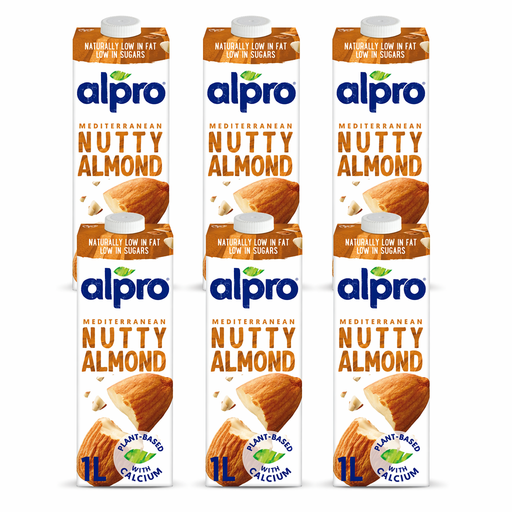
These Alpro multipacks are options to consider where the school permits almond drinks. Each contains 1 L cartons, so plan how to portion and store an opened carton for packed lunches.
 No image available
For a lunch where almond drinks are permitted, this long-life option can be portioned from its 1 L cartons. The product description states 0.0 g sugars per 100 ml and lists calcium and vitamins B2, B12 and D; check the current pack for the calcium amount and iodine if using it to replace dairy. It contains almond. Refrigerate after opening and follow the stated five-day use period.
 No image available
For a lunch where almond drinks are permitted, this UHT multipack contains six 1 L cartons to portion as needed. Its product description lists calcium, iodine and vitamins B12 and D2, as well as sugar among the ingredients; compare the current pack’s sugars and calcium values per 100 ml before choosing it for a particular nutrition need. It contains almond. Refrigerate after opening and follow the stated five-day use period.
Check that school’s current allergy policy and the pupil’s allergy circumstances first. Almond is a tree nut, and Department for Education guidance for England says schools may discourage certain foods and should consider food brought from home in their allergy-safety arrangements.
Check the current carton for added calcium, iodine, vitamin D and B12, and compare its protein and energy per 100 ml. NHS South West London’s parent guidance advises checking dairy alternatives for calcium fortification; do not assume that an almond drink matches cow’s milk nutritionally.
Not on its own. A short ingredient list does not establish fortification, so read the nutrition panel if the carton is expected to contribute calcium or other added nutrients. Check school and allergy requirements separately.
Follow that carton’s instructions after opening, including refrigeration and its stated use-within period. Marks & Spencer specifies 0°C to +5°C and three days for its Unsweetened Almond Drink; Tesco specifies refrigeration and five days for its long-life unsweetened almond drink.
No. ‘No sugars’ refers to sugars, not allergens. Alpro’s Roasted Almond No Sugars drink contains almond, which the Food Standards Agency classifies as a tree nut.