Families looking for a mild snack drink
If a child can have almonds and prefers a lighter flavour, compare how individual drinks are described and whether they suit serving cold, with cereal or in a smoothie.


For an occasional after-school snack, a lightly flavoured unsweetened almond drink is an option if the child can have almonds; Rude Health describes its No Sugars drink as subtly nutty, though taste is personal. If the drink replaces dairy, check the carton for calcium and iodine: Kingston and Richmond NHS Foundation Trust advises choosing fortified substitutes when a child cannot consume dairy. Do not give almond drink to a child with an almond allergy, and check the school’s allergy policy before packing one.
If a child can have almonds and prefers a lighter flavour, compare how individual drinks are described and whether they suit serving cold, with cereal or in a smoothie.
When a child cannot consume dairy, calcium and iodine on the individual carton matter more than an organic or short-ingredient-list description. Kingston and Richmond NHS Foundation Trust notes that some dairy substitutes are unfortified or low in protein or energy.
Almond drinks contain almonds. Before packing one for school, check the child’s allergy needs and the school’s own policy; England’s Department for Education says schools must publish an allergy safety policy.
Start with whether almonds are suitable for the child, then decide whether the drink is simply part of a snack or needs to replace dairy in their diet.
| Priority | What to check | Your needs |
|---|---|---|
| Flavour and sugars | Look for a flavour description that appeals to the child, then compare sugars using the same unit on each carton. Alpro UK lists 2.4 g sugars per 100 ml for Almond Original and 0 g per 100 ml for Roasted Almond No Sugars. | For a drink alongside a snack, I would rather start with a light flavour than assume every unsweetened variety tastes alike. |
| Replacing dairy | Check the exact carton for calcium and iodine, as well as its protein and energy values. Kingston and Richmond NHS Foundation Trust advises fortified dairy substitutes when a child cannot consume dairy and notes that some alternatives are low in protein or energy. | If dairy is excluded from the child’s diet, I need to consider what this drink contributes alongside the rest of their food, not just whether it tastes mild. |
| Allergens and school rules | Read the carton’s allergen declaration and check any child-specific allergy plan. Before packing the drink, check the school’s policy; England’s Department for Education requires schools to publish arrangements for managing allergy risks. | A child with an almond allergy cannot have an almond drink. For a school snack, I also need to know what that particular school permits. |
A short ingredient list or an unsweetened recipe does not establish the drink’s role in a dairy-free child’s diet. Kingston and Richmond NHS Foundation Trust notes that some dairy substitutes are unfortified or low in protein or energy.
If the child cannot consume dairy, check calcium, iodine, protein and energy on the carton, and consider the drink as part of their overall diet.
An almond-containing drink may conflict with a child’s allergy needs or a school’s arrangements. England’s Department for Education requires schools to publish an allergy safety policy.
Check the individual school’s policy and any child-specific allergy plan before packing almond drink. Choose a suitable non-nut option when almond is not permitted or is unsafe for the child.
Alpro UK lists 2.4 g sugars per 100 ml for Almond Original, compared with 0 g per 100 ml for Roasted Almond No Sugars. The range name alone does not tell you which recipe you have picked up.
Compare the nutrition panel and ingredients on the exact variant, including its fortification if the drink will replace dairy.
Ingredients and allergen information can change; Marks & Spencer advises shoppers to read the carton label rather than relying only on its website information.
Check allergens, fortification and storage instructions on the carton you buy.
These are references for comparing individual recipes and labels, not a substitute for checking the carton you intend to use.
Almond Original and Roasted Almond No Sugars offer different sugar levels within Alpro’s almond-drink range.
No Sugars Organic Almond Drink is an option to consider when a lighter flavour description is the starting point.
Plenish Almond M*lk is presented for uses including cereal and smoothies.
Unsweetened Almond Drink is a supermarket option with stated fortification.
These Alpro packs are options to compare for an after-school almond drink. The No Sugars pack speaks to an unsweetened preference; check the carton of either pack if it will replace dairy in a child’s diet.
 Image unavailable
For a child who can have almonds, this long-life pack offers an option labelled No Sugars for after-school snacks. If the drink will replace dairy, check the carton for calcium and iodine; follow the school’s allergy policy before packing it.
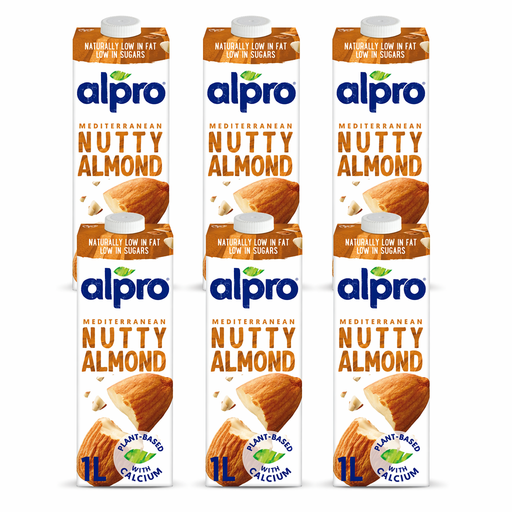 Image unavailable
For an after-school drink where dairy is excluded, compare this almond-drink pack against the carton’s calcium, iodine and sugars information before choosing it. It contains almond, so check the child’s allergy needs and any school policy before packing it.
Check the individual school’s allergy policy before sending one. In England, the Department for Education says schools must publish an allergy safety policy setting out how they reduce contact with known allergens; check any child-specific allergy plan as well.
For a child over one who can have almonds, check that the chosen drink lists calcium and iodine if it will replace dairy. Kingston and Richmond NHS Foundation Trust advises fortified substitutes when a child cannot consume dairy and notes that some alternatives are low in protein or energy. North East London NHS Foundation Trust says plant-based drinks should not replace breast milk or formula as the main milk drink before age one.
No: sugar information and flavour descriptions answer different questions. Alpro UK lists 0 g sugars per 100 ml for Roasted Almond No Sugars, while Rude Health describes its own No Sugars drink as subtly nutty with a light mouthfeel. Check the exact variant and remember that a child’s taste preference may differ from the description.
Follow the storage instructions on the individual carton, including its refrigeration guidance and time limit after opening. Check those instructions for each brand and format rather than applying one product’s directions to another.