Parents checking a school’s nut policy
Almonds are tree nuts, according to the Food Standards Agency. Check the school’s current packed-lunch rules before choosing a drink, even if your child can have almonds.


Check the school’s packed-lunch and allergy policy before buying almond drink: the Food Standards Agency classifies almonds as tree nuts, so it is not a lunchbox option where the school restricts them. If the school permits almonds and the child can have them, check that a multipack contains practical individual portions rather than assuming a large carton or multi-buy will do. If the drink will regularly replace dairy, compare fortification on the current label and seek advice about any restricted dietary needs.
Almonds are tree nuts, according to the Food Standards Agency. Check the school’s current packed-lunch rules before choosing a drink, even if your child can have almonds.
If almond drink will regularly replace dairy for a child, consider the child’s allergies and compare calcium, iodine and vitamin information on the specific pack. Discuss a restricted diet with an appropriate healthcare professional.
Check both the number of units and the volume of each one. A large carton or a multi-buy offer does not necessarily provide a separate, sealed drink for each lunch.
Start with the school’s rules and the child’s allergen needs; only then compare portion format, storage instructions and the label information relevant to how often the drink will be used.
| Priority | What to check | Your needs |
|---|---|---|
| School rules | Ask whether the school permits almond products in packed lunches. The Food Standards Agency identifies almonds as tree nuts; check the particular school’s allergy arrangements. | I need a drink the school permits in my child’s lunchbox, not just one labelled dairy-free. |
| Portion and storage | Check the unit count, volume per unit and whether each portion is sealed. Read the pack’s instructions for storage before and after opening. | For several lunches, separate portions may be more practical than dividing an opened large carton. |
| Regular dairy replacement | Compare calcium, iodine and listed vitamins on the current nutrition label. Consider the child’s wider diet if the drink will be used regularly in place of dairy. | If this will be a regular dairy-free drink, I want to compare the actual labels rather than assume all almond drinks have the same fortification. |
| Allergen label | Read the ingredients and allergen statements on the specific pack, including any suitability warnings. Check again when changing products. | A familiar product name is not enough when I am checking whether a drink is suitable for a child with allergies. |
Almond is a tree nut, according to the Food Standards Agency. A school restriction on nuts can rule out an almond drink regardless of whether it contains dairy.
Read the school’s current packed-lunch and allergy policy before buying. If it restricts nuts, choose a drink the school permits instead.
A 1L carton does not provide separate sealed drinks for several lunches. Tesco’s almond-drink category includes 1L cartons and a 500ml item, so category placement alone does not establish the format.
Check the number of units and millilitres per unit on the product page or pack; do not rely on a multi-buy label.
Those descriptions do not tell you whether a drink lists calcium, iodine or added vitamins. This matters when it will regularly replace dairy.
Compare current nutrition labels. For a child with a restricted diet, seek individual advice rather than treating different almond drinks as interchangeable.
An opened large carton is not equivalent to a sealed individual portion. Marks & Spencer says its 1L Unsweetened Almond Drink should be consumed within three days of opening.
Follow the storage and use instructions on the carton you buy before planning to use it across several lunches.
These references help distinguish product types and label details; a brand’s inclusion does not mean every one of its drinks comes in a lunchbox multipack.
Alpro UK lists Almond Original as a 1L drink.
Rude Health lists a standard Almond Drink and a chilled Almond Drink with Calcium.
M&S lists Unsweetened Almond Drink in a 1L carton.
Tesco’s almond-drink category lists its own Unsweetened Almond Drink alongside other brands.
Tesco lists Plenish Organic Almond Milk Dairy Alternative Chilled in a 1L format.
This almond-drink multipack has 20 × 240ml units for shoppers considering separate packed-lunch portions. Its suitability still depends on the school’s nut rules, the child’s allergies and the current pack label.
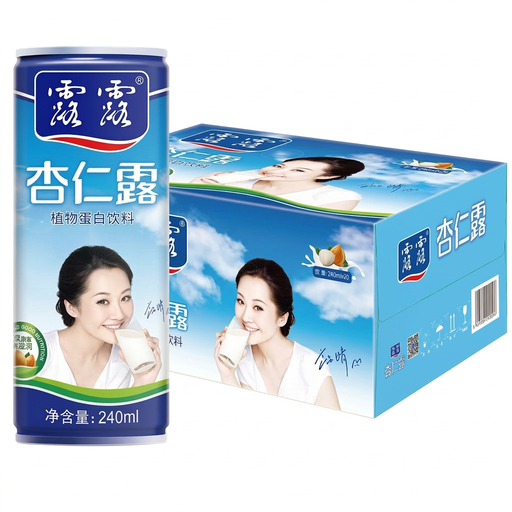 No image available
The listed 20 × 240ml format is worth considering if you need a separate portion for several school lunches. It is an almond juice, so confirm that the school permits almonds and that the child can have them. Check the individual packaging and storage instructions; if it will regularly replace dairy, compare the current label’s fortification information.
Check the particular school’s packed-lunch and allergy policy first, and only pack it if the child can have almonds. The Food Standards Agency classifies almonds as tree nuts; a school restriction on nuts can therefore rule out almond drink.
No. Almond is a tree nut, and M&S explicitly identifies its Unsweetened Almond Drink as unsuitable for people with a nut allergy. Read the allergen information on the specific product rather than relying on its dairy-free description.
Compare calcium, iodine and listed vitamins on the current packs, alongside the child’s wider diet and allergy needs. NHS milk-free-diet guidance for babies emphasises fortified alternatives, particularly calcium and iodine; for a school-age child with a restricted diet, seek advice suited to that child.
Follow the purchased carton’s instructions for storage and use after opening; it is not the same as having a sealed portion for each lunch. For example, M&S says its 1L Unsweetened Almond Drink should be consumed within three days of opening.
Check the individual school’s policy rather than assuming one rule applies everywhere. The Department for Education school-allergy guidance cited here concerns England; it should not be treated as a rule for every UK school.