What should you check?
Decide where the drink will be used most often, then compare the current cartons on nutrition, ingredients and any instructions for that use.
| Priority |
What to check |
Your needs |
| Added nutrients |
Compare calcium, iodine, vitamin D and vitamin B12 on the nutrition panel. Check protein separately; fortification alone does not make an almond drink nutritionally identical to dairy milk. |
If I use almond drink in place of dairy most days, I want to know which of those nutrients the carton lists. |
| Sugars |
Read sugars per 100ml and the ingredient list, rather than relying only on words such as “original” or “unsweetened”. Alpro UK lists 0g sugars per 100ml for Almond Roasted No Sugars and 2.4g for Almond Original. |
For a regular breakfast drink, I may prefer to compare the sugar figures before choosing a flavour. |
| Ingredients |
Check the complete list if organic ingredients or a short recipe matter. Plenish describes its standard Almond M*lk as water, organic almonds and salt; check its nutrition panel separately for the nutrients you need. |
I would choose a simpler recipe for its ingredients, not assume it has the same added nutrients as another carton. |
| Intended use |
Look for coffee-specific wording if you plan to steam the drink. For ordinary hot drinks, follow the carton’s instructions; Sainsbury’s advises letting hot water cool slightly before adding its Unsweetened Almond Drink to reduce separation. |
For cereal and smoothies, I can focus on the everyday carton. If I mainly make coffees with foam, I would check a barista formulation. |
| Allergens and children |
Check the current allergen declaration if nuts are a concern. For a baby, do not use almond drink as the main milk drink in place of breast milk or formula before age one, according to North East London NHS Foundation Trust guidance. |
If I am shopping for someone with an almond allergy or for a young child, those needs come before flavour or convenience. |
Brand references
These examples show how particular almond-drink recipes differ; compare the exact variant and its current label rather than treating a brand name as a nutrition specification.
Alpro
Alpro UK lists both Almond Roasted No Sugars and Almond Original as almond-drink options.
- Almond Roasted No Sugars lists 0g sugars, 120mg calcium and 22.5µg iodine per 100ml, with vitamins D2 and B12 listed.
- Almond Original lists 2.4g sugars per 100ml. Check the precise variant rather than transferring one carton’s figures to another.
Plenish
Plenish offers a standard organic Almond M*lk and a separate Barista Almond M*lk positioned for coffee.
- Plenish describes its standard Almond M*lk as made with water, organic almonds and salt, without added sugar, oils or additives.
- A short ingredient list should not be taken as evidence of added calcium, iodine or vitamins; check the exact carton’s nutrition panel.
Rude Health
Rude Health’s Almond Drink is an organic recipe containing rice as well as almonds.
- Its stated ingredients include spring water, organic rice, organic Italian almonds (1%), sunflower oil and sea salt.
- Check the ingredient list if you want a drink made without rice or oil; this recipe is distinct from a three-ingredient almond drink.
Sainsbury’s
Sainsbury’s Unsweetened Almond Drink is an own-label 1L option listing calcium, iodine and vitamins D and B12.
- Its product information lists 120mg calcium and 22.5µg iodine per 100ml.
- Sainsbury’s says this product is not suitable as a main milk alternative for children under three and advises cooling hot water slightly before adding it.
M&S
M&S Unsweetened Almond Drink lists added calcium, iodine and vitamins D and B12.
- Marks & Spencer lists 0.2g sugars and 0.5g protein per 100g for this product.
- The figures are given per 100g, so check the units before comparing them directly with figures stated per 100ml on another carton.
Almond drinks on Joybuy
These Alpro cartons are options for cereal, smoothies and other everyday uses. Compare the exact pack and nutrition panel before choosing one for a regular dairy-replacement routine.
 No image available
Alpro Almond No Sugars Long Life Drink, 8 x 1L
An option for cereal, smoothies and hot drinks when you want a no-sugars almond drink. The listing states 0.0g sugars and 0.5g protein per 100ml, and names calcium and vitamins B12 and D. If iodine matters to your choice, check the current nutrition panel; the 8 x 1L pack also calls for storage space.
View on Joybuy
 No image available
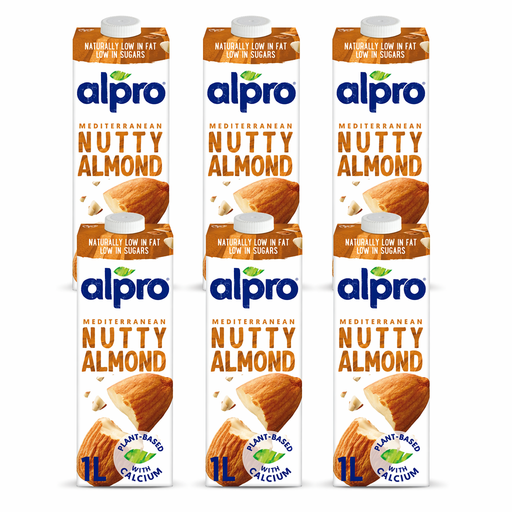
Alpro Almond Drink 1L
The listing describes this almond drink for cereal, smoothies, hot drinks and cooking, and names calcium, iodine and vitamins among its ingredients. Check the current nutrition panel to compare amounts and sugars with another carton. Confirm the pack quantity before ordering: the listing title indicates “6”, while its description gives a net quantity of 1L.
View on Joybuy
Questions about almond drinks
Should I look for added nutrients if almond drink regularly replaces dairy?
Yes, compare calcium, iodine, vitamin D and vitamin B12 on the carton if those nutrients are part of your reason for choosing it. The UK Office for Health Improvement and Disparities notes that plant-based drinks vary considerably in nutrient content; also check protein rather than assuming fortification makes the drink nutritionally identical to dairy milk.
Does an organic almond drink provide the same added nutrients?
Do not assume it does. Check the nutrition panel for the nutrients you want: Plenish describes its standard organic Almond M*lk as water, organic almonds and salt, while the UK Office for Health Improvement and Disparities distinguishes organic plant-based drinks from fortified options.
Can almond drink replace breast milk or formula for a baby?
No, not as the main milk drink before age one. North East London NHS Foundation Trust says plant-based milks may be introduced in food during weaning from six months but should not replace breast milk or formula as the main milk drink during that period.
What if someone has an almond allergy?
Do not choose an almond drink for someone who must avoid almonds. The NHS identifies almonds as tree nuts that can cause food-allergy reactions; check the exact carton’s allergen declaration and any precautionary wording.
What should I choose for coffee?
Look for a barista-specific almond drink if foam is important: Plenish markets its Barista Almond M*lk for that purpose. For an everyday carton in a hot drink, follow its pack instructions; Sainsbury’s advises letting hot water cool slightly before adding its Unsweetened Almond Drink to reduce separation.


