Second-home owners making infrequent visits
Unopened-carton storage matters between visits, but the more immediate question is whether you can refrigerate and finish a carton after opening it.


For a second home, compare fat and sugars on each almond drink’s nutrition panel rather than treating “unsweetened” as a fat figure. Alpro UK lists 1.1 g fat per 100 ml for Roasted Almond No Sugars, while M&S lists 0.9 g per 100 g for its Unsweetened Almond Drink; those different measurement bases should not be treated as a direct numerical ranking. Choose a carton you can store as labelled before opening and finish within its own refrigerated use-within period afterwards; fortification, ingredients and coffee use may also affect the choice.
Unopened-carton storage matters between visits, but the more immediate question is whether you can refrigerate and finish a carton after opening it.
Read the declared values and their per-100 ml or per-100 g basis. “Almond”, “unsweetened” and “no added sugar” do not, by themselves, tell you the fat content.
Decide whether you mainly need a drink for cereal and tea, added nutrients, a short ingredient list or a recipe intended for foamed coffee.
Start with the carton’s nutrition and storage labels, then weigh recipe and coffee requirements against how often the second home is occupied.
| Priority | What to check | Your needs |
|---|---|---|
| Fat and sugars | Read both values per 100 ml or per 100 g, and note the basis before comparing cartons. Alpro UK lists 1.1 g fat and 0 g sugars per 100 ml for Roasted Almond No Sugars; M&S lists 0.9 g fat and 0.2 g sugars per 100 g for its Unsweetened Almond Drink. | I want a stated fat figure, not an assumption based on “unsweetened”. If sugars matter too, I will check that separate figure. |
| Storage and carton size | Check the unopened storage conditions and best-before date, then the refrigeration temperature and use-within period after opening. M&S specifies 0°C to +5°C and use within three days once opened. | Visits may be short, so I need cartons I can store as labelled and finish after opening. A large multipack only helps if its individual cartons will be used in time. |
| Fortification and ingredients | Compare the nutrient and ingredient lists for the exact variant. Alpro UK lists calcium, iodine, vitamin D2 and vitamin B12 for Roasted Almond No Sugars; Plenish lists water, organic almonds and salt for its standard Almond M*lk. | Added nutrients may matter more to me than a short recipe, or the shorter ingredient list may be my priority. |
| Coffee use | Check whether the variant is intended for foaming, then read its own fat, sugars and ingredients. Plenish describes Barista Almond M*lk as foamable; Rude Health’s Barista Almond recipe includes oats and sunflower oil. | If I make foamed coffee during visits, a barista version is worth considering. For other uses, I still want to compare the actual recipe. |
| Allergens | Read the current pack’s highlighted allergens and precautionary statements for each variant. The Food Standards Agency identifies almonds as tree nuts, and M&S states that its Unsweetened Almond Drink is unsuitable for people with nut or peanut allergy. | Anyone using the second home who has an allergy needs the specific carton checked; “plant-based” does not establish allergen suitability. |
Sugar wording does not give the fat figure. Alpro UK lists 0 g sugars and 1.1 g fat per 100 ml for Roasted Almond No Sugars, while M&S uses a per-100 g basis for its Unsweetened Almond Drink.
Read fat and sugars separately, and check the measurement basis before comparing numbers.
A home left empty after a visit may have an opened carton that cannot be finished within its labelled period. M&S specifies three days after opening; Plenish lists its standard Almond M*lk in an 8 x 1 L multipack.
Check the unopened-carton dates and storage conditions, and open only what you can refrigerate and use as directed.
Fortification and ingredients differ by product: Alpro UK lists added nutrients for Roasted Almond No Sugars, while Plenish lists three ingredients for its standard Almond M*lk. Rude Health’s Barista Almond also contains oats and sunflower oil.
Compare the exact variant when choosing between added nutrients, a shorter ingredient list and coffee use.
Almond is a tree nut, according to the Food Standards Agency. A barista recipe may contain additional ingredients, so a plant-based description is not enough to assess allergen suitability.
Check the physical pack’s allergen information and precautionary statements for every variant.
These product-line details help distinguish the choices; they do not describe every drink made by each brand.
Alpro UK publishes nutrition and fortification details for its almond drink variants, including Roasted Almond No Sugars.
Its almond range includes No Sugars Organic Almond Drink and a separate Barista Almond recipe.
Its standard Almond M*lk and coffee-oriented Barista Almond M*lk serve different recipe preferences.
Tesco lists an own-label Unsweetened Almond Drink described as UHT.
M&S provides nutrition and post-opening directions for its Unsweetened Almond Drink.
These Alpro listings are options to consider when stocking almond drink between second-home visits. Check the current carton for nutrition and post-opening directions before choosing between them.
 Image unavailable
The listed 8 x 1 L format is worth weighing against how many cartons you will use during occasional visits. Check the current pack’s fat and sugars panel, storage directions and post-opening period; this listing is not the Roasted Almond variant discussed above.
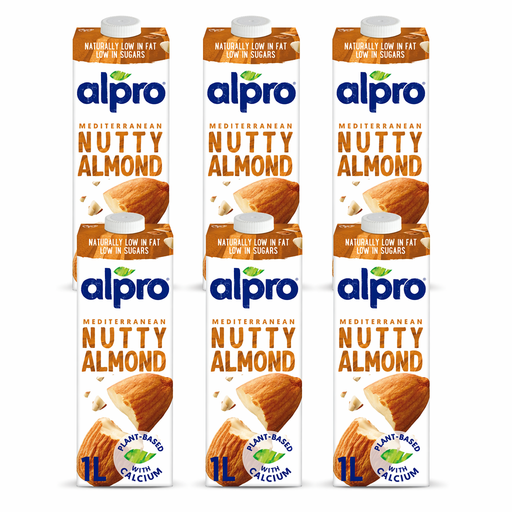 Image unavailable
For infrequent visits, confirm what the listing’s “6” denotes before deciding how much to stock. Check the current carton’s numerical fat and sugars values, unopened storage conditions and post-opening directions.
Read the fat value on each carton’s nutrition panel and check whether it is given per 100 ml or per 100 g. “Unsweetened” describes a different consideration, and figures on different measurement bases should not be treated as a direct numerical ranking.
Follow the individual carton’s unopened storage instructions. Alpro says its aseptic beverage packs do not need refrigeration before opening; check the relevant carton’s conditions and best-before date, then follow its separate directions once opened.
Use the instruction for that product. M&S says to refrigerate its Unsweetened Almond Drink at 0°C to +5°C after opening and consume it within three days; another variant may give different directions.
Do not assume it is suitable. The Food Standards Agency identifies almonds as tree nuts, and M&S states that its Unsweetened Almond Drink is unsuitable for people with nut or peanut allergy. Read the specific pack’s allergen and precautionary information.
Choose a barista variant when its coffee-foaming purpose matters to you, rather than assuming it is necessary for cereal or tea. Plenish describes its Barista Almond M*lk as foamable for coffee, while Rude Health’s barista recipe includes oats and sunflower oil; check the variant’s nutrition and ingredients if fat or recipe simplicity matters more.