Everyday top-up shoppers
If you need almond drink for cereal, smoothies or drinking, the first decision is whether one carton will do or a larger pack fits your routine. An unsweetened label is worth checking if sugar content matters to you.


For a quick top-up, start with a single 1L carton if that is all you need, then choose between unsweetened, fortified and coffee-oriented almond drinks according to how you will use it. If the drink regularly replaces dairy, check the exact carton for added nutrients; if coffee foam matters most, look for a barista formulation and check its pack size.
If you need almond drink for cereal, smoothies or drinking, the first decision is whether one carton will do or a larger pack fits your routine. An unsweetened label is worth checking if sugar content matters to you.
Fortification differs between products. Check the exact carton for calcium, iodine, vitamin D and vitamin B12 rather than assuming that one almond drink has the same nutrient profile as another.
If you make drinks with steamed milk, a barista-labelled almond drink may be more relevant than an everyday carton. Check the seller’s pack size before choosing one for a small top-up.
Decide how much you need now, then use the exact pack label to compare the features that matter for your usual drinks and meals.
| Priority | What to check | Your needs |
|---|---|---|
| Pack size | Check the number and size of cartons. A 6 x 1L or 8 x 1L bundle is a different purchase from one 1L carton. | I only need to replace one carton today, or I have room and a use for several. |
| Sugar | Look for an unsweetened or no-sugars designation, then read the “of which sugars” line. Use the same measurement basis when comparing labels. | For cereal or everyday drinking, I want to choose the sugar content and flavour for myself. |
| Added nutrients | Check the exact carton for calcium, iodine, vitamin D and vitamin B12; do not assume that an organic or short-ingredient drink is fortified. | Almond drink regularly takes the place of dairy in my meals, so its labelled nutrients matter to my choice. |
| Coffee use | Check whether the maker describes the drink as barista-oriented or foamable, and whether it is sold as a single carton or a multipack. | I mainly buy it for coffee with foam, rather than for cereal or smoothies. |
| Ingredients | Read the full list if you have a recipe preference. Rude Health lists rice, 1% organic Italian almonds and sunflower oil in its Almond Drink; Plenish Drinks lists water, organic almonds and salt for its standard Almond M*lk. | A shorter ingredient list matters more to me than choosing a particular coffee formulation. |
| Allergens | Read the precise product’s allergen declaration and precautionary warnings on each purchase. The Food Standards Agency classifies almonds as tree nuts. | Someone in my household has a nut allergy, so I need to establish whether this particular product is suitable before buying it. |
Added nutrients vary by carton. Hertfordshire and West Essex NHS clinical guidance also cautions that almond-based drinks are too low in energy and protein for young children with cow’s-milk protein allergy.
Check the exact pack’s nutrients, energy and protein. For a young child with cow’s-milk protein allergy, follow advice from their dietitian or GP rather than choosing almond drink as a default replacement.
Plenish Drinks describes its Barista Almond M*lk as foamable for coffee, but its brand-store listing is a 6 x 1L pack.
Check for a single-carton option if this is a quick replacement purchase. A multipack makes more sense when you can use and store all the cartons.
Six cartons also take more storage space than one.
A simple recipe tells you what goes into the drink, not which nutrients have been added. Plenish Drinks lists three ingredients for its standard Almond M*lk.
If added calcium, iodine or vitamins are part of your decision, check the ingredient and nutrition information for that precise product.
Almond is a tree nut, and warnings need to be checked for the individual product rather than inferred from its plant-based description.
Read the current carton’s allergen and precautionary statements before buying for anyone with a relevant allergy.
Alpro almond drinks appear in no-sugars and other formulations, so the variant name matters.
Rude Health’s Almond Drink has a recipe that includes rice and sunflower oil as well as almonds.
Plenish Drinks distinguishes its standard Almond M*lk from a barista version intended for coffee.
Tesco lists a 1L own-label Unsweetened Almond Drink for shoppers seeking a single everyday carton.
M&S lists a 1L Unsweetened Almond Drink with added nutrients.
These Alpro bundles are options for stocking up on everyday almond drink rather than replacing just one carton during a top-up shop.
 No image available
For shoppers choosing a No Sugars almond drink and buying several cartons at once. This is an 8 x 1L bundle, so check whether that quantity fits your storage space and usual use; read the carton if specific added nutrients matter.
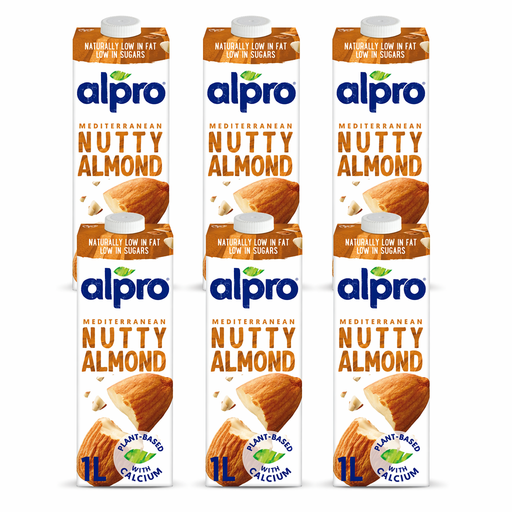 No image available
For replenishing an everyday almond drink when six cartons suit your household better than a single-carton top-up. Compare the exact pack’s sugar and added-nutrient information with your requirements before choosing it.
No. The Food Standards Agency classifies almonds as tree nuts, so someone with an almond allergy should avoid almond drinks. Check the exact pack’s allergen and precautionary statements for other relevant allergies.
Do not choose it as a default replacement. Hertfordshire and West Essex NHS clinical guidance advises against almond- and hazelnut-based drinks for young children with cow’s-milk protein allergy because they are too low in energy and protein. Follow the child’s dietitian or GP’s advice.
Follow the storage instructions on the carton you buy. Marks & Spencer instructs shoppers to refrigerate its Unsweetened Almond Drink at 0°C to +5°C after opening and use it within three days; another product may give different instructions.
Not on that basis alone. Plenish Drinks describes its Barista Almond M*lk as foamable for coffee, while its standard Almond M*lk is presented for uses including cereal and smoothies. Choose by your main use and check whether the available pack size suits a top-up.