Home cooks making easy-to-chew meals
If you use almond drink in porridge, sauces or other soft recipes throughout the week, carton size and storage matter when planning how much to buy.


Check the carton size rather than assuming almond drink comes in a single 4-pint bottle: Tesco’s reviewed almond-drink range lists mainly 1L cartons, so several cartons may be needed for repeated meals. If almond drink regularly replaces milk, compare the exact pack’s added nutrients and ingredients as well as its flavour. Where easy-to-chew meals are part of a swallowing plan, the permitted drink consistency is a separate decision from food texture.
If you use almond drink in porridge, sauces or other soft recipes throughout the week, carton size and storage matter when planning how much to buy.
If almond drink is a regular alternative to dairy milk, compare the nutrients added to the exact product. Fortification differs between the reviewed cartons.
If easy-to-chew food is part of a clinician-led plan, check the prescribed drink consistency separately. The International Dysphagia Diet Standardisation Initiative (IDDSI) uses different level ranges for foods and drinks.
Start with the volume your recipes require, then compare the exact carton’s ingredients and nutrition information. If a swallowing plan applies, establish the permitted drink consistency before choosing a product.
| Priority | What to check | Your needs |
|---|---|---|
| Carton size and storage | Check the volume per carton and, for a multipack, the carton count. Compare chilled and long-life storage instructions, including what to do after opening. | I use almond drink across several meals and need enough cartons without assuming one will contain 4 pints. |
| Added nutrients | Read the exact pack for calcium, iodine and vitamins, and compare energy and protein per 100ml. The reviewed Tesco and Alpro products declare added nutrients, but formulations differ. | If almond drink regularly replaces milk in my recipes, I want to know what the product actually contains rather than relying on its category name. |
| Sugar and flavour | Compare the ingredient list and sugars per 100ml on the exact carton. Consider whether its almond flavour suits a savoury dish or a lightly sweet recipe. | For a sauce, I may not want the drink to add sweetness; for porridge, the flavour may matter differently. |
| Drink consistency | Check the individual swallowing plan if one applies. IDDSI classifies drink thickness separately from easy-to-chew food texture; the Royal College of Speech and Language Therapists advises assessment by a dysphagia-trained practitioner before thickener is prescribed. | If meals must meet a prescribed texture, I also need to know whether the drink’s usual thin consistency is permitted. |
| Almond allergen | Check the exact pack’s allergen declaration and any cross-contact statement. Almond is a tree nut, as identified by the Food Standards Agency. | I need a different drink if the intended eater is allergic to almonds; I cannot judge suitability from the recipe alone. |
Tesco’s reviewed almond-drink range lists mainly 1L cartons, so a single carton may not cover several recipes.
Check the stated volume and, if buying a multipack, the number of cartons. Choose chilled or long-life cartons according to when you will use them and the pack’s storage instructions.
Added nutrients vary by exact product: the reviewed Tesco and Alpro cartons declare fortification, while Plenish describes a three-ingredient formulation.
Compare the ingredient and nutrition panels for the nutrients, energy and protein relevant to your recipes rather than deciding from “almond milk” or “organic” alone.
IDDSI assesses food texture and drink thickness separately. A person prescribed a modified drink consistency needs their individual instructions followed.
Use the swallowing plan provided by the dysphagia team; do not choose a thickener or alter almond drink’s consistency independently.
Tesco lists 0.5g protein and 15kcal per 100ml for the reviewed Alpro Almond No Sugars 1L carton. That product should not be assumed to meet someone’s additional energy or protein needs.
If poor intake or malnutrition risk is a concern, seek advice from the person’s dietitian or clinical team about suitable foods and any swallowing restrictions.
These examples show why the exact variant matters; a brand name alone does not establish carton size, ingredients or fortification.
The reviewed Original and No Sugars almond drinks include 1L chilled or long-life variants.
Tesco Unsweetened Almond Drink is a reviewed 1L own-label option.
Plenish describes its standard almond drink as containing almonds, spring water and salt; its site also shows an 8 x 1L multipack.
Rude Health lists both a standard Organic Almond Drink and a separate chilled Almond Drink with Calcium.
These Alpro options are relevant to buying cartons for repeated cooking or drinks rather than choosing a single 4-pint container. Check pack quantity carefully, particularly where a listing title and its description differ.
 Image unavailable
Eight separate 1L cartons may suit repeated porridge and drink recipes when you prefer a no-sugars variant. Check the exact pack’s nutrition panel if iodine or protein content affects your choice, and follow any individual swallowing plan before using the drink.
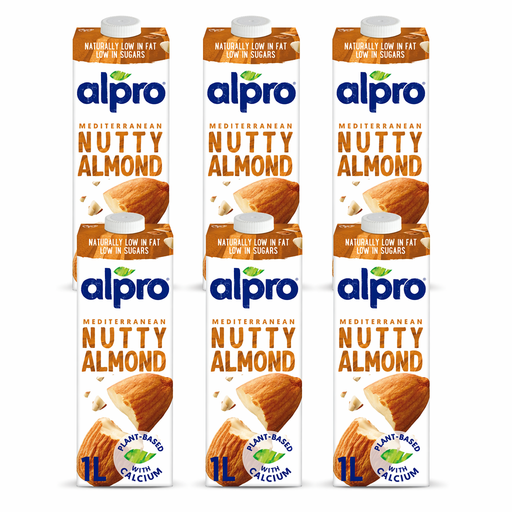 Image unavailable
This almond drink is described for cooking and hot or cold use. Its title includes “6”, while its description gives a net quantity of 1L, so confirm the carton count and total volume before ordering. Check the exact nutrition panel if sugar content or added nutrients matter to your recipes.
Do not assume you can: Tesco’s reviewed almond-drink range lists mainly 1L cartons and also includes a 500ml option. Check a retailer’s current pack size, then choose the number of cartons or a stated multipack that covers your recipes.
Almond drink can be an ingredient in dishes such as porridge or sauces when its flavour and ingredients suit the recipe. If “easy-to-chew” refers to a prescribed diet, check both the food texture and the permitted drink consistency: IDDSI assesses them separately.
Only use it at its usual thin consistency if that person’s individual swallowing plan permits thin drinks. IDDSI gives milk as an example of a Level 0 thin drink, while the Royal College of Speech and Language Therapists advises a detailed assessment by a dysphagia-trained practitioner before thickener is prescribed.
No. The reviewed Tesco and Alpro product pages declare added nutrients, but formulations vary by product. If almond drink regularly replaces milk in your recipes, read the exact carton for calcium, iodine and the vitamins you want to compare.
Do not use an almond drink for someone with an almond allergy. Almond is a tree nut, according to the Food Standards Agency; check each alternative product’s allergen and cross-contact information as well as the ingredients in the finished meal.