For a child who regularly has an almond drink instead of dairy milk, start by checking unsweetened products for calcium, iodine, vitamin D and vitamin B12, as well as the child’s age guidance and allergen label. A short-ingredient organic drink may suit a preference for a simpler recipe, but the UK government’s SACN/COT assessment says organic plant-based drinks in the UK cannot be fortified; no almond drink should be assumed to replace cow’s milk nutritionally.
Who is choosing?
Families avoiding dairy
For cereal, smoothies or a drink alongside snacks, an almond drink is an option only if the child can safely have almonds. If it is used regularly in place of dairy milk, check its fortification and consider the child’s diet as a whole.
Households looking for less sweetness
For a drink served with snacks or poured over cereal, compare the sugars figure per 100ml and the ingredients. An unsweetened name alone does not tell you whether two products have the same nutrient content.
Adults choosing by flavour and ingredients
For coffee, cereal or smoothies, roasted-almond flavour or a short ingredient list may matter more than fortification. That preference needs a separate check if the same drink will also be used regularly as a child’s dairy alternative.
What matters when choosing?
Decide first whether the drink will be an occasional snack ingredient or a regular dairy alternative, then compare the exact packs for nutrition, allergens and age guidance.
| Priority | What to check | Your needs |
|---|
| Fortification |
Look for declared calcium, iodine, vitamin D and vitamin B12. For regular use in a child’s dairy-free diet, check amounts rather than assuming all almond drinks contribute the same nutrients; the NHS-linked Frimley Healthier Together guidance identifies at least 120mg calcium per 100ml and iodine as checks for plant-based alternatives. |
If a child regularly avoids cow’s milk, I want to know what the drink contributes to their diet, not just how it tastes in a smoothie. |
| Sugars |
Compare sugars per 100ml and read the ingredient list, particularly where a recipe includes rice or sugar. Alpro lists 0g sugars per 100ml for its Roasted Almond No Sugars Drink 1L; that figure does not describe every Alpro almond drink. |
For cereal and holiday snacks, I’d prefer a less sweet option and want the figure for the exact drink I’m buying. |
| Allergens |
Check the current pack for almonds and any statements about other nuts or peanuts. Sainsbury’s and M&S give different product-specific allergy warnings, so a dairy-free label is not an allergy clearance. |
If anyone being served has a relevant allergy, I need to assess the exact product label before offering it. |
| Age and use |
Read the product’s stated age guidance and whether it can be used as a main milk alternative. Sainsbury’s says its Unsweetened Long Life Almond Drink can be part of a balanced diet from one year, but is not suitable as a main milk alternative for children under three; Rude Health states that its standard Organic Almond Drink is suitable from age five. |
A drink for a toddler needs a different check from one used occasionally by an older child or adult. |
| Ingredients and flavour |
Compare recipes and any roasted-almond description. The UK government’s SACN/COT assessment says organic plant-based drinks in the UK cannot be fortified, so check that trade-off if you favour an organic, short-ingredient recipe. |
For an occasional snack recipe, I might choose a simpler, nuttier-tasting drink; for regular dairy replacement, fortification matters more to my decision. |
What is easy to overlook?
-
Assuming almond drink replaces cow’s milk nutritionally
Plant-based drinks vary in fortification. A child who excludes cow’s milk may need their intake considered across their whole diet, not judged by the drink’s plant-based description.
For regular dairy-free use, compare the label’s calcium, iodine, vitamin D and vitamin B12 information. Seek appropriate specialist advice for a medically necessary dairy-free diet.
-
Overlooking the organic fortification trade-off
The UK government’s SACN/COT assessment says organic plant-based drinks in the UK cannot be fortified with nutrients. A short ingredient list therefore answers a different buying need from labelled fortification.
Choose by ingredients and flavour when that is the priority, but consider the rest of a child’s diet if the drink will be used regularly instead of dairy milk.
-
Treating dairy-free as allergy-safe
Almond drinks contain almonds, and individual products may carry warnings concerning other nuts or peanuts. The word “dairy-free” does not resolve those risks.
Read the allergen declaration and precautionary statements on the exact pack. Follow the child’s allergy clinician’s advice where relevant.
-
Applying one product’s age guidance to every drink
Sainsbury’s states that its Unsweetened Long Life Almond Drink is not suitable as a main milk alternative for children under three, while Rude Health states that its standard Organic Almond Drink is suitable from age five. Neither statement establishes a rule for other products.
Check the age guidance and intended use on the drink you plan to serve, especially for a toddler or a child with a restricted diet.
Brand and own-label examples
These examples show how recipes and label information differ; check the exact product rather than applying one variety’s details to a whole brand.
Alpro
A fortified, no-sugars example for comparing nutrition labels.
- Alpro lists 0g sugars, 120mg calcium and 22.5µg iodine per 100ml for its Roasted Almond No Sugars Drink 1L.
- That product’s recipe also includes stabilisers, natural flavouring and lecithins; its figures should not be transferred to another Alpro variant.
Rude Health
Organic recipes with notably different ingredient lists.
- Its standard Organic Almond Drink lists spring water, organic rice, 1% organic Italian almonds, sunflower oil and salt; Pure Almond lists water and 5% organic Italian almonds.
- Rude Health states suitability from age five for the standard Organic Almond Drink. Check which recipe and age guidance apply to the pack you choose.
Plenish
An organic option for shoppers comparing short ingredient lists.
- Plenish describes its Almond M*lk as water, organic almonds and salt, without oils or added sugar.
- Under the UK organic rule described in the government’s SACN/COT assessment, an organic plant-based drink cannot be fortified with nutrients.
Tesco
An own-label unsweetened, long-life option with listed fortification.
- Tesco describes its Unsweetened Almond Drink 1L as UHT with added calcium, potassium iodide, vitamin E, vitamin B12, riboflavin and vitamin D2.
- Check the current pack for amounts, allergens and age guidance before using it regularly for a child.
Sainsbury’s
An own-label long-life almond drink with stated nutrients and child-use limits.
- Sainsbury’s lists added calcium, iodine, vitamin D and vitamin B12 for its Unsweetened Long Life Almond Drink 1L.
- Its product guidance says it is not suitable as a main milk alternative for children under three. Check its allergy statements on the current pack too.
M&S
A fortified own-label unsweetened almond drink.
- M&S lists added calcium, iodine and vitamins D and B12 for its Unsweetened Almond Drink.
- M&S states that this product is not suitable for people with a nut or peanut allergy.
Almond drinks on Joybuy
These Alpro options are relevant to almond drinks for cereal, smoothies and other school-holiday snacks. Compare their exact labels if sugars, fortification or a child’s suitability will determine your choice.
 No image available
Alpro Almond No Sugars Long Life Drink, 8 x 1L
The no-sugars variety is one to consider when choosing an almond drink for cereal or smoothies. This listing is for 8 x 1L; check the exact pack’s nutrition, age guidance and allergen statements if it will be served regularly to a child.
View on Joybuy
 No image available
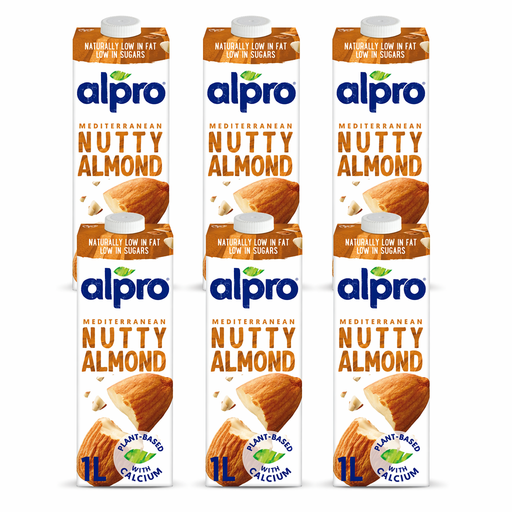
6 Alpro Almond Drink 1L
For snacks or drinks, compare this variety’s sugars per 100ml and ingredients with the no-sugars option rather than treating them as the same recipe. Check the exact pack quantity, fortification, age guidance and allergen statements before buying for regular use.
View on Joybuy
Questions about almond drinks
Can children have almond drink with school-holiday snacks?
An almond drink can be used in snacks, cereal or smoothies if the child can safely have almonds, but it should not be assumed to replace cow’s milk nutritionally. For regular use in a dairy-free diet, check fortification, the product’s age guidance and the child’s diet as a whole; seek specialist advice for a medically necessary dairy-free diet.
What should I check if an almond drink will be used regularly?
Check declared calcium, iodine, vitamin D and vitamin B12, then sugars per 100ml, allergens and age guidance. The NHS-linked Frimley Healthier Together guidance identifies at least 120mg calcium per 100ml and iodine as useful checks for plant-based alternatives in a child’s dairy-free diet.
Are organic almond drinks fortified?
Plant-based drinks labelled organic in the UK cannot be fortified with nutrients, according to the UK government’s SACN/COT assessment. If the drink will be used regularly instead of dairy milk, consider what the rest of the child’s diet provides.
How should I store almond drink after opening?
Follow the storage instructions and use-by period on the exact pack after opening. Do not apply another variety’s refrigeration or use-within instructions to the drink you bought.


