What to check before choosing
If almond drink regularly replaces milk, check fortification first, then compare sugars and protein per 100ml and the ingredients of the exact variant. The NHS recommends unsweetened, calcium-fortified plant alternatives as an option in the dairy-and-alternatives food group.
| Priority | What to check | Your needs |
|---|
| Fortification |
Look for declared calcium on the exact carton. Check iodine, vitamin D and vitamin B12 individually if you are counting on the drink to provide them; recipes differ between variants. |
I use almond drink in place of milk regularly and want to know which added nutrients this carton actually supplies. |
| Sugars |
Compare total sugars per 100ml, not just wording on the front. Alpro UK lists 0g sugars per 100ml for Roasted Almond No Sugars; the Joybuy nutrition listing for Rude Health Organic Almond Drink lists 4.7g per 100ml. |
For a lower-sugar choice, I want a like-for-like figure from the nutrition panel rather than relying on “no added sugar” wording. |
| Protein |
Read protein per 100ml and consider what else is in the meal. Alpro UK lists 0.5g per 100ml for Roasted Almond No Sugars and 0.4g for Almond Original; the NHS advises including beans, pulses and other proteins in a vegan diet. |
If my drink accompanies lunch, I need another food to provide the meal’s protein rather than treating almond drink as that food. |
| Ingredients and variant |
Compare the full ingredients list with the fortification details. Plenish describes its Almond M*lk as almonds, water and salt; Rude Health lists rice and sunflower oil in its standard Almond Drink, while its chilled calcium variant also lists calcium carbonate. |
A short ingredient list matters to me, but I do not want to assume it provides the same added nutrients as a fortified carton. |
Almond drink brands and ranges
Brand names are a starting point, not a substitute for the label: sugar, ingredients and added nutrients can differ between products in the same range.
Alpro
Alpro UK publishes separate nutrition figures for Almond Original and Roasted Almond No Sugars.
- Roasted Almond No Sugars lists 0g sugars, 120mg calcium and 22.5µg iodine per 100ml.
- It lists 0.5g protein per 100ml, so it should not be counted on as the meal’s protein source.
Rude Health
The standard Almond Drink and Chilled Almond Drink with Calcium have different ingredient lists.
- Rude Health lists calcium carbonate in the chilled calcium variant.
- The standard drink lists rice and sunflower oil; the Joybuy nutrition listing for Rude Health Organic Almond Drink gives 4.7g sugars per 100ml. Check which variant is on the carton.
Plenish
Plenish describes its Almond M*lk as a drink made from almonds, water and salt.
- The brand describes this product as having no added sugar, oils or additives.
- If added calcium or vitamins matter to your choice, confirm them on the exact carton rather than inferring fortification from the ingredient count.
Tesco
Tesco describes its Unsweetened Almond Drink as a fortified own-label option.
- Tesco lists added calcium, potassium iodide, vitamin E, vitamin B12, riboflavin and vitamin D2.
- Use the current carton’s nutrition panel when comparing its sugars and protein with another product.
M&S
M&S describes both sweetened and unsweetened almond milk in its range.
- M&S states that its almond milk is fortified with calcium, vitamin D and iodine.
- Check the exact unsweetened carton for its ingredients and nutrition figures before comparing it with another drink.
Almond drinks on Joybuy
These Alpro almond drinks are options for using with cereal, smoothies or hot drinks alongside a dairy-free lunch. Compare their exact variants and carton labels rather than applying one product’s nutrition figures to the other.
 Image unavailable
Alpro Almond No Sugars Long Life Drink 8 x 1L
An almond drink for cereal, smoothies and hot drinks alongside lunch. Its product information lists 0.0g sugars and 0.5g protein per 100ml, and declares calcium, vitamin B2, vitamin B12 and vitamin D2 in the ingredients. Check the current carton for iodine if you intend to obtain it from this drink, and include another protein-containing food at lunch. Contains almond.
View on Joybuy
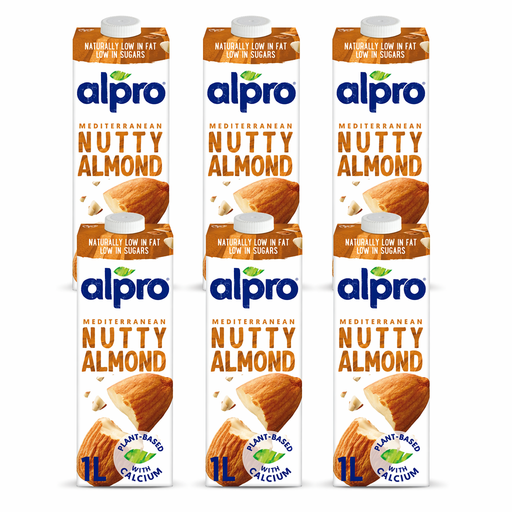 Image unavailable
Alpro Almond Drink 6 x 1L
This almond drink is described for cereal, smoothies, hot drinks and cooking. Its listed ingredients include calcium, potassium iodide, vitamin B12, vitamin D2 and vitamin E; they also include sugar. If sugars per 100ml are decisive, compare the current carton’s nutrition panel with the other drink rather than assuming the figures match. Contains almond.
View on Joybuy
Frequently asked questions
Is almond drink enough on its own for lunch?
No: use it as a drink or accompaniment, not the meal’s protein source. Alpro UK lists 0.4g or 0.5g protein per 100ml for the two almond drinks cited here; the NHS advises including beans, pulses and other proteins in a vegan diet.
When should I look for fortified almond drink?
Look for declared calcium when almond drink regularly replaces milk in your meals. The NHS says unsweetened, calcium-fortified plant alternatives can count in the dairy-and-alternatives food group. Check the exact carton for other added nutrients rather than assuming every almond drink contains them.
Does “no added sugar” mean zero sugars?
No. Compare total sugars per 100ml on the nutrition panel. Alpro UK lists 0g for Roasted Almond No Sugars, while the Joybuy nutrition listing for Rude Health Organic Almond Drink gives 4.7g per 100ml.
Is dairy-free almond drink suitable for someone with an almond allergy?
No. Almond drink contains almonds, which the Food Standards Agency classifies as nuts. Read the product’s allergen statement, including precautionary cross-contact wording, when checking suitability for other nut allergies.
How should I store almond drink after opening?
Follow the instructions on the exact carton. The Joybuy listing for Rude Health Organic Almond Drink says to refrigerate it after opening and use it within 5 days; do not assume every brand or format has the same instructions.


